Pain at the gas pump not likely to ease soon
Americans on the highway over the July Fourth holiday week face gasoline prices that are higher than a year ago and likely to climb further by the end of summer.
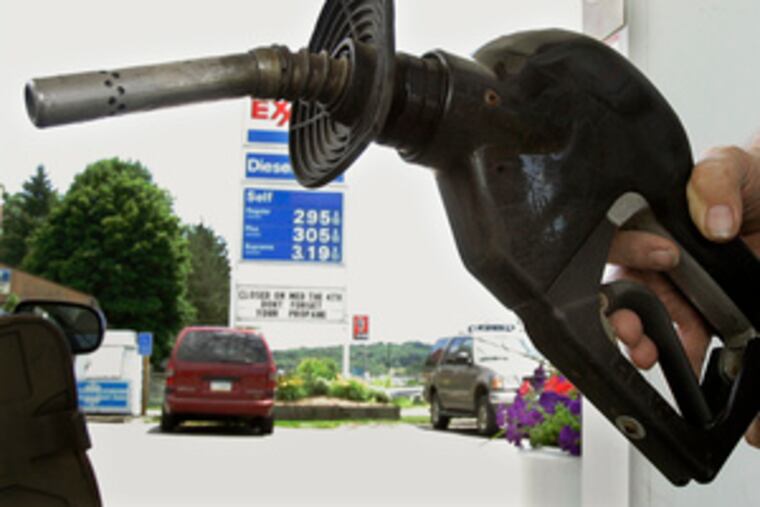
Americans on the highway over the July Fourth holiday week face gasoline prices that are higher than a year ago and likely to climb further by the end of summer.
In four of the last five years, the pump price in the United States peaked in late summer or early fall, according to Energy Department data. Below-normal fuel inventories and the possibility that hurricanes will disrupt refineries and pipelines may cause gasoline to top the record set last month, when prices touched an average of $3.227 a gallon nationwide.
"They should be heading back up to the high we saw several weeks ago, and possibly drifting higher," Joseph Stanislaw, senior energy adviser for Deloitte & Touche L.L.P., said in a telephone interview from Boston.
The national average retail price for regular gasoline is $2.975 a gallon, AAA said on its Web site. That is 12 cents higher than a year ago. Prices have fallen 7.8 percent from the all-time high on May 23.
Stanislaw expects prices to rise to about $3.50 a gallon this summer and possibly exceed $4 a gallon if a hurricane strikes the U.S. Gulf Coast, the most important region for the nation's oil production, imports and refining.
Higher-than-normal prices have not caused people to reduce driving, according to Energy Department data. Gasoline demand is up 1.5 percent from a year ago to 9.5 million barrels a day, based on the four-week average. Demand normally rises between 1.5 percent and 2 percent a year.
"I don't think people are giving price a consideration," said Robert Spiegel, vice president of SOS Fuels, a fuel wholesaler in Tuxedo, N.Y., that supplies about 100 filling stations. "I am experiencing a lot of fuel being sold."
A record 41.1 million vacationers in the United States were expected to have traveled over the July Fourth holiday, according to AAA, the largest U.S. motoring club. About 34.7 million people took to the nation's highways by car or light truck, 0.7 percent more than last year, AAA had predicted.
At Colorado's Rocky Mountain National Park, where all of the reserved campsites are booked for the next three weeks, high gasoline prices do not appear to be reducing the number of visitors, said park spokeswoman Kyle Patterson.
"It seems like some of our visitors are staying a little longer when they visit the park," she said. "Maybe gas prices are causing some folks to do one longer vacation in one area vs. going one place and driving to another place and driving to another place."
Of the three million people who visit Rocky Mountain National Park each year, 700,000 come in July, making it the busiest month, Patterson said.
Higher gasoline prices may be reducing consumer confidence. A report last week showed the Conference Board's index of consumer confidence fell to 103.9 in June from a revised 108.5 in May. The drop may signal a decreased willingness to spend.
The price of gasoline probably won't keep people from traveling, "but it may reduce some of their spending while traveling," said Bruce Brossman, director of sales and marketing for Xanterra South Rim L.L.C., which manages lodgings inside Arizona's Grand Canyon National Park and is the park's primary concessionaire. "Some discretionary spending may suffer a bit."
Passing along gasoline increases to consumers can be tricky. At Sun Buggie Fun Rentals in Pismo Beach, Calif., owner Randy Jordan was not planning to raise prices for dune buggy rentals until after the July Fourth holiday.
"That last thing you want to do when the market is hurting is raise prices," Jordan said. "It's not intelligent."
Gasoline prices rose 28 percent this year as refinery problems pushed up futures prices 42 percent. Crude oil rose 15 percent this year. Crude oil determines about half the price for a gallon of gasoline.
Gasoline inventories last week were 4.4 percent below the five-year average, the Energy Department reported this week, wider than the 4.2 percent deficit the previous week.