Presidential copter passes test
The maiden flight of the future U.S. presidential helicopter, conducted Tuesday in Yeovil, Britain, was a success, Lockheed Martin Corp., the prime contractor, said yesterday.
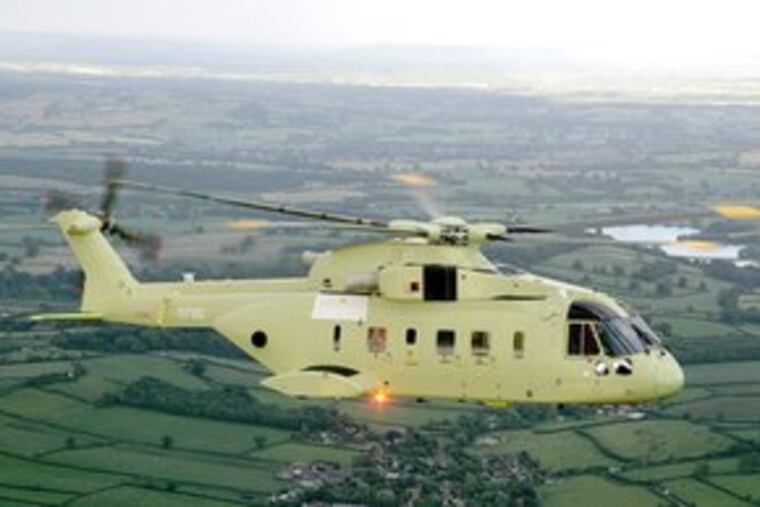
The maiden flight of the future U.S. presidential helicopter, conducted Tuesday in Yeovil, Britain, was a success, Lockheed Martin Corp., the prime contractor, said yesterday.
Dubbed the "world's most technologically advanced helicopter," the future "Marine One" flew 40 minutes at varying speeds up to 155 m.p.h.
Two Philadelphia area Lockheed Martin units are working on the helicopter - the integrated-systems operation in Valley Forge and the logistics design and support team in Moorestown, Burlington County.
Lockheed Martin has more than 13,500 employees at several locations in the Philadelphia area.
Its main subcontractors on the presidential helicopter are Bell Helicopter Textron, which will do final assembly at its Fort Worth, Texas, plant, and AgustaWestland, the British-Italian aerospace conglomerate.
The U.S. version of the aircraft, to be called Marine One when the president is aboard, has been designated VH-71 and is powered by three General Electric turbine engines. It is based on the AgustaWestland EH101 that entered service in 1997.
About 130 of the helicopters have been flown, for a total of 130,000 hours, by military units in Britain, Italy and Canada, as well as by governments of other countries, often in harsh environments, Lockheed Martin said.
The initial flight tested handling and avionics systems. After evaluating the test data, Lockheed Martin said the aircraft remained on schedule to become "the flying Oval Office" in October 2009.
It will replace the Sikorsky VH-3D Sea King, the original Marine One, versions of which have been transporting U.S. presidents since 1962.