Boom time for concrete industry
The concrete industry expects major growth as infrastructures are rebuilt.
There's a lot of weight on Joshua Travis' shoulders.
Last week, he supervised a 20-man crew pouring concrete in Harrisburg at Pennsylvania's $98 million first-ever judicial center.
If Travis miscalculated the concrete's water evaporation rate during his 2 a.m. shift or quit paying attention to its sloshy composition as the crew pumped it seven stories up, the floor's foundation could crack.
But that did not seem to bother Travis, though he is only 21 and just a summer intern at the concrete giant Pennsy Supply Inc.
The college senior is highly qualified. As part of a requirement to earn a bachelor's degree from Middle Tennessee State University in concrete industry management, a major with growing popularity, he has been certified as a concrete field-testing technician.
"I've been doing this stuff since my sophomore year," Travis said confidently.
The increase in students such as Travis reflects the growth in the concrete business. Despite a downturn in the housing market in the last two years, it remains at historically high levels as commercial and government contracts pick up the slack.
Now, concrete companies are gearing up for a round of government contracts to fix aging bridges and roads. The companies also are attracting interest from private-equity groups, which want to streamline their fragmented operations.
And they are welcoming more students, such as Travis, who are training to guide the industry through its next phase of growth, consolidation, and high-tech innovation.
"They're giving these guys $10,000 signing bonuses," said James Brown, director of the concrete industry technology management program at the New Jersey Institute of Technology in Newark, one of four such programs in the United States. "They can't get people trained fast enough to put them into this industry."
Consumption of cement, the main ingredient in concrete, has climbed 54 percent in the United States in the last 10 years to 116.5 million metric tons, even with a small downturn in the last two years, according to the Portland Cement Association, a Skokie, Ill., trade group.
In the Mid-Atlantic region, consumption rose 23 percent in the same period to 8.4 million metric tons - despite a small decline because of the housing slowdown.
"If you put our market in context historically, it's absolutely a boom period," said Ed Sullivan, Portland's chief economist.
D&D Concrete Corp., which builds garage floors and patios for homes in Philadelphia and Delaware County, still is growing, owner Frank DiDio said on his cell phone from a job site. Cayuga Concrete Pipe, of Croydon, has averaged 4 percent revenue growth since 2003, including a 20 percent spike in 2005, the company said.
The boom has even spread to suppliers, such as Nielsen Kellerman Inc., of Boothwyn. The weather meter company designed a pocket meter specifically for the concrete industry. It expects sales of the meter, which calculates water-evaporation rates, among other things, to add 5 percent to its revenue after it launches the product next month.
Commercial construction - up 26 percent in the last two years, according Global Insight Inc., a Lexington, Mass., research firm - has boosted revenue of companies pouring the world's most popular building material.
So have billions of dollars in government contracts to fix decaying bridges and roads. Last week, a bridge deemed "structurally deficient" collapsed in Minnesota. New Jersey's Department of Transportation is asking for $16 billion in funding over the next five years compared with the $13.6 billion it received for the previous five years. Last month, Pennsylvania lawmakers increased transportation funding nearly $1 billion to $6.5 billion for the next 10 years.
"Anytime you see public money being spent, you're going to see an uptick in the concrete industry," said Robert Garbini, president of the National Ready Mixed Concrete Association.
Meanwhile, prices for cement are rising - largely because of demand from China. The United States produces 75 percent of its annual cement needs; the rest is imported.
So, for example, the State of New Jersey paid about $499 per cubic yard of concrete in 2000, its transportation department said. This year, it is paying $1,058 per cubic yard.
Focusing on commercial projects has cushioned Nitterhouse Concrete Products Inc. from the residential tumble.
The Chambersburg, Pa., company's revenue jumped 50 percent in the last three years, said Mark Taylor, executive vice president and chief operating officer.
Among its current projects are a 60,000-square-foot parking garage in King of Prussia and an 85,000-square-foot assisted-living home in Pennsville, N.J. Both are set to be completed this fall.
America's ravenous appetite for concrete has made the many small manufacturers attractive to private-equity firms anxious to consolidate the industry and boost efficiency. For example, Ready Mixed Concrete Co., of Raleigh, N.C., was sold last year by a Boston private-equity firm for $435 million - a profit of $225 million on the price it paid just two years earlier.
Locally, Cayuga Concrete Pipe, the Croydon company, was bought in 2000 and now is part of an Irish firm that is one of the world's largest concrete companies.
Though the ivy-covered fences and the geese swimming in a pond on Cayuga's grounds might fool an observer, the company is no backyard operation. Revenue is down this year because of the housing slump, but production has not slowed, the company said.
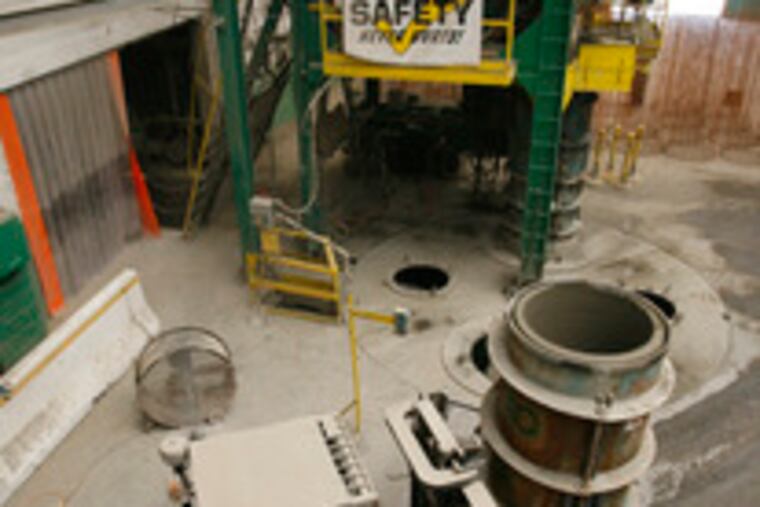
In fact, it opened its third plant in June to boost annual production 140 percent, or 70,000 tons of concrete pipes - to be used on projects such as expansion of the Philadelphia International Airport, relocation of the Please Touch Museum, and extension of Route 309 in eastern Pennsylvania.
To meet demand, the roaring plant in Croydon can spit out a pipe measuring 18 inches in diameter every 60 seconds.
To keep its operations running, Cayuga needs managers trained in the latest computer software to automate its production lines. It also needs workers, who are educated on the latest chemical additives to make concrete stronger.
"People think you just throw together a few things and you've got concrete," said Mark Bishop, 23, a former architecture student who will be part of the New Jersey Institute of Technology's first graduating class next spring.
"But it's such a finite mix," he said. "When concrete has been used correctly, it will last 100 years."