Putting their energy into it
Instead of spending their vacation soaking up the summer sun, some Penn State students have been hard at work trying to harness its energy.
Instead of spending their vacation soaking up the summer sun, some Penn State students have been hard at work trying to harness its energy.
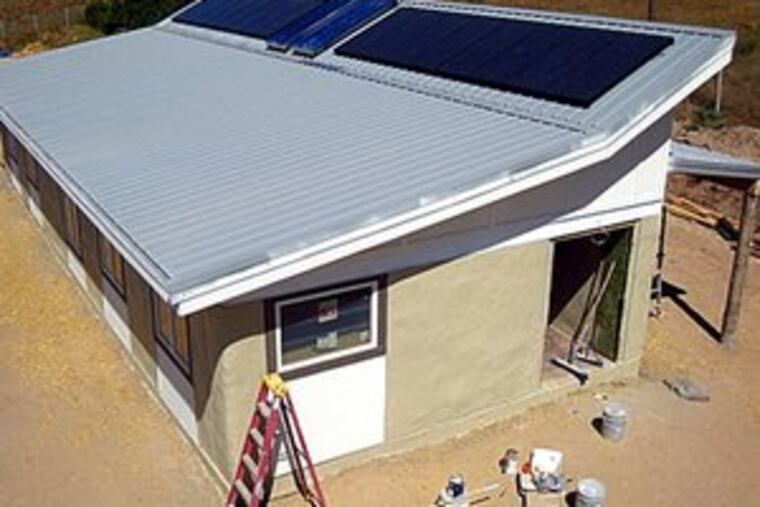
About 900 graduate and undergraduate students, most from the architecture and engineering departments, are involved in creating two solar houses: one as the university's entry in this year's Department of Energy Solar Decathlon; the other, a prototype straw-bale house at Chief Dull Knife College in Lame Deer, Mont.
Penn State is one of 20 colleges and universities worldwide (including Carnegie Mellon in Pittsburgh) competing in the decathlon, which will take place Oct. 12-20 on the National Mall in Washington. The competition, begun in 2002 and held every two years, has as its goals to teach the participating students about the benefits of renewable energy, to increase public awareness of it, and to accelerate the development of technology.
A core team of 16 students (all project managers), assisted by contractors, faculty advisers, and other experts, has been working virtually nonstop on both houses since the construction phase of the now-18-month-long effort began in earnest in June, said Gretchen Miller, the communications project manager.
"We spent June and July working on the house in Montana, and the Pennsylvania house is about 45 percent completed," she said.
It takes time to build one of these houses, Miller said, because "the technology has to be installed slowly and well." And while the students have their work cut out for them to finish the Pennsylvania house and then transport it to Washington, she said, "we are pleased with the progress.
"Our plans had to be reworked as we proceeded. We are not professional builders, and this is our first house."
The houses are called MorningStar Pennsylvania and MorningStar Montana. The name refers to the planet Venus and takes its inspiration from the culture of the Northern Cheyenne. Morningstar also was another name for Chief Dull Knife, the tribe's revered 19th-century leader.
The idea for both houses came from project adviser David Riley, an associate professor of architectural engineering. He also heads the department's American Indian Housing Initiative, a collaborative effort to adapt and deploy sustainable-building technologies on reservations, which are short about 200,000 units of housing nationwide.
For several summers, Riley has taken Penn State student teams to Montana to work with the Northern Cheyenne to build affordable houses from straw bales, which have been used in construction since ancient times and were common in the Plains states in the late 19th and 20th centuries where lumber was scarce.
Straw bales are used as structural elements and insulation. Coupling this relatively inexpensive construction method with solar technology can reduce long-term energy costs to make these houses even more affordable.
The Montana house was designed as a prototype and will serve as on-campus housing at Chief Dull Knife College for a visiting faculty member. Built for $109,000, its design had to both reflect Cheyenne values and be straightforward enough so that anyone could construct such a house inexpensively, said Claudia Torres, who was in charge of analyzing the economic aspect of both projects.
So far, the decathlon entry has cost $400,000, a lot of it financed by sponsors. That cost includes transporting the house to Washington for the decathlon and then back to University Park, Miller said.
Penn State submitted its entry application for the decathlon in December 2005, "and, even though we were not sure that we would be chosen, we began working on the project before they announced the decision on Jan. 11, 2006," said Torres.
The design and materials of each of the houses reflect their locations, said Sal Gimbert, the structural-team leader.
The decathlon entry, being crafted near Penn State's Beaver Stadium, is an 800-square-foot pre-fab house built with Pennsylvania steel and structural insulated panels from a nearby supplier. Parts of the exterior were clad in Pennsylvania black slate, and the interior and exterior use various woods that were sustainably harvested around the state, Gimbert said.
The dining-room table was built by an architecture student from the wood of an elm tree that had to be removed from the university's Allen Street Mall, Miller said. Exterior siding panels on the south side of the house are Pennsylvania white oak, from a tree also harvested on campus.
The dining room and a living room and bedroom make up the house's living core, while the technical core includes the mechanical room, kitchen, bathroom and laundry. One interior wall in the living area can be moved to expand whatever space is in use.
The house also has a breezeway for movement of people and air between the living area and the technical core, Miller said. The cores will be connected after they arrive at the Mall in Washington.
The largest cost - $100,000 - has been for the technology, which remains very expensive, said Angela Lewis, who is overseeing that part of the project.
"There were no specific criteria set up by the decathlon that we had to follow," Lewis said, though each team must provide enough solar electricity to power an electric car.
The competition does require that the energy systems maintain the house within a certain temperature range, provide lighting, and run appliances. Energy generated by photovoltaic systems should directly produce electricity, and there should be solar thermal systems for space heating and cooling and for water heating.
For this house, Lewis said, that means an eight-kilowatt solar-panel array on the roof, with a secondary array of "sun slates" - solar tiles that blend in with the black-slate cladding.
The sun slates are a dedicated direct-current power source for LED lights for the house. A series of glass-tube solar collectors will provide energy to heat water, Lewis said.
After the contest is over, the MorningStar house will return to Penn State, Miller said, and be used for teaching, research and public outreach by its Center for Sustainability.