Olly Shoes seeks to make a fresh start
The company is again eyeing national expansion but plans to move a bit more slowly this time.
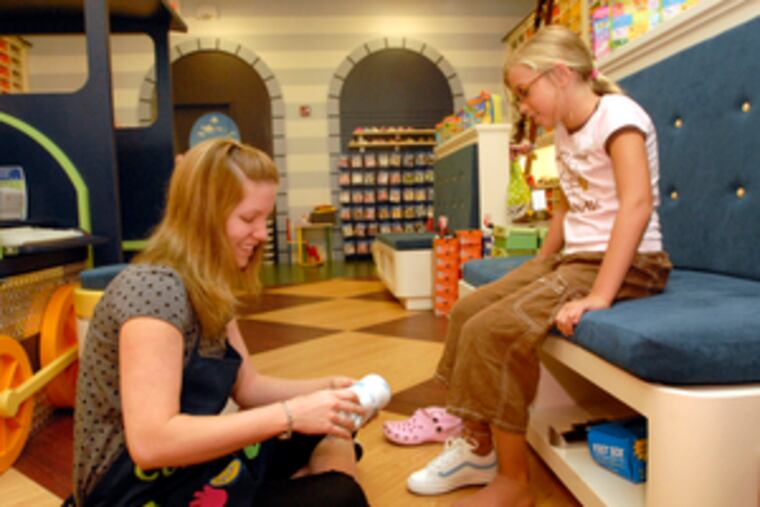
Kirby B. Lohff, the new president and chief operating officer of Exton-based Olly Shoes, is closely watching shoppers' response to recent changes at the privately held boutique retailer of children's footwear.
After a false start in 2003, the company again has its sights on a national expansion. But its near-term goal is "the most incredible back-to-school on record ever," said Lohff, 50, who joined Olly Shoes June 25 from a ticket-sales company but previously ran operations and personnel for F.W. Woolworth Co.'s Lady Foot Locker and Kids Foot Locker divisions. "I don't think the company has ever been more prepared for back-to-school."
Olly Shoes was founded by entrepreneur Katherine Chapman and Staples founder Tom Stemberg around a new technology for fitting children's shoes. The company uses scanners embedded in the floor of a train-shaped kiosk to measure and record a child's foot size.
Olly Shoes opened its first store in Toronto in 2001, and entered the U.S. market in September 2003 in the Main Street at Exton shopping center.
Having closed two short-lived stores in Washington, Olly Shoes now operates three stores in Toronto, seven in the Philadelphia area, and one each in Virginia, Maryland and Delaware. The company's full branding is "Olly, shoes fit for a kid," but most U.S. stores are branded "Olly Kids."
The 13-store chain will approach $10 million in revenue this year, Chapman, the company's chief executive officer, said. Its stores range from roughly 1,800 to 2,200 square feet, and report sales up to $1.5 million.
Lead Olly Shoes investor Stemberg (now managing general partner of Highland Capital Partner's Consumer Fund) said that, amid a depressed retail environment, Olly Shoes "comp-store sales increases are in the double digits. It speaks to the strengths of the concept."
When it entered the U.S. market in 2003, Olly Shoes publicly stated plans to go national within three to five years. But Stemberg said the company was now focused on a "more gradual growth plan."
"We have found that embedding yourself in a community takes time. . . . Word of mouth is very important," he said.
Chapman said: "We felt we could do 200, 250 in terms of ultimate locations." But she said she and Stemberg realized "we had to grow more organically than we originally thought."
The plan now is to expand slowly based on word-of-mouth brand awareness and clusters of store locations.
"We're now looking for locations that are close by, but not too close to our existing locations in New Jersey and Philadelphia," Chapman said, citing Allentown and Collegeville as possibilities.
To grow and maintain control over the customer experience, Chapman said Olly Shoes would not use franchises. "We are now privately funded, and will remain so until we hit a much higher level of store count," she said.
Lohff said that he believed the 200-store goal "is still a viable number" but that the company planned to get existing stores operating at peak level before any larger-scale rollout.
With only 13 stores in the chain, "we should be able to see relatively quickly within the next year what changes we want to make and what's the right assortment for this marketplace," he said.
The chain's newest store, at Garden State Park along Route 70 in Cherry Hill, sells shoes, socks, tights, rain gear, jewelry, music boxes, water toys and soft books.
Nearly all the impulse purchases are placed at child's eye level, creating a potential nightmare for parents of demanding children, but those same items also offer gift-giving solutions.
Olly Shoes' brands include Ecco, Geox, Keen, Nina, UGG, Jumping Jacks, Puma, Nike, New Balance, Adidas and Tsukihoshi.
The company has found success in placing its stores in power/lifestyle retail centers in suburban markets with a high density of children and average family incomes of $75,000 and up.
The Olly Shoes customer demographic is "definitely the mid to upper end," Chapman said, but the chain also attracts customers who are "nowhere near that level of income" but believe quality footwear is important to their child's health.
To prepare for the 2007 back-to-school shopping season, Olly Shoes brought in its merchandise a littler earlier to capture early sales and tweaked its product mix, adding the fashion casual line Geox for back-to-school, and also Agatha Ruiz De La Prada, a fashion brand out of Spain, in higher-end stores. Olly Shoes this year is the uniform shoe supplier for 24 Philadelphia area schools, up from 16 in 2006.
Lohff also changed the company's visual merchandising techniques to better display its style-oriented shoes. "Call it basic retail," he said, "but when you walk by our stores, we will definitely look like a shoe store. We'll be leading with our best foot."
Based in Exton, Lohff reports directly to Toronto-based Chapman. He replaced Paul Bundonis, who left Olly Shoes and joined Build-a- Bear Workshop Inc. of St. Louis in May 2006.
Much of Lohff's career has been in footwear retail, starting with his first job in high school as a part-time sales person at a Kinney Shoes store in Des Moines, Iowa.
For the future, Lohff said: "we really want to zero in on product and assortment needs of our customers 12 months out of the year, rather than just the three big peaks: Easter, back-to-school and holiday."
In addition, he said, the company is launching a direct-marketing initiative inviting customers who made purchases more than 90 days earlier to come back in to Olly Shoes for a "fit check."
For Lohff, Olly Shoes' long-term growth has become a personal goal. "Nothing would excite me more," he said, "than to be able to look out across the company and see us definitely more than 200-plus stores."