Phila. cruise-passenger volume rose in '06
Philadelphia boosted its traffic in cruise-ship passengers last year, while rivals Boston and Baltimore lost ground, a study released yesterday showed.
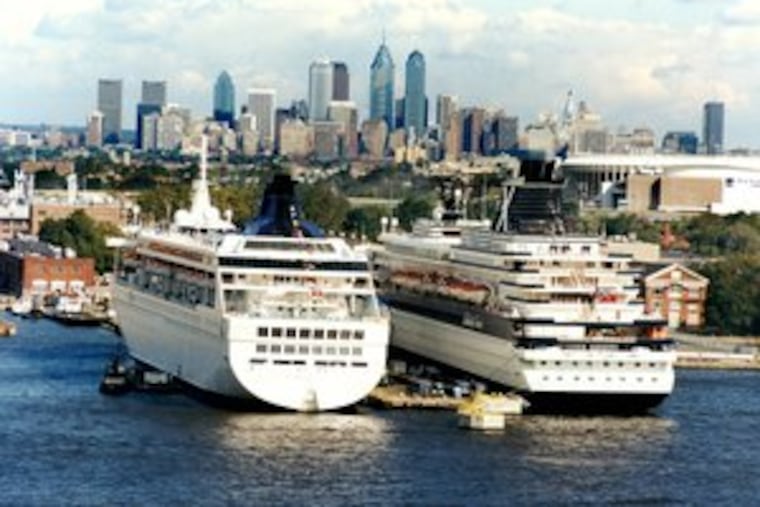
Philadelphia boosted its traffic in cruise-ship passengers last year, while rivals Boston and Baltimore lost ground, a study released yesterday showed.
But all three were overshadowed by the two New York-area cruise ports.
The study, sponsored by the Cruise Lines International Association, an industry trade group, showed that 52,000 passengers embarked on cruises from Philadelphia's Navy Yard terminal in 2006, a 4 percent increase from 50,000 in 2005.
Separately, officials at the Port of Philadelphia and Camden, the division of the Delaware River Port Authority that runs the cruise terminal, said that 65,000 passengers boarded ships here in 2006. That included both the passengers embarking here and, unlike the cruise group's study, those who made one-day visits to the city as part of cruises that started elsewhere.
DRPA's 2006 total was a record for the terminal, situated in a century-old former Navy machine shop at the foot of South Broad Street. Port officials have said they expect the record to stand because the number of cruises embarking from Philadelphia will drop to 20 this year from 38 last year.
That reflects strong rivalry within the Northeast market.
Andrew J. Moody, president of Business Research & Economic Advisors, an Exton market-research firm that conducted the industry study, said Philadelphia faced stiff competition as it tried to attract cruise lines that would base ships at the Navy Yard for a full spring-through-fall season.
All of the Northeastern ports compete for travelers to Bermuda or to eastern Canada and New England because those are the only places from which ships can complete a round-trip cruise in the traditional seven days, Moody said.
"It's very much a seasonal market," he said.
New York's cruise terminal had 10 times as many passengers last year as Philadelphia: 536,000, up from 370,000 in 2005, according to the study. At the Cape Liberty cruise terminal in Bayonne, N.J., boardings increased in 2006 to 160,000 from 147,000, the study found.
Boston saw 62,000 passengers leave on cruises last year, compared with 80,000 in 2005; Baltimore had 59,000 passengers embark in 2006, down from 67,000 the year before.
The two New York-area ports, with their larger market, are the only ones in the Northeast that can support year-round cruising, with a handful of ships that go to the Caribbean in the winter, Moody said.
Philadelphia officials said Norwegian Cruise Lines planned to base its Norwegian Majesty ship here in 2008 for five round trips to Bermuda and five to Canada and New England. Other lines have not announced their plans for visiting Philadelphia or basing ships here.
The industry study showed that Florida continues to be the cruise-industry leader, with five year-round ports that were used by 5 million of the 9 million passengers who took cruises from U.S. ports last year. U.S. passengers make up 78 percent of the worldwide cruise market, the study found.
Cruise lines and their passengers spent $17.6 billion in the United States in 2006, a 9 percent increase that compared with a 10 percent increase the year before, according to the study.
Over the last few years, the cruise business has had to deal with a number of public relations issues, including bouts of stomach illness aboard ships, passengers who have disappeared overboard, and a ship fire. But cruise lines continue to add ships to their fleets, with seven last year and 30 more expected to be built by the end of 2011, the association said.