Game gives immigrants a face - and causes a stir
The rules are simple: Keep a low profile. Don't shoplift. Steer clear of immigration officers. And you might avoid ending up in a deportation facility.
The rules are simple:
Keep a low profile. Don't shoplift. Steer clear of immigration officers.
And you might avoid ending up in a deportation facility.
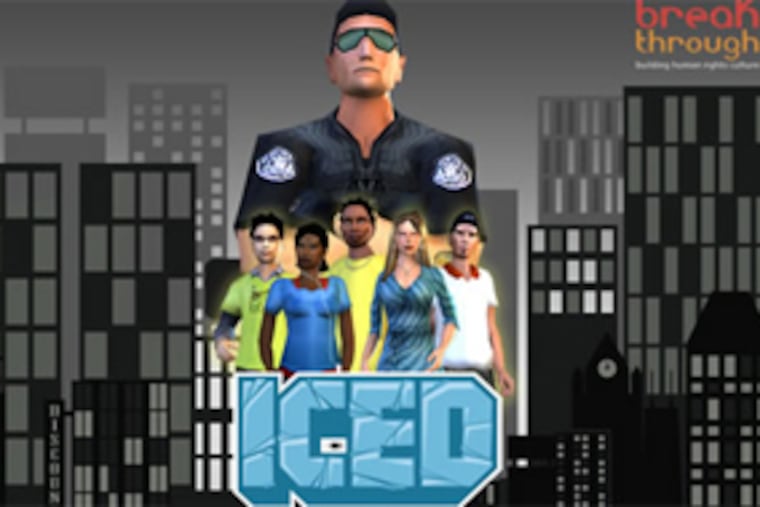
ICED, a video game set to be released for free in November, pits five immigrant teens trying to stay in the country against a slew of immigration officers. The title is a play on Immigration and Customs Enforcement, also known as ICE - the government agency that, among other duties, targets illegal immigrants with outstanding deportation orders.
The game was developed by a New York-based nonprofit organization, Breakthrough, to raise awareness about the effects of changes to immigration law enacted in 1996.
"This is virgin territory," said Mallika Dutt, the group's executive director. "You can watch a documentary, you can watch a video story, but there's really no other way that you can get into the skin of another person and actually see what it's like."
The game lets one player roam a virtual metropolis modeled after New York City. If you make good choices - for example, not jumping the subway turnstiles or stealing from convenience stores - you'll earn points that will keep you on the streets.
Players can also boost their points by walking into a language center, by recycling, or by correctly answering questions along the way. The more points earned, the fewer immigration officers chasing you down.
Eventually - it is virtually inevitable - you will be arrested and taken to a second level, the detention facility.
Here, players must avoid getting into fights, starting hunger strikes, or signing a voluntary deportation letter. At the end, players will face a judge who will determine their fate.
The game is timely and necessary, said Cheryl Little, executive director of the Florida Immigrant Advocacy Center.
"Immigrants have been demonized recently to an extent that I haven't seen in a long, long time," Little said. "Perhaps it'll result in a little more compassion."
About 100 students at three New York City high schools pitched ideas for the game. Some, like Daniel Laverde, a 10th grader at Renaissance High School in Queens, also did voice-overs.
"Pretty much everything that I wanted to see in the game was there already, from the different ethnicities to the different situations," Laverde said.
The five characters were based on actual case studies, and developers had to work hard to avoid watering down complicated ideas, said the game's codesigner, Heidi Boisvert.
Their budget was only about $15,000, she said.
It is the first game of its kind to provide an open, 3-D environment, said Suzanne Seggerman, president and cofounder of Games for Change, which provides support to groups using video games for social causes.
"It's also the first of its kind in that it's really taking a stand on an issue," Seggerman said. "We're sort of at a turning point now where games are really growing up."
Although the game is still in development, it already has its detractors.
Joanna Marzullo, president of New Yorkers for Immigration Control and Enforcement, a group that opposes illegal immigration, said the game made a joke of the immigration debate.
"It's trying to inoculate our youth with a sense of sympathy for illegals," Marzullo said. "It creates the image of the U.S. as a big bully. I think it's wrong."
Dutt, the executive director of the group making the game, said she had also seen opposition in blogs and forums.
"There are those who believe that saying anything positive about immigrants is anathema to American values," she said. "We find that to be a little bit bizarre."