Commerce's evolution
What Vernon W. Hill II knew about banking he learned from the burger business. As a young Wharton School graduate following his father into real estate, the Commerce Bancorp founder searched upstate Pennsylvania for McDonald's locations in the late 1960s. He was amazed at how the burger giant's look-alike stores and fatty menus, backed by saturation advertising, raked in heavy users and high profits by making cheap lunch fun.
What Vernon W. Hill II knew about banking he learned from the burger business.
As a young Wharton School graduate following his father into real estate, the Commerce Bancorp founder searched upstate Pennsylvania for McDonald's locations in the late 1960s. He was amazed at how the burger giant's look-alike stores and fatty menus, backed by saturation advertising, raked in heavy users and high profits by making cheap lunch fun.
Hill later bought a chain of Burger Kings in Montgomery and Bucks Counties. And he put the lessons learned to work at his bank, which, three months after Hill's ouster, agreed yesterday to an $8.5 billion buyout by TD Bank Financial Group, of Toronto.
Hill started Commerce in 1973, and it won market share from richer, slower rivals for more than three decades with simple service menus and a predictable experience in a clean, well-lighted, and carefully cheerful environment designed to speed customers along like the toll lanes on the New Jersey Turnpike.
Hill called his 400-plus Commerce offices stores instead of branches. Instead of old-fashioned "bankers' hours" that ended at 3 p.m. and left workers home weekends and holidays, Commerce was open late - seven days a week.
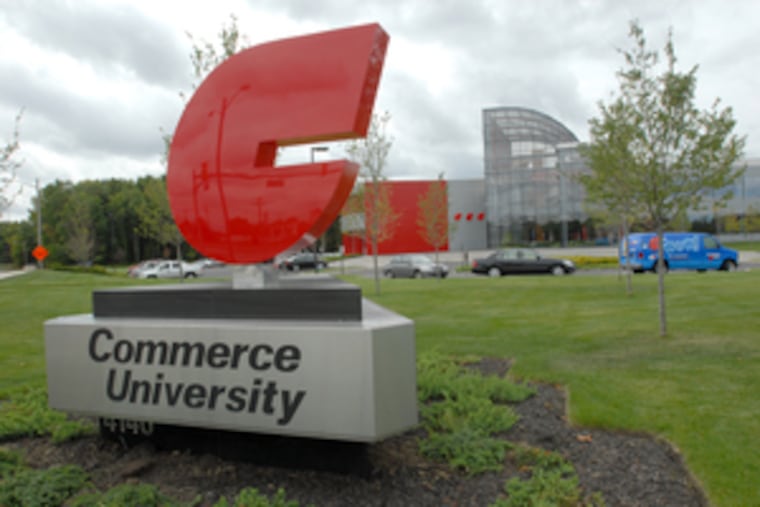
Where Burger King offered playgrounds, Hill installed fancy lobby change machines that let children turn hoarded pennies into crisp bills. Where McDonald's trained staff at Hamburger University, Hill had his wife design Commerce University in Mount Laurel to indoctrinate new and promoted employees with his religion of customer service and brand awareness.
Hill drove home the message with the kind of corporate rah-rah that vanished from cost-conscious rival banks with the wrenching merger-fed layoffs of the 1980s and 1990s. Commerce-themed T-shirts, music videos and pep rallies at Radio City Music Hall and other first-class venues, with sports cars awarded to branch managers of the year, all were designed to create a sense of what Hill called "Wow!" that workers were supposed to communicate to customers.
Commerce sales, profits, deposits and branch openings surged at double-digit rates for most of its history, giving Commerce a premium share price and allowing Hill to claim he ran a fast-growth company in a slow-growth business.
It could not grow that way forever. Hill's penchant for paying the design firm of his wife, Shirley, millions of dollars a year, while employing his brother and son at his real estate firm that picked more than 400 branch locations for the Cherry Hill-based bank, drew unwelcome scrutiny from federal regulators, who stopped approving the new branches Commerce needed to make its numbers, and forced Hill out of the chief executive officer and chairman posts last summer.
Rising interest rates also trimmed Commerce's profitability and threatened its premium share price. Hill tried to hold out for better times by slowing the growth of his workforce, while pushing to meet his aggressive schedule for growing beyond the Philadelphia and New York markets into Washington and Florida. Sandler O'Neill & Partners analyst Mark Fitzgibbon wrote in an August report that the bank suffered a decline in customer service, from among the best in New York in prior years, to among the worst, with longer wait times and less-helpful staff.
By that point, Hill's handpicked board of directors had already accepted what Hill never publicly did - that the bank needed to be part of a bigger, more diversified organization if it was to grow substantially beyond its New Jersey-Philadelphia-New York base.
"They had the world's greatest retail-banking franchise. But the institution needed a more diversified earnings stream, which would have taken years to create de novo. They basically didn't have a capital markets presence," said Orin Kramer, chairman of New Jersey's state pension fund and a New York investor and political fund-raiser.
"Commerce revolutionized retail banking. The name will still be Commerce, which tells you all you need to know about the value of the retail brand," Kramer said.
His critics said Hill was always a deal-maker rather than a banker at heart, relying too heavily on political connections and government business. When challenged, Hill always said his bank delivered value, hard times would pass, and his brand, guided by his people's hard work, would vindicate itself.
It is now up to the bank's new owners, rich with swollen Canadian dollars, to prove Hill's claim to have built "America's most convenient bank."