Celebrating City Avenue
A sign to be lighted tonight will mark what officials say is a safer, cleaner and better business district.
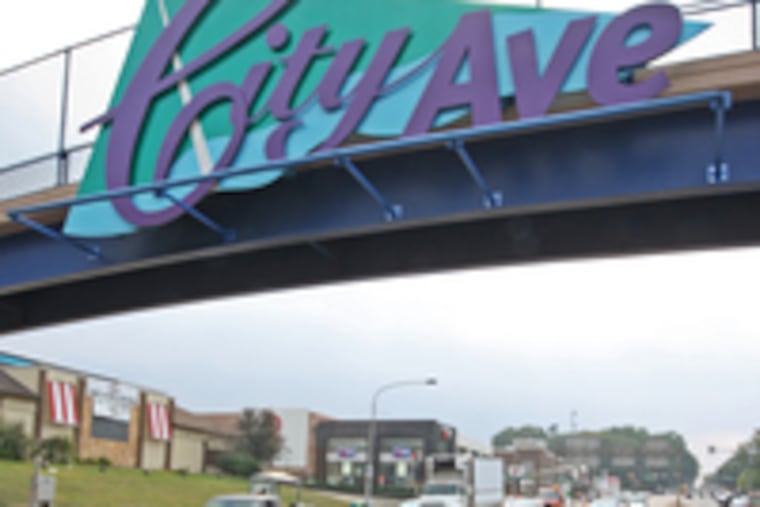
You may think of it only as City Line. But the real name of the stretch of U.S. Route 1 between the Schuylkill Expressway and 63d Street is City Avenue, and by tonight it should be hard to miss.
The border between Philadelphia and Lower Merion Township has been renamed, unofficially, "CityAve" by the business and political leaders who have worked for more than a decade to make the corridor safer and more attractive.
Dozens of those leaders are scheduled to gather at 6:45 tonight on the pedestrian overpass at the Presidential Boulevard intersection. They will turn on recently installed lights on a "CityAve" sign that tells motorists they are entering a "business improvement district" that is living up to its name.
The City Avenue Special Services District, one of 23 similar nonprofit organizations in Pennsylvania and more than 1,200 in North America, has been around since 1999.
But its leaders have a good reason to celebrate now. Between Presidential and Monument Avenue, the once run-down site of the old Adam's Mark Hotel was filled in this summer with a Target department store, two quick-service restaurants, and branches of Commerce and PNC banks.
Most of City Avenue remains one of the region's great development mishmashes: In a couple of miles, there are office buildings, high-rise apartments, television studios, schools, a hospital, hotels, elegant-apparel stores, gas stations, and fast-food and sit-down restaurants.
Nearly all the office space is on the Lower Merion side of the road, where business taxes are lower than in the city, and where employees from the suburbs can avoid Philadelphia wage taxes.
Like similar, heavily traveled streets in the suburbs, parking lots and gaps between the buildings on City Avenue make driving appear to be the only sensible way to get from one block to another.
But Terrence Foley, chief executive officer of the City Avenue District, said the organization was formed in part to try to make the avenue more pedestrian-friendly by adding streetlights and landscaping.
"It's to improve people's perception of safety," said Foley, a longtime marketing executive with Amtrak and Philadelphia port agencies before joining the organization 18 months ago. "The lights are closer together . . . so there are no dark spots."
The Target store and nearby bank branches and restaurants are among businesses that have added pedestrian lighting, he said. And the district has enlisted the help of St. Joseph's University and property developer Brickstone Cos. to add the lighting around 54th Street and City Avenue, he added.
The City Avenue District also employs eight "community service representatives" who patrol the street on bicycles between 10 a.m. and 8 p.m. weekdays and until 6 p.m. Saturdays. They are armed with two-way radios, which they use to alert police if needed.
The PNC branch, which will hold a reception for the business leaders before the sign-lighting ceremony, is the bank's first "green" building in the city, constructed with only recycled materials and using energy-efficient glass, branch manager Ralph Luna said.
For years, Luna said, PNC had looked for a good location for a new branch to replace two older ones that were a block or two off City Avenue. The lighting around the store and the City Avenue District's efforts to keep the area trash-free made the new location ideal, he said.
"When you go outside, you can see the area is being taken care of," he said. "The street's cleaner. It's now an area that's aesthetically pleasing."
Other changes in the last few years have included a new City Avenue dormitory at St. Joseph's University and new shops in the Bala Cynwyd Shopping Center, including an LA Fitness.
The City Avenue District has the distinction, its officials said, of being the first organization of its type in the nation that crossed municipal boundaries, gaining support from both the Philadelphia and Lower Merion governments.
Paul R. Levy, president of the Center City District, the region's oldest similar group, said the organizations amounted to a recognition that businesses along a major road such as City Avenue must compete with suburban office parks and shopping centers with the money to provide their own security and keep nearby streets and parking areas clean.
"People recognized that government would never have the resources to address all the issues," Levy said. "This is about making centers of business really competitive. . . . This is a mechanism to minimize whatever negatives an area has and maximize the positives."