Orleans Tech clears a path to stable jobs
Jerome Henry knows hustle when he sees it - and he sees a lot of it in his carpentry classes at Orleans Technical Institute, especially among the ex-offenders, who number about one-third of his class.
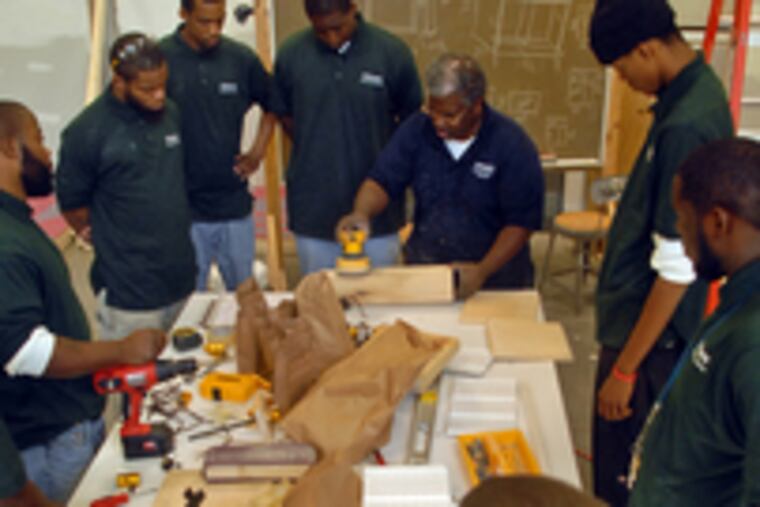
Jerome Henry knows hustle when he sees it - and he sees a lot of it in his carpentry classes at Orleans Technical Institute, especially among the ex-offenders, who number about one-third of his class.
"They are excellent businesspeople, except they were in the wrong business," Henry said. "They can talk, they can sell, they are excellent hustlers. They may have been hustling a bad product.
"Once they get a taste of this type of work, they have no taste for the other life."
Today, Henry and the other 90 faculty and staff, as well as the school's 1,102 students, will celebrate the official opening of Orleans Tech's $21 million facility on Red Lion Road in Northeast Philadelphia. The school, founded in 1974, had been on Rhawn Street.
There is an open house for the public tomorrow between 10 a.m. and 2 p.m., although the building actually opened in July.
The 88,000-square-foot site was built with money raised through borrowing, public and private support, and the potential sale of the old building.
Jewish Employment and Vocational Services, a Philadelphia nonprofit workforce-development program, operates Orleans, along with other programs that serve 17,000 people a year. The programs are nonsectarian.
Orleans Tech students can enroll in certificate programs in carpentry, building maintenance, electricity, plumbing, refrigeration and heating, and air-conditioning, as well as court-reporting.
"These are careers that provide long-term job stability with sustainable incomes for families," spokeswoman Kristin Rantanen said. She cited reports from the U.S. Department of Labor and the Commonwealth of Pennsylvania showing that those skills are in high demand.
The City of Philadelphia runs an apprenticeship program through the school to help it find enough court reporters, she said.
Orleans places 100 percent of its court-reporting graduates and more than 80 percent of building-trades graduates in jobs that start at an average of $11.95 an hour, Rantanen said. The court reporters earn in the range of $23,000 to $40,000 a year.
Tuition runs about $8,000 a year, and most students receive financial aid, Rantanen said.
The new facility makes it easier for Henry, who until last year worked in construction as a project manager, to attract students to the program. His shop, one of 29 classrooms, technology labs and workshops, is twice the size of his former classroom at the Rhawn Street site.
Now, he can divide his new classroom into zones - one mimicking a construction site, and another more like a workshop. Each year, the class builds a miniature version of a house, complete in every detail.
About one-third of the school's students have criminal records.
"This is excellent for young and older men, and women, who want to get their life back on track," Henry said. Unlike other professions, the building trades can accommodate talented ex-offenders, he said.
"Their background is not held against them," he said. "They are given a sense of hope. Before, no one showed them a different way of earning a living other than the bad way. They see a new way, and they jump right into it."