Montco firm's big deal
The nation's biggest venture-capital deals typically take place in Palo Alto, Calif., or Cambridge, Mass. But not this quarter. Look no further than Audubon, Pa., where Globus Medical Inc. attracted the most money from venture capitalists - $110 million - during July, August and September.
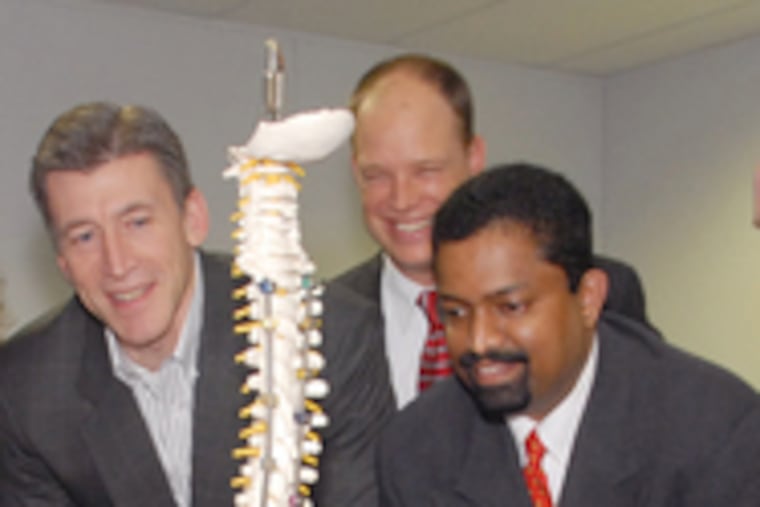
The nation's biggest venture-capital deals typically take place in Palo Alto, Calif., or Cambridge, Mass. But not this quarter.
Look no further than Audubon, Pa., where Globus Medical Inc. attracted the most money from venture capitalists - $110 million - during July, August and September.
Globus, which is working on spinal-implant devices for back problems that improve mobility, topped a private-equity investment for a Cambridge energy company that raised $100 million in the third quarter, according to a new investing survey.
Globus is also tied as the biggest venture-capital deal of 2007 with a San Diego firm, CardioNet Inc., which makes mobile cardiac outpatient monitors and raised $110 million in March, according to the MoneyTree report by PricewaterhouseCoopers and the National Venture Capital Association, based on data from Thompson Financial.
It was the largest private-equity deal in the Philadelphia metropolitan area since 2001, based on MoneyTree data.
Not since Juniper Financial Corp. of Wilmington raised $150 million in 2001, and ICG Commerce of King of Prussia got $117 million in 2000, has a business in the region raised such a large amount.
Globus Medical, founded four years ago, competes in the $4.2 billion global spinal-implant market that includes such big corporations as Medtronic Inc., Stryker Corp., Johnson & Johnson and Zimmer Holdings.
With 275 employees and 27 product "systems" that include implants and instruments, privately held Globus had revenue of $15.6 million in 2004, $43.7 million in 2005, and $82 million in 2006. This year, sales are expected to exceed $120 million, Globus chief financial officer Dave Demski said.
"They've got a great product lineup, and a strong and capable management team," said Kurt C. Wheeler of Clarus Ventures L.L.C., which led the Globus financing along with AIG SunAmerica and Goldman Sachs.
"The company has been growing very fast, with some unique and clinically relevant products," said Wheeler, who is based in San Francisco. "The technology is right. The team is terrific. They've demonstrated an ability to execute and deliver products to the spine community that are very much needed and help people."
Nationally, venture capitalists invested $7.1 billion in 887 deals in the third quarter, down slightly from the second quarter, when $7.2 billion went into 1,000 deals, the MoneyTree survey said. Quarterly venture investing has been growing steadily since 2001, the year the dot-com bubble burst.
In the Philadelphia region, 22 companies attracted $186.2 million in the third quarter, up from $168.7 million invested in 30 companies in the second quarter, and ahead of $184.7 million for 17 companies in the third quarter last year.
"Overall, in terms of venture-capital dollars invested, 2007 is shaping up to be the best year since 2001," said Albert Piscopo, head of PricewaterhouseCoopers' venture-capital practice in Philadelphia. So far in 2007, there were 79 deals in the metropolitan Philadelphia region. There were 76 deals in all of 2006, he said.
"The overwhelming majority of investment dollars is still being poured into biotechnology and medical-device sectors" in the Philadelphia region, Piscopo said. Nationally, software edged narrowly ahead of life-sciences investing in the quarter. Also nationwide, more investment dollars went to industrial and energy companies, so-called clean technology.
Venture investors also favored companies at earlier stages of their development during the third quarter in Philadelphia. Ten deals in the region were investments in start-ups or "seed-stage" companies. Nine were funded by Ben Franklin Technology Partners of Southeastern Pennsylvania.
"This is the most number of deals for that stage of development since 1998 in the region," Piscopo said.
But the dollars were dominated by Globus, which was founded by David Paul, who came to the United States from India in his early 20s to go to graduate school.
After getting a master's degree in engineering from Temple University, Paul eventually joined Synthes Spine in Paoli. In 2003, Paul and seven others, including several former Synthes employees, started Globus to develop alternatives to spinal-fusion surgery, where adjacent vertebrae in the spine are fused together to relieve back pain.
Globus is working on non-fusion techniques and devices that allow greater mobility and flexibility. The company is testing its motion-preservation artificial disc in a pilot study in Brazil.
Globus will use part of the financing for clinical trials next year on several new products, Demski said. It plans to expand product sales into new geographic markets in the United States, Europe and Asia.
Globus, which previously raised $18 million from angel investors, manufactures fusion products, including plates, screws, rods, and the instruments surgeons use to install them.
It also makes instruments for minimally invasive surgery, biomaterials to help the body heal and stimulate bone growth, and motion-sparing implants that don't require spine fusion.
"Fusion products is still an attractive business because of the aging population," Demski said. "The baby boomers are starting to have back problems. That market has been growing rapidly."
The other large local venture investments in the quarter were:
Tengion Inc. of East Norriton, which raised $33.4 million, and is developing regenerated human organs. Tengion's first product, a neo-bladder made from a patient's own cells, is in mid-stage clinical trials in children with defective bladders because of spina bifida and in adults with spinal-cord injuries. It previously raised $89 million.
LiquidHub Inc., a King of Prussia technology company, which raised $20 million in a stock financing, and an additional $18 million in loans. The company said it would use the funds to make strategic acquisitions, add to its consulting practice, and expand into new industries and markets. NewSpring Capital of Radnor led the round with $7.5 million.