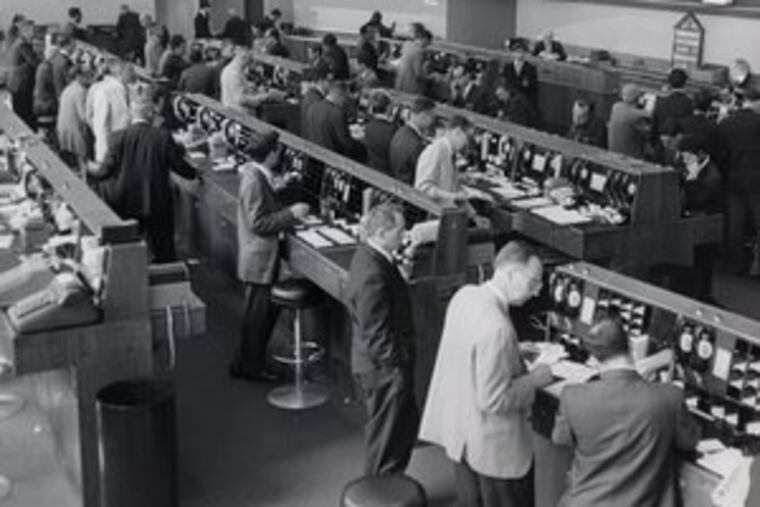
Marc Eisen has made his living trading options on the floor of the Philadelphia Stock Exchange for 20 years.
He was relieved yesterday to hear that the Nasdaq Stock Market Inc., which agreed to buy the exchange for $652 million in cash, plans to keep the trading floor open.
"That's what all of us were hoping for," said Eisen, who for nine years has been in business for himself at the nation's oldest exchange.
Nasdaq's purchase of the exchange on Market Street in Center City, whose primary business is trading options on stocks and indexes, will give the New York company a strong position in an industry that has grown at a 35 percent annual rate since 2003. Investors have paid nearly $1 trillion in options premiums so far this year, including $121 billion through Philadelphia.
Options represent a "phenomenal opportunity," said Christopher R. Concannon, Nasdaq's executive vice president for transaction services.
The sale, if it closes as expected in the first quarter of 2008, will end a volatile decade at the Philadelphia exchange, which was slated for closure in the late 1990s, only to experience a revival in recent years, thanks to heavy investment in technology and the backing of Wall Street powerhouses.
In an industry increasingly dominated by electronic trading, Philadelphia has maintained an open-outcry options floor - where 300 traders scramble to make deals - to complement its army of computers that match up bids and offers.
Nasdaq officials said they planned to keep that floor - which accounts for 40 percent of Philadelphia's volume - in operation because it is integral to the way trading is done here.
Nevertheless, "the floor, like everything we do, has to be self-supporting," Bob Greifeld, Nasdaq's president and chief executive officer, said during a conference call with reporters.
Peter Lawler, chief operating officer of Options House, an online options brokerage in Chicago, said that made sense because trading floors were useful for large, complex trades with different types of options, a variety of expiration dates, and different strike prices.
"That gets negotiated better on a floor," Lawler said yesterday. "There's no current mechanism to do a good job of negotiating that electronically."
An option is the right, but not the obligation, to buy or sell a security for a certain price and by a certain date.
Philadelphia's trading floor has fewer traders than it did even five years ago, when more than 800 people worked it. The exchange employs 380, including 200 in technology and the rest in administration and regulatory compliance.
Some jobs will be lost, but there is no preconceived notion of how many, said Meyer S. Frucher, chairman and chief executive officer of the Philadelphia Stock Exchange.
"We made this deal to preserve jobs," said Frucher, who will remain CEO of the Philadelphia operation under Nasdaq. "The reason we looked at this deal is, we believed long term we couldn't survive."
The global financial exchange industry is rapidly consolidating. Nasdaq alone has three deals in the works: the Boston Stock Exchange, OMX in Europe, and now Philadelphia.
Under chief information officer Bill Morgan, Philadelphia's technology group created what Nasdaq called a key asset in the transaction, the exchange's proprietary trading platform, which Nasdaq called "best in class."
That group stays here, a Nasdaq official said. "We're very excited about working together and leveraging the platform that Philly has built," said Anna Ewing, Nasdaq's chief information officer.
The Philadelphia exchange's planned $25 million data center at the Navy Yard is a likely casualty of the deal with Nasdaq, which outsources its data operations, Frucher said.
One question around the deal is what the six Wall Street trading firms that own 89.4 percent of the Philadelphia exchange, and provide about 40 percent of the options-trading volume here, will do with that volume after the sale. The six firms, including Citadel Derivatives Group L.L.C., Merrill Lynch & Co. Inc., and Morgan Stanley, paid a total of $33.75 million for their shares.
"There are no agreements in place" to keep that volume in Philadelphia, Greifeld said in a conference call with stock analysts. Instead, he said, Nasdaq is counting on the quality of the service to keep the volume there.
The deal with Nasdaq means a big financial gain for former exchange members, who became stockholders after demutualization in January 2004. They were left with 10.6 percent of the exchange after the investments by institutional traders. In early 2004, a block of 100 shares, the equivalent of a seat, sold for $15,000.
Under the deal announced yesterday, each of those blocks of stock is worth nearly $300,000, including stock awarded to former members in a recent legal settlement.
Meanwhile, Eisen said he thought Nasdaq's backing would be great. "If it gives me a couple more years, I'm happy," said Eisen, 43. "I thought I'd eventually be trading off-floor, in an office somewhere."
Market Merger
Philadelphia Stock Exchange
Founded: 1790.
Headquarters:
1900 Market St.
Securities traded: 7,000 stocks, 2,520 equity options, 19 sector index options, and currency options and futures.
2006 revenue:
$113.5 million.
2006 loss: $424,000.
Nasdaq Stock Market
Founded: 1971.
Headquarters: New York.
Securities traded:
3,100 stocks.
2006 revenue:
$1.7 billion.
2006 profit: $128 million.
SOURCES: Philadelphia Stock Exchange, Nasdaq.
EndText