Warning ordered on Avandia
GlaxoSmithKline P.L.C.'s once popular diabetes drug Avandia received the government's strongest warning - a black-box label - yesterday, indicating that users may face a small but increased chance of heart attacks.
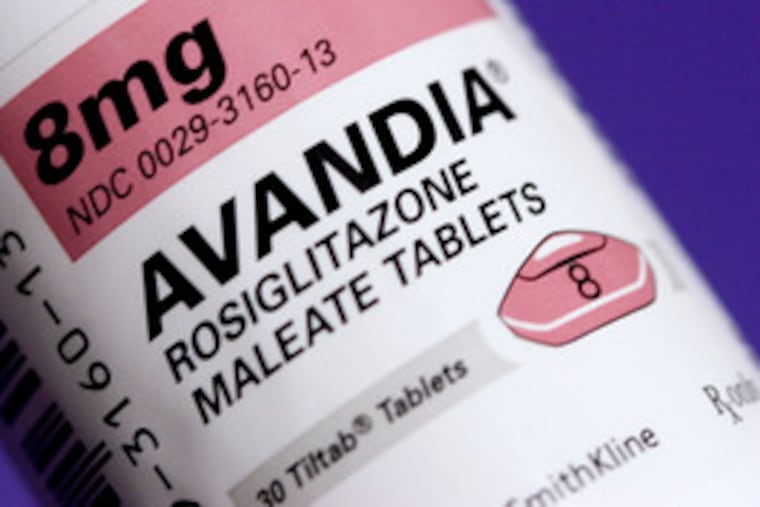
GlaxoSmithKline P.L.C.'s once popular diabetes drug Avandia received the government's strongest warning - a black-box label - yesterday, indicating that users may face a small but increased chance of heart attacks.
But the Food and Drug Administration stopped short of banning the former blockbuster, saying Avandia did not appear to be more dangerous than other diabetes medicines.
"We are keeping Avandia on the market because we have concluded there isn't enough evidence that the risk of heart attacks is higher than other treatments," said Janet Woodcock, the FDA's acting director of the Center for Drug Evaluation and Research.
The decision is likely to help the British company, which has a U.S. headquarters in Philadelphia and is laying off workers worldwide to cut $1.4 billion in costs. And some doctors praised Avandia, saying it was a valuable tool in treating a disease that afflicts nearly 21 million people.
But the debate over Avandia's safety may not be finished. Disgruntled patients are already queueing up to sue the drugmaker. Groups ranging from the U.S. Department of Veterans Affairs to Canada's leading health agency have announced restrictions on the drug. And new study results could still cause Avandia to be withdrawn.
Barry J. Goldstein, a diabetes specialist at Jefferson Medical College, said he was glad the drug was still available. He said he had seen some patients develop side effects from Avandia, such as weight gain and swelling. But he said he had found some success by giving moderate doses of Avandia in combination with other drugs. The lower doses minimized Avandia's side effects, but the combination helped keep down patients' blood sugar, said Goldstein, who has consulted for several drug firms, including GlaxoSmithKline.
"A lot of patients can do well on a mid-range dose," he said.
The decision to keep Avandia on the market was a close one. Woodcock, the FDA executive, acknowledged that an internal safety committee had split over whether to keep the drug on the market, with a majority voting to keep it available. She declined to reveal the exact vote.
U.S. Sen. Charles Grassley (R., Iowa), a frequent critic of the FDA, declared recently that the internal vote had been 8-7 in favor of the drug, based on his contacts within the agency. Yesterday, he issued a statement criticizing the fact that a new Avandia study required by the FDA will not be completed until 2014.
"This case is a clear example of the problem within the FDA," he said. "The office that reviews drugs after they're on the market must play second fiddle to the position of the FDA office that approved a drug for the market in the first place. The system is off balance, and that's not good for public safety."
Glenn Fallon of South Amboy, N.J., would agree. He said he took Avandia for more than a year before suffering a stroke at age 51.
The black-box warning "is a little too late, especially for me," said Fallon, who has hired attorney James Pepper of the Philadelphia firm Sheller P.C. "I am still suffering the effects of this stroke. I'll never be the same as I was. My whole left side is only about 90 percent back."
Fallon must still prove that his stroke was linked to Avandia. Before this week, the drug had a black-box warning label for heart failure. And yesterday the FDA added a warning for heart attacks, but said nothing about strokes.
Nancy Pekarek, a company spokeswoman, said Avandia appeared to show a stroke reduction in one trial, although she said the drug needed to be further studied.
At least three clinical studies are ongoing, she said, and yesterday the company agreed to start another trial at the FDA's request.
The FDA decision qualified as good news for GlaxoSmithKline, at least for now.
Avandia, used for Type 2 diabetes, had been the company's second-biggest seller. Its sales were $2.2 billion in 2006, 20 percent more than in the previous year, according to IMS Health Inc., a health-care-information company.
But sales plummeted 38 percent worldwide in the most recent quarter from last year after a study in the New England Journal of Medicine in May linked the drug to an increased number of heart attacks.
Avandia's percentage of new diabetes prescriptions fell from 14 percent to 4 percent after the journal article, according to ImpactRx Inc., a pharmaceutical-tracking firm in Mount Laurel.
The drop-off has spurred the drugmaker to cut sales and manufacturing jobs worldwide, including an unspecified number in the Philadelphia region, where the firm employs about 6,000.
Linda Bannister, an analyst at the investment firm Edward Jones, of St. Louis, said the black-box warning "is almost the best scenario that could have occurred."
The worst could be over, and the drug could stage a moderate comeback, Bannister said. Her firm has a buy on the stock because it is trading at a discount to its peers. GlaxoSmithKline's U.S. shares have fallen 5.2 percent so far this year.
Yesterday, GlaxoSmithKline shares closed at $49.99, down 61 cents, or 1.21 percent.