JonMar: Cards for African Americans
John Erving's former employer was bought by an international conglomerate in 1995, and the work he loved - outside sales and marketing - had morphed into a desk job.
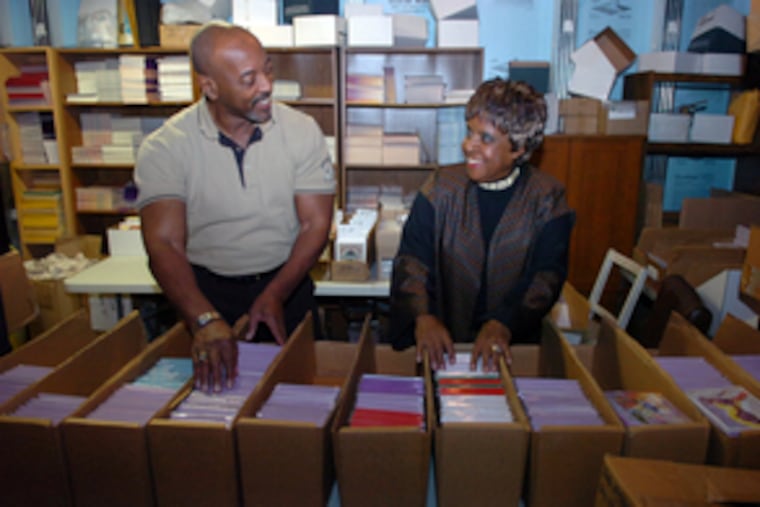
John Erving's former employer was bought by an international conglomerate in 1995, and the work he loved - outside sales and marketing - had morphed into a desk job.
"It was definitely time to leave, but I didn't really have something else lined up," Erving said. "Then I thought about greeting cards, and how it would be good to serve my ethnic market, the African American market. I can't tell you how satisfying it's been to do it."
JonMar Creations Inc., the company Erving runs with the help of his wife, Margaret, out of their home office in Lawnside, is part of a significant, if not particularly burgeoning, ethnic-greeting-card market. The Greeting Card Association, a national trade group, estimates that Americans spend $7.5 billion on greeting cards every year and that African Americans spend as much as 10 percent of that total.
"If someone is looking to start a business and looking for a niche where, say, American Greetings or Hallmark isn't completely dominant, then ethnic specialties is a good entry point," said Barbara Miller, a spokeswoman for the Washington-based association.
Erving said he wanted to be careful about becoming an entrepreneur. He had been in the Air Force and then mostly in sales, and was leery, but excited, about going into his own business at the age of 46. He scoured the Rutgers-Camden business library, and then went through the New Jersey Economic Development Authority's Entrepreneurial Training Institute course. Based on a business plan he developed in the course, he qualified for a $30,000 loan, which he used to buy his first line of cards.
He quit his full-time job and went part time at Wal-Mart. Margaret Erving, meanwhile, stayed at her job in quality assurance at Fort Monmouth, in part to keep the couple's health insurance.
"I still thought I needed help, though," he said, and turned to the Service Corps of Retired Executives, a nonprofit mentorship program through which retirees help people new to the business world. Score set him up with Albert Nelson, who had recently handed over his own greeting-card import business to his son.
"That was the key. Al told me everything he knew, and even let me contact his hundred sales reps," Erving said. "The next day, there was a $550 order coming through my fax machine. I knew I could make it."
Erving also decided he would have to learn how to draw. He had never had any real interest in art, but artists for cards seemed awfully expensive to him. He now draws about half his greeting cards - about 100 of the 200 different designs. Some of the JonMar line has nature scenes, but most of the cards are clearly African American, with people the focus of the front of the cards to make it obvious.
JonMar has Kwanzaa cards, but the business revolves around the more usual holidays and themes.
"Christmas, of course, is our busy season," Erving said. "But we have birthday, and Mother's Day, and inspirational, and just plain cards, too. You have to build a variety if you want a store to take you."
In the beginning, Erving went to A&P supermarkets in black middle-class areas with 30 kinds of cards. A&P let him set up rotating stands that would hold about two dozen varieties.
Pathmark eventually took over many of those same A&Ps, and Erving persuaded the company to give him shelf space for his cards on an experimental basis. The card racks still held mostly cards from big names such as Hallmark, and American Greetings, and the like, but there was JonMar and its cards with the black-sheep logo on the back. Margaret named him Little Wooley and said he represented the favorite of Jesus the shepherd's flock.
"So what do you think, but people came in and bought our cards. I was turning them over quickly," Erving said. He said JonMar now had its cards in 40 CVS stores and 40 Pathmark supermarkets from New England to Virginia and out in Detroit. They are all in African American neighborhoods, Erving said, but that is only natural.
"It is a niche market, to be sure, but even the big companies are focusing on some small segments these days," said Eli Nelson, the son of Erving's mentor, Al Nelson, whose Nelson line of primarily fancy imported cards has headquarters in nearby Moorestown. "Someone like John can go after that and compete if he is conscientious and slightly different."
Erving does a lot of his own distribution, going on the road to make sure his cards are stocked properly. He did not divulge his income, but he said he recently bought a property in Burlington County with a huge shed to house his inventory. He sells "tens of thousands" of cards, mostly at $7.99 for a pack of 15, he said. His all-occasion cards retail for less than $3, while the average card on the shelf from the big companies may be $3.49. He said he did not sell much online and has decided that greeting cards are still an in-store purchase.
"You learn in business every day that, if you have a niche and you service it correctly, you can at least run with the big boys," he said, noting that Hallmark has a line called "Mahogany" to cater to the African American community. "We try to be smart in where we are selling the cards and keep in mind who we are selling to. I think there is still something in ethnic groups - a pride - that will always have a place in retail."