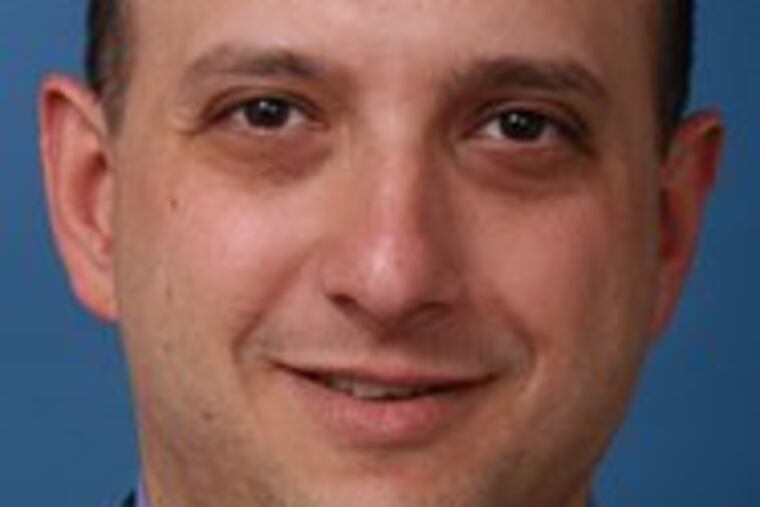
The planned sale of American Financial Realty Trust has freed its founder, Nicholas S. Schorsch, who left the Jenkintown company last year as the share price fell, to get back into the bank-landlord business.
This time, Schorsch said, he has a new company that is tailoring investment products to the increasingly choosy and specialized investors who buy commercial real estate.
"Our message was muddled because we were doing so many things in one platform," said Schorsch, 46. "The analysts want a simple, explainable story."
This new company, American Realty Capital, with offices in Jenkintown and New York, is not publicly traded, while American Financial is. Instead of lumping all its properties into one package, American Realty is setting up separate investor funds, one to buy retail-store branches and rent them to big national chains, another for more speculative office and warehouse turnaround projects.
"The institutions and pension funds need very transparent investments that give them exactly what they're supposed to do," Schorsch said. "We're happy to change our paradigm."
Schorsch said American Financial, of Jenkintown, which leases bank branches and offices to Bank of America Corp., Wachovia Corp. and other big financial companies, waived his noncompete agreement Nov. 5, when it agreed to a $1.1 billion takeover by Gramercy Capital Management Corp., of New York.
Ten days later, his new company, American Realty Capital, agreed to buy 16 offices from Harleysville National Bank for about $40 million. Those branches will be rented back to the bank, so "we can focus on what we do best - serving customers," Harleysville president Paul Geraghty said in a statement.
American Financial spokeswoman Muriel Lange confirmed Schorsch's account of the noncompete agreement and declined further comment, citing the company's pending sale, which is expected to close early next year.
Analysts such as John W. Guinee at Stifel, Nicolaus & Co. Inc. had questioned the value of American Financial's mix of branches and partly occupied office buildings. Guinee noted in a report last year that the company's office buildings were vulnerable to consolidation by big tenants such as Bank of America, which left a hole in its income statement. That made it hard to guarantee the dividends that had attracted investors to the stock.
The share price lost nearly 40 percent of its value from early June to mid-August 2006, more than double the drop of the benchmark Bloomberg real estate stock indexes. Feeling pressure, Schorsch said, he and American Financial director William Kahane, a former Morgan Stanley real estate lender who joined Schorsch's move to the new company, offered to buy American Financial for $12 a share - double its low for that year. As private owners, they believed they would have the patience to hold properties "opportunistically" - until they could be sold at a profit.
Instead, chairman Lewis Ranieri, a veteran Wall Street mortgage-securities investor, announced Schorsch's departure, along with plans to sell "noncore" assets and cut costs.
But after credit and real estate markets declined during the next year, and Schorsch's replacement as chief executive officer, former Philadelphia and New York banker Harold "Hal" Pote, died unexpectedly, Ranieri and his board ended up accepting Gramercy's cash-and-stock offer of just $8.43 a share.
Since last summer, Schorsch said he, Kahane, and other former colleagues who joined him at the new company had raised or borrowed $500 million for investments in property for pharmacies, grocery and other chain stores, and now banks.
American Realty Capital earlier this month filed an amended plan with the Securities and Exchange Commission to raise an additional $1.5 billion for the American Realty Capital Trust Inc. fund. Schorsch said his group also planned to raise at least $150 million more, for a turnaround fund.
Kahane is well-connected to help raise money. He has been managing director of GF Capital Management & Advisors, a New York merchant-banking firm whose head, Gary Fuhrman, has counted Seagram's heir, Hollywood investor Edgar Bronfman, and other wealthy individuals and families among his clients.
Schorsch and Ranieri started American Financial in 2002, seven years after Schorsch and his family sold their inherited metals business, Thermal Reduction Co., and began investing in a range of Philadelphia-area businesses, from cemeteries to warehouses.
Thermal Reduction clashed frequently with federal regulators in the 1980s and early 1990s over pollution and labor conditions at its Riverside, N.J., and Northeast Philadelphia properties. Schorsch, who had recently left school and started running the business, said he eventually changed the company's combative posture when he found that the old way was not helping solve problems.
Once again, he has adapted his strategy to changing times. "It used to be real estate, in the big institutional portfolios, was lumped into 'other investments' " and not differentiated, he said. "Today, the investor determines in his own mind what kind of properties, what kind of income. This is the right way to go forward."