Bonovitz ends a 10-year run
Duane Morris chairman and CEO is succeeded by his deputy, John Soroko.
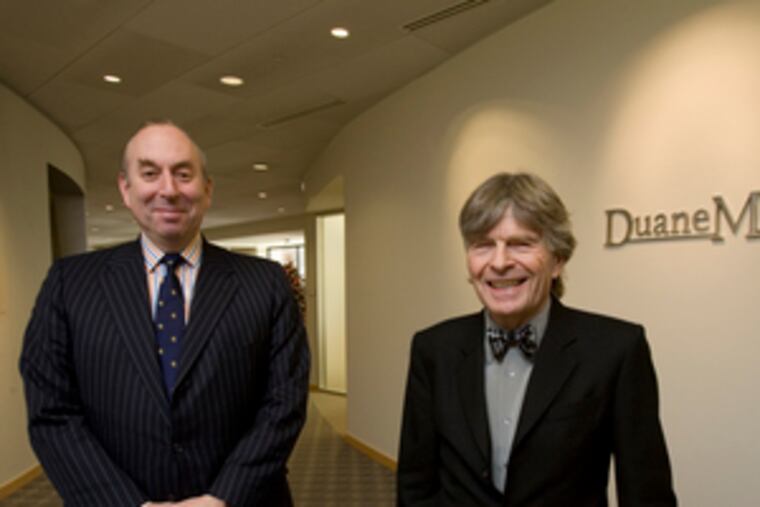
After a decade as chairman and chief executive officer of Duane Morris L.L.P., a prominent Center City law firm, Sheldon Bonovitz announced yesterday that he was stepping down and that he would be replaced by his deputy, John Soroko, a top trial lawyer.
Bonovitz presided over the firm during a period of explosive growth, both for Duane Morris and other large firms in the Philadelphia region and nationally. During his tenure, revenue grew from about $72 million a year to $375 million last year, while the number of lawyers at the firm increased from about 250 to 650, and the firm added 14 offices domestically and abroad.
Bonovitz, 70, said he was stepping down because he had achieved many goals he had set for himself when he took over in 1998. He said he would continue to be active in the firm in business development and recruiting while practicing some law.
"It feels right. The firm had a record year, and the time to change is when things are going great," said Bonovitz, who is also a director at Comcast Corp. and serves on the boards of a number of cultural institutions in the Philadelphia region. "If I were 10 years younger or even 15 years younger, I think I would have come to the same decision."
Soroko, 56, who is chairman of the firm's trial-practice group before taking over as chairman and CEO today, said he intended to build on Bonovitz's growth strategies. He said one of the biggest challenges facing firms like Duane Morris was competing to hire accomplished lawyers with ample client lists.
Growth can only continue, he said, by "adding lawyers who add to the practice."
In a profession where the largest firms employ 2,000 lawyers or more, Duane Morris is hardly a behemoth.
But its growth trajectory over the last decade has come to epitomize the profound changes under way in the practice of law and the way law firms position themselves in the legal marketplace.
Like most of its competitors, Duane Morris was a large regional firm in the mid-1990s that focused the bulk of its practice in the Mid-Atlantic.
As its clients expanded their geographic reach both domestically and overseas, they demanded the same of the firm.
The response of Duane Morris and other firms like it was to recruit established lawyers and add offices, aiming for larger clients at relatively high hourly rates.
Under Bonovitz, the firm added offices in 14 cities, including London; Ho Chi Minh City, Vietnam; Singapore; San Francisco; Boston; and Chicago.
The game, as practiced by Duane Morris and some other larger firms, was to ensure that new recruits could add quickly to the firm's bottom line, a tactic aimed at lessening the financial risk of opening a new office.
At the same time, the firm sought to market other legal services to the new clients brought in by the new recruits. If, for example, it hired a new partner whose main specialty was litigation, the firm would also seek to connect his clients with its own tax experts or lawyers specializing in mergers and acquisitions, if that was the service needed.
Mergers generally have been small, with the firm bringing on single lawyers or small groups of up to about a dozen. There have been exceptions, though. In 2006, the firm merged with the 64-lawyer Hancock, Rothert & Bunshoft, of San Francisco.
The firm's approach was lauded in a 2006 Harvard Business School case study, which concluded that Duane Morris had managed to preserve a relatively flat leadership structure and democratic traditions while riding a wave of growth.
Bonovitz, a tax expert, evinced many of the aspects of the contemporary law firm CEO. Although he had a substantial tax practice when he took over as chairman, he stopped practicing law as the demands of running a large firm, from recruiting to overseeing its far-flung real estate to hatching expansion plans, grew ever more intense.
Deeply enmeshed in the mechanics of running his firm, he could easily spout statistics on how many feet of office space the firm leases per lawyer (600) or average time it takes for the firm to receive payment from its clients (57 days).
Many leaders of top firms in Philadelphia and nationally still practice, such as Barton Winokur of Dechert L.L.P. and Nina Gussack of Pepper Hamilton L.L.P., both of whom maintain substantial practices. Moreover, Soroko, the new chairman and CEO of Duane Morris, said yesterday that he planned to continue to practice.
Besides his work at the law firm, Bonovitz is a high-profile figure in the city's cultural and business landscape. His wife, Jill, a first cousin of Comcast chairman Brian Roberts, is an accomplished sculptor, and the couple are among the city's most prominent art supporters. Positioned in front of the Duane Morris headquarters on 17th Street is a Roy Lichtenstein sculpture,
Brushstroke Group 1996
, one of only a handful on public display in the United States.
Bonovitz is also on the boards of the Curtis Institute of Music, the Philadelphia Orchestra, the Philadelphia Museum of Art, and the Barnes Foundation, among other institutions. He is a graduate of Harvard Law School, where he will begin teaching a course in 2009, and of the Wharton School.
Soroko, a graduate of New York University Law School and Haverford College, is also a member of the Federalist Society, the conservative legal group, many of whose members have gone on to win key judicial and executive branch appointments under President Bush, most notably Supreme Court Justice Samuel A. Alito Jr.
Soroko said yesterday that, with his appointment as chairman of the firm, Duane Morris lawyer Matt Taylor would take over as head of the trial-practice group.