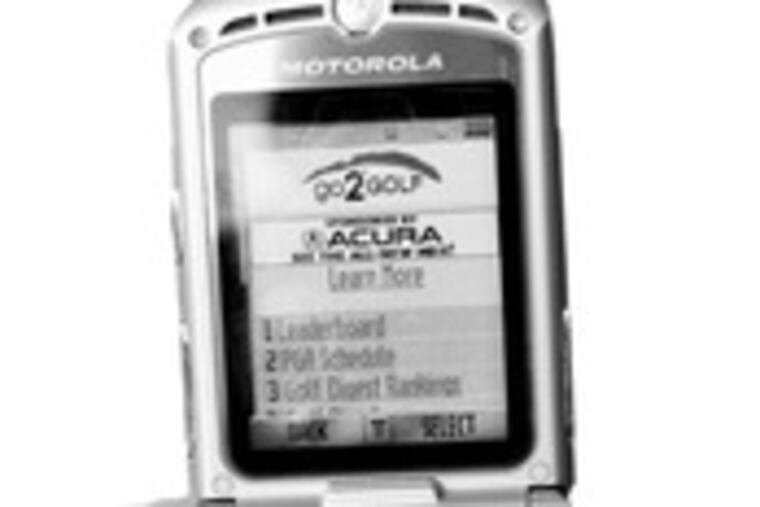
NEW YORK - Your cell phone is a potential gold mine for marketers: It can reveal where you are, whom you call, and even what music you like.
Considering the phone is usually no more than a few feet away, those are powerful clues for figuring out the right moment to deliver the right coupon for the store just around the corner.
But first, marketers will have to wrest the personal profiles from mobile carriers worried that annoyed subscribers might defect to rivals.
"It's proceed with caution," said Jarvis Coffin, chief executive of advertising distributor Burst Media L.L.C. "Are consumers going to be spooked by the idea that suddenly their phone goes beep and it's a Starbucks offer, and they are standing next to a Starbucks?"
Carriers now are guarding the data zealously, but many people believe it is only a matter of time - over the next year or two - before marketers can routinely target ads to a potential customer's location and actions.
"My phone has a lot of very specific and detailed information about myself . . . information that isn't always going to be resident when I'm at a number of PC browsers," said Rob Adler, chief executive officer for mobile Web company go2 Media Inc.
The research firm eMarketer Inc. estimates that U.S. spending in mobile ads, about $900 million in 2007, will grow more than fivefold to nearly $4.8 billion in 2011. Paid search and other online spending will only double, to about $42 billion in 2011.
Mobile ads today are mostly blasted at mass audiences. Few carriers offer limited targeting based on users' age, sex, zip code and other characteristics.
That should change. Ever since the Federal Communications Commission ruled in 1996 that wireless carriers must help 911 dispatchers identify a caller's location, technology companies and privacy advocates alike have been speculating about making phones' location information available to commercial services and advertisers.
Americans are finally using cell phones for more than calling, joining European and Asian counterparts in embracing data services such as text messaging and ringtones.
Devices also are improving. Last summer's release of Apple Inc.'s iPhone unleashed an era of bigger screens and friendlier interfaces for mobile Web browsing.
Advertisers, meanwhile, are starting to experiment with mobile ads. With a boom in GPS devices and location services such as maps and child tracking, it is only natural that advertisers, too, will want to take advantage of location information.
The phone's highly personal nature will mean more privacy red flags compared with what is collected when someone surfs the Internet from a regular computer.
Two industry trade groups - CTIA and the Mobile Marketing Association - have committees developing guidelines, including how properly to get customers' permission and periodically remind them of any tracking.
Companies are also developing ways to share profiles with marketers while stripping out sensitive information such as names.
On Sprint phones, all targeting to such attributes as age and zip code is done on Sprint Nextel Corp.'s end; advertisers give Sprint the ads for the company to place without having to share data with anyone, spokeswoman Emmy Anderson said.
Meanwhile, an ad-delivery system from Ad Infuse Inc. can be installed entirely on a carrier's own premises so that data remain under the carrier's control.
The wireless industry deserves credit for its caution, said Ari Schwartz, a privacy advocate with the Center for Democracy and Technology. He said advertising and technology companies were the ones having to first prove to wireless carriers "that they have put in a lot of thought about how to do it in a way that won't raise the creepiness factor."