You, Too, Can Be a YouTube Hero
He didn't think it was going to take off the way it did. That's what Andy McKee says. That's what they all say.
He didn't think it was going to take off the way it did.
That's what Andy McKee says. That's what they all say.
No more than 14 months ago, Andy McKee was the kind of musician you'd find in most every city in America. He was a guy with a dream. And it was a simple dream really.
"All I've ever said, since I was 14 years old, is that if I can make a living playing guitar, that's all I need," McKee says, from his home in Topeka, Kan. "I don't need a mansion or anything."
Then his little world of giving guitar lessons and playing his own finger-picking gigs ran into a Goliath named YouTube Inc.
Nearly 30 million views later, McKee has found fame - and his dream - as a viral musician, one who becomes famous though the Internet.
That same forward-this-to-everyone-you-know Web-surfing mentality has helped bring about a new type of music celebrity, the musician who can do something extraordinary with an instrument, videotape it and then put it on the Web for millions to watch and comment on.
It got McKee onto the front page of YouTube and earned him the title of the No. 1 artist on YouTube - all thanks to his most notable video, "Drifting," a three-minute instrumental song that has amassed more than 10 million views.
Just a little context on McKee's views: In the 2007 Neilsen BDS reports released last week, the highest number of music video streams was 23 million (Avril Lavigne's "Girlfriend").
McKee's total - though beginning in mid-November 2006 - would put him between Justin Timberlake and Shakira on those Neilsen charts.
"I'm playing the guitar in sort of an unusual way," McKee says, asked to explain his rash online success. "That has an appeal to people who had never seen the guitar played that way. And maybe the music wasn't half bad too."
Ah, yes, the quality of the music. This is where the viral musician differs from the Internet sensation - another viral wonder, but one spiked with humor instead of virtuosity.
Thirteen million people may have watched Tay Zonday sing the quirky "Chocolate Rain" this year, but a viral musician he is not. He is more akin to the William Hungs of the world.
Zonday was able to spin his odd voice and Internet fame into a Dr Pepper commercial. McKee, meanwhile, turned the momentum behind "Drifting" into some national touring, late-night TV appearances, and big guest spots.
Vocalist Josh Groban saw McKee's work on YouTube and recruited him to play on
Noel
, the Christmas album Groban released in October. With 3.69 million copies sold,
Noel
was the best-selling album of 2007.
"I think there's been a void in what the music labels are releasing as far as the talent levels are concerned," McKee said. "There are people who can sing or dance, but how many people are writing or creating their own music? That's why all these musicians are taking off on the Internet."
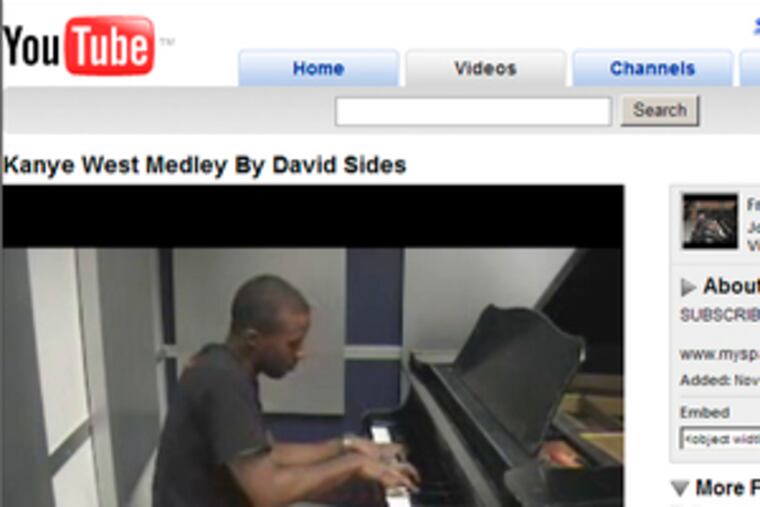
Another of those is David Sides, a 23-year-old piano player who is a recent graduate of the University of California, Riverside. As a teenager, he gained the nickname "Piano Man" because of his knack for listening to popular songs and replaying piano versions by ear.
For a couple of years, Sides said, a friend was urging him to record himself and put the videos on YouTube. Sides was skeptical at first, but eventually decided, "Maybe I should do that." In April, he put up videos of his piano versions of hits such as Sean Paul's "We Be Burnin'" and Fat Joe's "Make It Rain."
He has released 35 videos to YouTube, and seven of them have topped a million hits. His most popular thus far is a rendition of One Republic's "Apologize," which has gotten more than 2.2 million views since Nov. 7.
Like McKee's videos, Sides' are simple. Just him sitting at the piano playing. There's no flash. The music sells itself.
"Music today has changed," Sides said. "You hear more catchy hooks and poppy tunes. A lot of times the people who make this music are not really playing the instruments. The actual idea of musicianship has dwindled. Exposing kids to these instruments is very important to music."