Helicopter-maker expands in Philadelphia
Helicopter-maker AgustaWestland will celebrate a major expansion of its Philadelphia factory this morning, strengthening this region's long leadership in the evolution of rotary-winged flight.
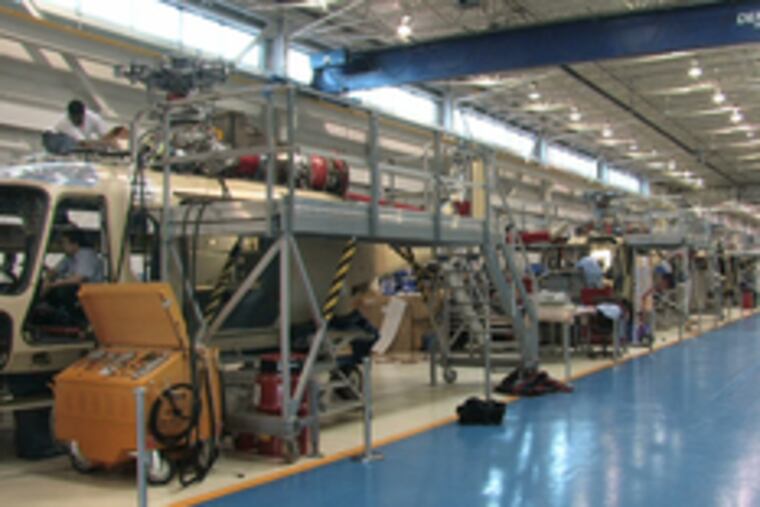
Helicopter-maker AgustaWestland will celebrate a major expansion of its Philadelphia factory this morning, strengthening this region's long leadership in the evolution of rotary-winged flight.
This is the second major expansion of the Italian aerospace firm's 20-year-old plant on Red Lion Road at Northeast Philadelphia Airport.
By the end of this year, the facility will employ 500 people, up from 200 in 2005, the company projected.
The new facility will assemble the midsize AW139, which chief executive officer Giuseppe Orsi described as "a very sophisticated and successful helicopter."
The twin-engine helicopter can be configured for VIP transport, law enforcement patrols, and delivering personnel and supplies to ships and offshore oil platforms, as well as military and homeland-security missions.
The AW139 is the fifth type of helicopter currently manufactured in the Philadelphia region. The others are the Boeing Chinook, Boeing-Bell Osprey, Sikorsky S-76 and AgustaWestland Koala.
Philadelphia has played a long and fruitful role in the development of rotary-winged vertical flight that began because several pioneers working on various aspects of the technology happened to live here.
For that reason, "some people would consider us the birthplace of the American helicopter industry," said Sean Saunders, executive director of the American Helicopter Museum in West Chester.
Today's event comes eight days after the death of Frank N. Piasecki, at age 88, who developed the tandem-rotor helicopter and founded the company that became the rotorcraft division of the Boeing Co. Piasecki, an Overbrook High School graduate, began work on helicopter design while in college and, in 1943, became the second American to build and fly a helicopter - Igor Sikorsky was the first.
At the time of his death, Piasecki was chief executive officer of Piasecki Aircraft Corp., of Essington, which is still actively developing helicopter technology.
In the decades before the flights of Sikorsky and Piasecki, others in the region were actively working on rotary-winged flight.
W. Laurence LePage worked with Harold Pitcairn in Horsham, creating an auto gyro "that led to development of the helicopter, many people believe," said Robert Spencer, a member of the museum's board of directors and chairman of its exhibit committee.
And, Spencer added, inventor-philosopher Arthur Young, working in a barn on his father's Main Line farm, "invented the control system still used today on Bell Helicopters." Young worked with Larry Bell on the Bell Model 30, the third U.S. helicopter to fly.
The region's helicopter business is expanding, aided by Boeing's presence and the region's proximity to the densely populated Northeast United States, which is a major helicopter-buying market.
Last year, the latest Boeing Chinook model entered Army service. Boeing is offering yet another version of its tandem-rotor helicopter for Air Force search-and-rescue missions. Winning that contract, which could come this year, would mean a big expansion of the Boeing plant in Ridley Township.
The Chinook, in service since the Vietnam war, is second by only a short time to the fixed-wing C130 Hercules in the race for the longest production run in aviation history, and Boeing talks of building it for at least another two decades. "The pilots who will fly the last Chinooks haven't been born yet," the museum's Spencer said.
While Boeing has plans to expand, rival Sikorsky has already doubled the size of its Keystone Helicopter Corp. unit, which it acquired in 2005.
David Ford, president of Sikorsky's Keystone unit, said the firm had completed its move from West Chester to Coatesville, next to the Chester County Airport. Its new 800-person facility, called the Heliplex, last year won a license to build and certify new aircraft - in addition to the customizing, overhaul and repair work it has done for 55 years.
Last year, it built five Sikorsky S-76s and will ramp up to 20 to 30 this year, Ford said. Next year, all S-76s will be made in Coatesville. The S-76 carries four or five people when configured for VIP missions; nine or more when set up for such utility work as transporting workers and supplies to offshore oil rigs.
AgustaWestland, a subsidiary of Italy's Finmeccanica S.p.A., came to Philadelphia in 1982. In 1988, it consolidated scattered operations on a 10-acre site where it initially completed helicopters built in Italy.
In 2004, the Philadelphia plant, its only manufacturing facility in North America, was expanded to assemble the single-engine AW119 Koala, which can be modified for military, law enforcement, firefighting and other missions.
This latest expansion will make room for manufacture of the larger AW139, which also can be configured for a wide range of uses.
"Our strategy," said Orsi, AgustaWestland's CEO, "is to design, develop, test and produce our helicopters close to our customers. And the U.S. is our biggest single market."
Tour the AgustaWestland plant and hear CEO Giuseppe Orsi talk about the expansion plan via video at http://go.philly.com/agusta
EndText