1 bedroom is all I need . . .
Oops. A Chicago artist's plan for his bachelor pad produced the clean, elegant space he wanted. Then he met Clare. . . .
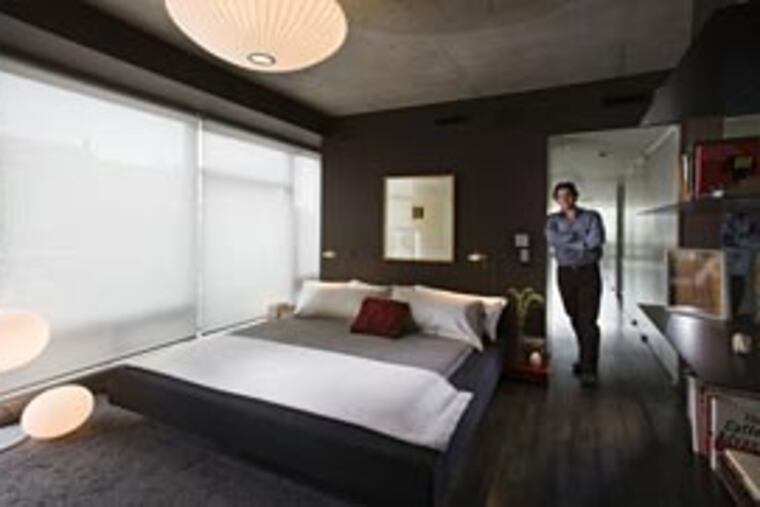
Chicago artist Lincoln Schatz laughs when he says, "Things don't always work out the way we expect them to." In fact, his condo chronicle gone awry has left him elated.
The story starts in 2003. After a divorce, Schatz was living in a rental and looking for a place to buy. A project designed by his friend Ralph Johnson, an award-winning principal of the architecture firm Perkins & Will, caught his eye when it was still so raw that "I had to take a construction elevator to the ninth floor, then climb a ladder up three more levels that were nothing more than concrete platforms and support columns," Schatz recalls.
Yet the framework was so inspirational, he says, that he "had a vision. I knew this would make the world's best bachelor's pad."
Schatz grew up in a Mies van der Rohe building and was an acclaimed sculptor before segueing into the new-media work he is noted for today. His vision for the new apartment was of "a stripped-down, architecturally intriguing space" done to suit himself, and this place had enormous potential.
It wrapped around half a floor and boasted floor-to-ceiling windows. It would offer 1,800 square feet, sport a 55-foot-long terrace, and have a soaring three-story atrium at one end. With all that glass, it promised to be clean-lined, well-lighted and loaded with spectacular views.
Schatz bought the flat on the spot and consulted with Johnson to change its layout.
"It was slated to have three bedrooms, but I definitely didn't need them. So we knocked it down to one," he says. To refine the rest of the space to match his vision, he hired architect Steve Kadlec of Kadlec Architecture & Design and interior designer Jason Hall.
The design team gave the interior the same kind of architectural weight as the exterior by elegantly redefining the layout, redesigning the kitchen, and cladding the walls with a series of sleek, precisely milled panels that echoed the building's exterior curtain wall.
More walls were removed to give the public areas loftlike proportions. The kitchen was doubled in size and outfitted with custom-made cabinets, and a panel system was used to hide bathrooms, closets, a laundry room, and a computer cubicle in the apartment's core.
The kitchen is sited in the 30-foot-high atrium and was inspired by a luxe German line. "I loved it, but customizing it to the larger scale this space required made it cost-prohibitive," Schatz says. "So I had my architect design our own."
His version has cabinets stained chocolate brown, Miele appliances, integrated Sub-Zero refrigeration, and honed black-granite countertops. It cost about 50 percent less than the German design, Schatz estimates. Best of all is a large wall left blank above the cabinets that he has transformed into a constantly changing new-media work.
"I installed a projector overhead and play soundless art films there."
Eight months after Schatz bought the place, he moved in with nothing but two Ligne Roset sofas and a bed. Three days later, his plans to furnish the place as a bachelor pad came to a crashing halt: He had his first date with Clare Pinkert, a civil-rights attorney he met online.
They went out the next night, and then the next. Here, a Yiddish proverb Schatz and Pinkert now adore applies: "Mensch tracht, un Gott lacht." Translation: "Men plan, and God laughs."
"We were engaged in five weeks," Schatz reports gleefully, and they were married within a year.
"But I didn't marry him for the apartment," Pinkert says with a laugh. "I had my own place under contract . . . and had to cancel it."
The couple set out to furnish the space together. Fortunately for Schatz, Pinkert embraced the same aesthetic.
They stuck to daringly designed yet neutral pieces that were multifunctional, to keep the loftlike space variable. This included a Marcel Wanders giant white cotton floor lamp, Paulo Haubert's Rasta ottomans, Henk Vos' Aulia coffee table on wheels, and Piero Lissoni's Extra Wall seating system.
The last piece has become the spatial organizer because "it's essentially a building-block system that can be configured any way you dream up," Schatz says.
Now, they need furnishings of a different ilk - they're expecting their first child in the spring. Kadlec has plans to add one of those bedrooms back in as a nursery.