Even in hard times, gamblers keep . . . ROLLING THE DICE
All the doom and gloom over the economy has Tony Marty seeking sanctuary in a familiar place. Behind a slot machine.
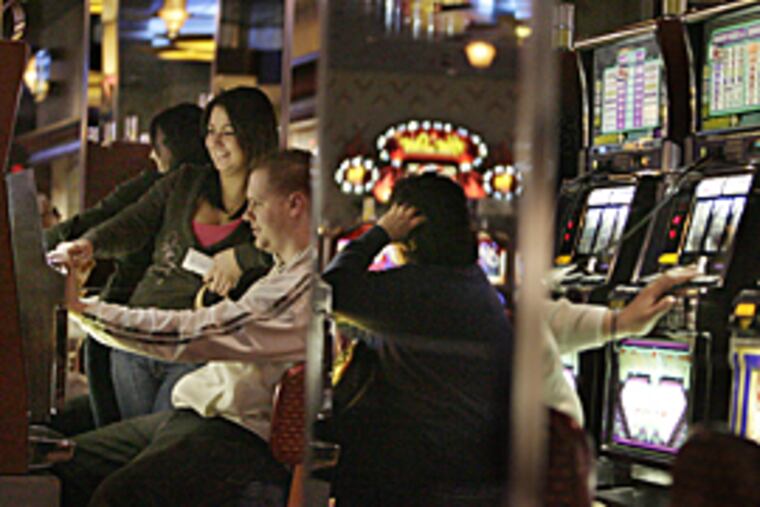
All the doom and gloom over the economy has Tony Marty seeking sanctuary in a familiar place.
Behind a slot machine.
Marty, 41, has intensified his gambling habit during this economic downturn. He used to frequent the casinos in Atlantic City once a month; now, he's at a gambling hall in the Philadelphia suburbs at least once a week.
"I'm thinking anything can happen at any time . . . at any spin," said Marty, who drove to Philadelphia Park Casino in Bensalem last week after his graveyard shift at a Cherry Hill baked-goods company. "You never know. I could walk out of here able to pay off my house or car."
Experts say that gamblers such as Marty thrive in uncertainty and that an unstable economy only fuels their pastime - which helps explain high profits at the year-old Philadelphia-area slots parlors.
A sampling of more than half a dozen area gamblers last week showed that they were making tough choices, like any consumer, on issues ranging from where to gamble to how often.
"Uncertainty is a realm that these risk-taking personalities thrive in and thrive on," said Frank Farley, a psychologist at Temple University who has studied risk-taking, thrill-seeking, and human motivational behavior for decades. "Uncertainty, by an economy going shaky on all of us or unsteady, is exciting to them.
"It just raises their arousal and gets their juices going," he said.
Robert Goodman, author of The Luck Business and an expert on economic development at Hampshire College in Amherst, Mass., said there were two types of gamblers during recessionary times.
"Some people - the more responsible ones - will cut back on gambling," he said. "But not the problem gamblers. They will likely increase their gambling . . . and see themselves as investing in gambling to make up for the deficit in their incomes."
Stephanie Weyant, spokeswoman for the Pennsylvania Department of Revenue, which oversees the state lottery, said the economic downturn was negatively impacting lottery sales - except whenever the Powerball jackpot was extremely high.
Total lottery sales were $2 billion through the end of February, $42 million less than the same period in 2007.
But lottery sales spiked around two occasions in the last fiscal year. First in July and August 2007, when the Powerball jackpot reached $300 million, then earlier this month, when it was $276.3 million.
Weyant said lottery sales for March 11 to 17 were up $26 million from the previous week because of the Powerball jackpot, which was claimed March 15.
"Even when the economy is in a downturn, when Powerball has a large jackpot, people go out and buy Powerball tickets," she said.
Gambling, like dining out and shopping, depends on discretionary spending, experts say, and when that reserve is tapped out, gamblers look for ways to cut back in other areas.
James Duffy did not want to pay the gasoline and tolls and log 300 miles on his leased car, so the 30-year-old computer-software salesman bought a one-way bus ticket from Washington to Atlantic City on Tuesday.
"I did the math," Duffy said as he took a seat at a $10 blackjack table - down from his usual $25 table - at the Atlantic City Hilton. "I get 30 miles per gallon on my car. That would have been 10 gallons, or over $30 for gas. That didn't include all the crazy tolls in Maryland and Delaware. It was $28.50 for the one-way bus ride."
Duffy's friends in Philadelphia drove him back to Washington the next day, saving him even more money.
Instead of a steak dinner and playing the $15 blackjack tables in Atlantic City, Larry Krayn of Freehold, N.J., had a burger and played the quarter slot machines at Resorts on the Boardwalk last week.
"I'm not playing as much, and the wagers have gone way down," said the 22-year-old, whose girlfriend, Krystal Longo, 21, was at his side. "We're not going to go crazy like before."
Adding to the anxiety, Krayn said business had been "very slow" in his field. Krayn is an independent contractor who installs wiring for new industrial and commercial buildings. His phone has stopped ringing.
"We're down here for a couple days," said Krayn, who got a free hotel room, or "comp," from Resorts for being a regular there. "It helps you forget about the stress."
Joyce Copeland did not shop at all for clothes and designer shoes during her visit to Atlantic City last week from Portsmouth, Va. - unlike previous years.
"I can't afford to," said the 55-year-old, who took the bus to the seaside resort with her daughter, Dee Clark, 38. "I'm going to spend it all on slot machines."
Indeed, Copeland's entire $300 to $400 budget during her four-day, three-night stay at the Atlantic City Hilton went to slots. Her meals and hotel room were comped by the casino.
Joel Naroff, chief economist at Commerce Bancorp Inc., said the typical slots customer who frequented casinos tended to be in an income bracket that could get hit hard in the current downturn, "especially if we see rising unemployment rates and a weakening labor market."
Naroff said that this group tended to watch every dollar more closely and that issues such as higher gasoline prices were a huge factor.
"The opening of the Philadelphia-area slots parlors comes at a right time . . . given the gas issues because people are staying closer by," he said.
One such person is Janet Battistoni, 62, of Limerick Township, Montgomery County, who said she tended to gamble more during a bad economy.
The retiree made her first visit Wednesday to Harrah's Chester Casino & Racetrack in Delaware County, where she was able to earn points on her loyalty player card, called Total Rewards, for free gifts and meals. She used the same card at Bally's in Atlantic City - also owned by Harrah's Entertainment Inc. - which she has not visited since January.
"It only takes a quarter of a tank of gas to get to and from here from my home," she said, "vs. almost a tank going back and forth to Atlantic City."
It is pure calculation for Marty, the slots aficionado from Cherry Hill, who stopped frequenting Atlantic City's casinos this year because of gasoline prices, New Jersey's tolls, and the casino smoking ban there.
"That extra $20 or $30 that you spend on gas could be what it takes to win money on a penny machine," he said as he puffed on a cigarette at PhillyPark last week. "With that, you could walk over to a $1 slot machine . . . and win $500 to $3,000 at any time.
"I've seen it happen to people," he said. "It just hasn't happened to me lately."