Dollar, travelers don't go as far
If you're annoyed at paying $2 for a small bottle of water at an airport before taking off to Europe, think of Philadelphia native George Terhanian. At the Barcelona, Spain, airport last week, he paid $3.50.
If you're annoyed at paying $2 for a small bottle of water at an airport before taking off to Europe, think of Philadelphia native George Terhanian. At the Barcelona, Spain, airport last week, he paid $3.50.
That's just one example of rising costs vacationers and business travelers face because of the sinking value of the U.S. dollar against the euro, the British pound and other currencies. Adding to the pain, higher oil prices are driving up international airfares.
While some travelers have found a way to cope with the higher costs, the dollar's decline - it has set new record lows against the euro in recent months - and a slowing economy mean fewer business trips, vacations closer to home, or more careful spending for everyone headed abroad, travelers and industry officials say.
"I don't meet the number of people I used to meet coming to Europe to do business," said Terhanian, who grew up in Germantown and now lives in London, running the European office of market-research firm Harris Interactive Inc. "They're holding many more conference calls."
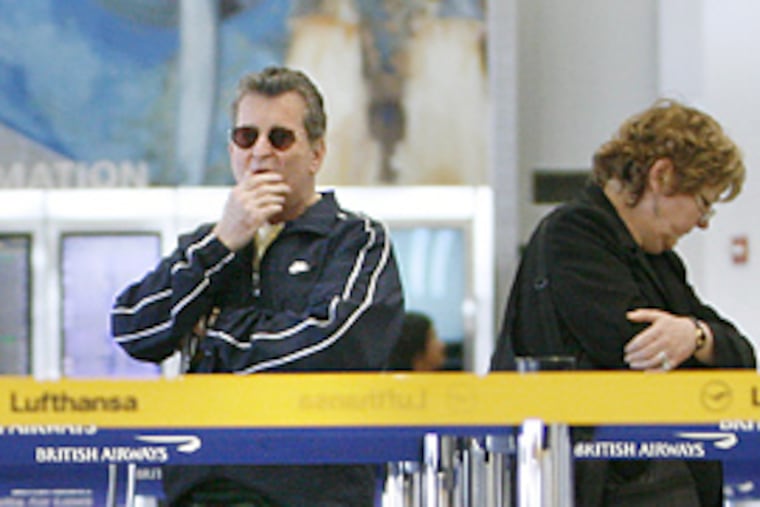
Neal Kushner, while waiting last week at Philadelphia International Airport to check in for his 11-day vacation to Italy with his wife, Yvonne, said he forked over $170 for 100 euros the week before.
"It hurt," said Kushner, 61, owner of a cable and wire wholesaling firm in Newtown. Kushner said overseas travel was something "we rarely ever do," so he did not think about the weak dollar when planning the trip.
As Mark Naples, a Center City media consultant who has canceled two business trips to Europe recently because of the costs, put it: "It's just crazy. If you're going to Milan, you're in a world of hurt."
The other side of the equation, of course, is that it is getting cheaper for Europeans, Canadians, Japanese and others to visit this country - something Philadelphia tourism officials are promoting. Some even jet over to do holiday shopping, a double savings.
The dollar has been sliding in value when exchanged for the euro for most of the last six years. But the decline has been particularly steep the last few months. An American traveler now needs about $1.60 to buy one euro, compared with $1.20 in mid-2005 and $1.35 a year ago. The U.S. dollar also buys fewer Canadian dollars, British pounds, Swiss francs and Japanese yen.
Travel agents who arrange trips for groups and individual leisure travelers to Europe each summer report a mixed reaction when clients realize that not only airfares are higher, but so, too, are all costs on the ground.
Round-trip coach fares this summer between Philadelphia and Paris are more than $1,300, 6 percent higher than last summer, according to www.farecast.com, an airline cost-forecasting Web site.
To Rome and back, the cost is a little less but still is about 5 percent higher. Airlines will have 159,000 available seats for sale in June on nonstop flights between Philadelphia International and Europe, compared with 113,000 in June 2003, primarily because of new routes offered by US Airways Group Inc., according to consultant OAG Back Aviation Solutions.
"The airfares to Italy, Eastern Europe and other points of interest, including Ireland and France, are just killing us," said Marvin Weber, owner of Marvelous Travel and Cruise Center in Plymouth Meeting. "The airfare has dampened the plans of many of my clients."
At MTS Travel in Ephrata, Pa., a specialist in arranging tours for churches and other nonprofit groups, president Jim Buddendorf said he learned about the dollar's decline on his own trip to Europe in December.
"It was frightening," he said. "When I got home and looked at my credit card statement, I couldn't believe what I was paying."
To cope, some groups on a budget have decided to put up their tour groups in less-luxurious hotels or cut the duration of the trip, Buddendorf said.
"We have longtime group leaders who have done it for years," he said. "When the prices for this year come back, they're shocked. . . . Right now the economy and the dollar has us very anxious. But to date, it's not as bad as I thought it would be."
Travel agents like Veronica Liadis, of Liadis Travel Ltd., of Newtown Square, may be having the best time right now. Her agency specializes in travel to Greece, and she has well-to-do clients who have recently booked Mediterranean cruises and elaborate tours that cost $30,000 and more per couple.
"The more budget-oriented people are going toward cruises," Liadis said, because the traveler knows in advance what meals and lodging are going to cost. "And 80 percent of those going are using frequent-flier points for the airfare," she added. "That's a couple thousand extra dollars they have to play with."
Kate Murphy, owner of Wings Uniglobe Travel in Blue Bell, an agent with a mix of business- and leisure-travel clients, said European river cruises were particularly popular this year. "Europe is doing quite well with us."
One such traveler, Jan Krzak, 65, a retired public works official from Reading, Pa., said he booked his flight to Austria and Danube River cruise in July, when the euro stood at $1.29. Now his main current expense will be souvenirs, which he said he only buys if he loves.
"I am an inspired buyer," Krzak said with a smile while waiting to check in at the airport last week.
Not everyone is unhappy with the dollar's fall. For Europeans visiting the United States and those such as the region's visitor-promotion agencies that try to get them here, life is not so bad when a cup of coffee costs $2 here and $4 there.
The Philadelphia Convention and Visitors Bureau, in particular, targets travelers like businessman Jens Deward, of Leipzig, Germany, who was with members of his family, gathering information about Philadelphia at the Independence Visitor Center last month.
"The big thing now is to come here to go shopping at Christmas," Deward said. "I'm planning to go to - what is it called, the King of Prussia mall? - and get some shopping done."
And then there are the Americans who canceled overseas trips. In Bucks County, hotels, restaurants and attractions are seeing more visitors from New York and other nearby regions, said Jerry Lepping, executive director of the Bucks County Conference and Visitors Bureau.
"We're getting a lot of people who may have gone overseas," he said, "but are deciding to stay closer to home."