New Jersey energy plan sees renewables, nukes
By 2020, solar panels could be commonplace in New Jersey, wind turbines should be spinning offshore, and new nuclear cooling towers might rise in Salem County.
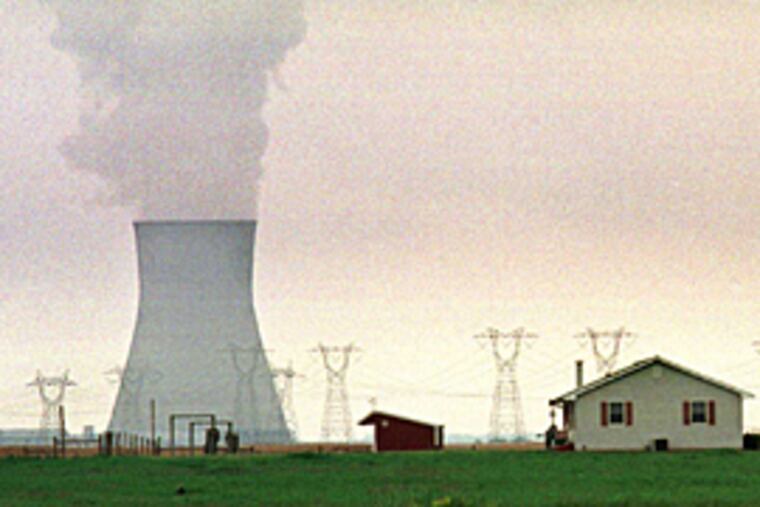
By 2020, solar panels could be commonplace in New Jersey, wind turbines should be spinning offshore, and new nuclear cooling towers might rise in Salem County.
That is the vision contained in the first draft of a state Energy Master Plan offered yesterday by Gov. Corzine.
New Jersey also should be using about 20 percent less electricity by then, even though demand is currently growing more than 1.5 percent per year, the plan concludes.
The plan was warmly embraced by industrial interests and criticized by environmentalists, who said it relied too heavily on traditional power plants.
Public Service Enterprise Group Inc., owner of the state's largest utility, also expressed support. "We think that the governor has his priorities straight and has covered the waterfront well," said Ed Selover, the company's executive vice president and general counsel.
Although it calls electric rates too high, the plan does not specifically propose direct steps to reduce them. But it expresses hope that more competition and less consumption will hold overall spending on electricity in check.
In a letter accompanying the plan, Corzine said that "a 'business as usual' energy policy risks enormous economic and environmental consequences."
Besides reducing overall consumption 20 percent, the plan calls for getting 22.5 percent of the state's energy from renewable sources such as solar and wind power, which do not emit greenhouse gases. The state now gets about 1.6 percent of its energy from such sources.
The plan also acknowledges that the state will continue to rely on electricity from traditional power plants. To that end, it calls for the construction of new nuclear and gas-fired generating stations. It dismisses coal-fired plants as offering "little promise of lower prices."
Though not a binding document, the plan offers varying agendas for legislation and regulation in support of its goals, Corzine spokeswoman Lilo Stainton said. It will be the subject of public hearings starting April 28.
The report says nuclear power - all but dismissed before the surge in oil prices and global-warming fears - should be considered because of its ability to generate tremendous amounts of electricity at relatively low cost without releasing greenhouse gases.
Although nuclear-power plants release no greenhouse gases, they do create large amounts of solid radioactive waste, which must be sealed and stored for thousands of years.
Even before the plan was released, PSEG had reported to shareholders that it was investigating the feasibility of adding a fourth reactor to its Salem and Hope Creek nuclear-generating stations in Salem County.
"One of the most important things in this plan is the recognition that even if all the efficiency, conservation and renewable-energy programs are a success, there will still be a . . . shortfall in the amount of energy necessary," said Steven Goldenberg, a Fox Rothschild L.L.P. lawyer who represents the New Jersey Large Energy Users Coalition. That group includes 25 of the state's biggest energy consumers.
Hal Bozarth, executive director of the Chemical Industry Council of New Jersey, called the plan a "bold vision."
"The chemical and pharmaceutical industries are very energy-intensive," Bozarth said. "They've done as much as they can to shave their demand; they've picked all the low-hanging fruit."
Bozarth and other industrialists said they hoped the final version of the plan would include a strong state power authority to facilitate and encourage the construction of new power-generating plants by companies that would compete with PSEG. Such competition, they hope, will lead to lower electricity rates in New Jersey, where industrial rates are much higher than the national average.
The draft released yesterday mentioned such an authority, but it was not specific about the power it would wield.
Environmental groups complained that the plan should have relied more on reducing consumption and using renewable-energy sources.
"New Jersey is at a historic crossroads," Dave Pringle, of the New Jersey Environmental Federation, said in a written statement issued by a coalition of environmental groups. "Governor Corzine is missing the opportunity to truly go green, drive the 21st-century economy, and rid ourselves of the 19th- and 20th-century technologies that saddle the state with so many environmental, public health and security problems."
Corzine's plan represents "a total failure of leadership," said Matt Elliott, clean-energy and global-warming advocate for Environment New Jersey.
"His plans to reduce energy demand and promote clean alternatives fall short of our state's potential, and he has failed to minimize our reliance on dirty and dangerous power plants."
Read the draft of the N.J. energy master plan (.pdf) via http://go.philly.com/ njenergy EndText