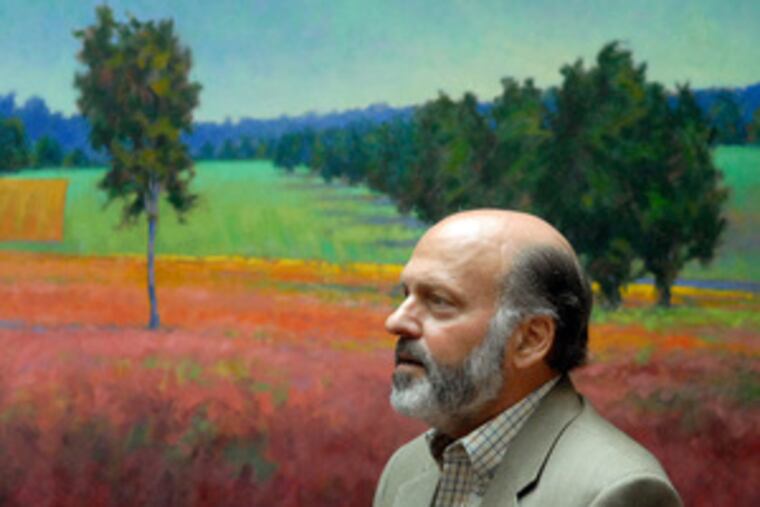
After 13 years as chief executive of Quaker Chemical Corp., Ronald J. Naples, 62, has decided to step down in October.
"I'm not using the 'r' word. I'm not going to retire," Naples said. "It's just time to move on. When you start to feel yourself in a warm bath, you figure maybe you'll start to shrivel, that it's time to step out and feel a little chilled . . . to do new things to stay energized."
Michael F. Barry, 50, now senior vice president for North America, has been named to succeed him.
On Naples' watch, the Conshohocken-based Quaker increased its sales 230 percent, to $545 million last year, and its market capitalization 300 percent. It has 1,500 employees worldwide, 120 of them in the corporate headquarters.
Naples also serves as board chairman at the University of the Arts and in numerous other civic roles. Over the years, he and his wife, Suzanne, have raised three children and taken in 15 foster children.
QUESTION: What are the key steps in being a global enterprise that, as your slogan, says, claims to be "delivering everywhere the best from anywhere"?
ANSWER: I think you begin with common purpose. People have to have a really powerful sense of common purpose - a sense that they're in this together, and really believe that they can produce more from a global integrated perspective than they can by operating individually and alone. . . .
We are now in, or have been in, virtually every large steel mill in the world. We learn stuff in China that we can use in Brazil the next day. We learn something in France that we can use in South America the next day. And so it's not just the knowledge in our research and development. It's the experience of being with a customer, solving a problem.
Q: What was the value of your West Point education and Army duty in Vietnam and Germany?
A: At West Point, you can't just focus on academics. You can't just focus on the sports. You can't just focus on the activities. You have leadership roles, and you have fellowship roles and learn to juggle a lot of things. You learn about commitment - to a mission, a purpose, to others. You can't hide at West Point. . . ..
There's a whole bunch of leadership that comes out of that experience and, of course, leading in combat later. If you want something that focuses the mind, nothing does that like combat. You learn a lot about yourself.
Q: What's the role of chief executive in making collaboration and respect happen across cultural borders?
A: I like to listen more than I talk. I like to try to let others shine, take initiative and lead. The more opportunities you give people to lead, the better they're going to be, the stronger the company's going to be.
You have to listen to the people closest to the action. They know what's going on, where the weak points are. They know where you can act now to make a difference.
A leader always has to decide when's the right time for long-term focus and when's the right time for short-term focus. You can't do both at the same time.
Q: When your customer is facing cost pressure, do you consider that your problem?
A: Absolutely. We can't ignore it when Baosteel in China or GM in United States, or whoever, has a tremendous amount of cost pressures in their own business. . . .
Competitive advantage is a pretty slippery thing. You can have it one day, but there are very few things in the world that a competitor can't match - usually pretty quickly. But it's very hard to match an organizational advantage, because it has a lot to do with the way people interact with each other.
Q: What was the key decision you made here?
A: Focusing on people, always on people . . . always finding the right person for the right job. The reality is, we can sit around and conceptualize strategies all day. But unless those strategies are in the hands of good people who want to do well, they'll fail.
Q: What's been the impact of post-Enron laws?
A: What I could have done six years ago in a hallway conversation now takes two committee meetings - and a bunch of money spent on a consultant - and a board meeting to figure out. There's a lot more form today. And some of it is good. But I think some of the Sarbanes-Oxley stuff has come down to form over substance.The purpose of fair disclosure was to make sure there weren't investors advantaged over other investors. But it's really had a counterintuitive effect, because you're so careful about what you say to who. . . . So, I'm not sure the quality of public information in companies has been improved.
Q: Some years ago, you redeveloped this site rather than move to a modern office building. How did that fit your strategy?
A: We were determined to try to recognize who we are. We're in industrial businesses, so we didn't need a marble and high-tech glass structure. We wanted to keep a link with our past, which dates back to 1918, because our character and how we did business and our values flowed from that and are an important part of the company we are.
Q: What have you learned from your 15 foster children?
A: Making a difference one at a time can be a powerful difference for young people. It was a powerful difference for us, because we got to have an emotional involvement with the kids we were helping that would never have happened if we were just helping organizationally.
It was a tremendous learning vehicle for our children. I believe it gave them a window on the world. My wife and I could have preached to them until the cows come home, and it would have gone in one ear and out the other.
They would have never viscerally have understood the kinds of challenges other kids face and what it is about their lives that was an advantage that they could build on. . . . When you devote yourself to this personally, as opposed to just impersonally, it's a powerful influence on your own life in terms of believing in what others can do.