Sensible Home: Window awnings can cut your home's energy use
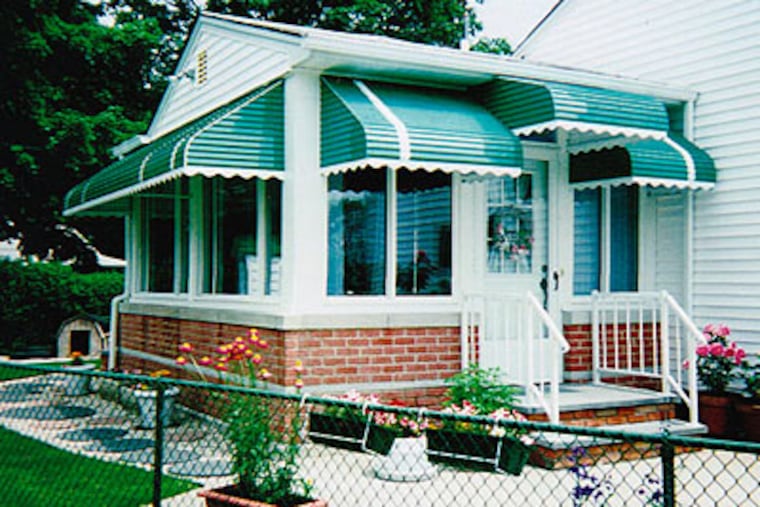
Adjustable versions allow you to tailor the shade to the conditions.
Question:
I have always liked the appearance of window awnings. The salesman told me installing them can also save a lot of energy.
Do they really save much? Which awning choices are best?
- William B.
Answer:
Installing window awnings can significantly reduce the amount of electricity you use for summertime cooling - for fans and air conditioning, that is. This reduction results because the awnings prevent direct radiant heat from the sun from passing through the windows.
Studies by the University of Minnesota found that installing window awnings reduced cooling-energy needs by 21 percent in Phoenix, 17 percent in St. Louis and 24 percent in Boston.
Another energy-saving advantage of awnings is greatest during the hottest hours of the afternoon, when the sun is most intense: They help reduce peak loads for electrical utilities, so there is less chance of brownouts and other problems associated with excessive demand.
Many window-awning options are available. The first decision to make: Do you want fixed awnings or adjustable ones? They are equally effective. The advantage of adjustable awnings is that the amount of shade they offer can be changed throughout the day, and from season to season.
Adjustable fabric awnings offer better protection from severe weather because some can be lowered until they are almost flat over a window opening. They can also be raised to almost completely expose the window glass. Maximum projection from the wall for an adjustable aluminum awning is fixed by its frame and its down arm length.
Sideless awning designs, called Venetian awnings, are effective for true south-facing windows because the sun's most intense rays come from nearly directly overhead. Actually, just a relatively short, flat board over a window, such as a large roof overhang, will be effective at blocking the sun.
If you also need to block the late afternoon sun at those south-facing windows, install hood-style awnings with sides. For casement windows, hip-style awnings provide clearance for the window sash to swing open outward for natural ventilation.
Proper sizing (projection length from the house wall) of awnings is important both for blocking the summer sun and for allowing the winter sun to shine through the windows for free, passive solar heating. This is particularly true if you install fixed awnings, because their shading levels cannot be changed.
If you're mathematically inclined, you can calculate the size of the awnings needed for the windows in your house, using the latitude angle for your area to determine how high the sun is in the sky and its angle of incidence on your windows. (The sun's height also varies throughout the day and by season.)
Or, you can just make some test awnings with cardboard to determine the proper size.
The following companies offer window/door awnings:
Awntech, 800-200-5997,
» READ MORE: http://www.awntech.com
.
Craft-Bilt, 800-422-8577,
» READ MORE: http://www.craftbilt.com
.
Durasol Awnings, 888-387-2765,
» READ MORE: http://www.durasol.com
.
Eastern Awning, 800-445-4142,
» READ MORE: http://www.easternawning.com
.
Try-Tech Industries, 866-337-2381,
» READ MORE: http://www.try-tech.com
.
Q:
My house is about 100 years old, and there have been many additions over the years. It is inefficient, and it needs an energy audit.
Whom can I find to do one who is not just trying to sell me products?
- Janet W.
A:
You will need to hire someone who is very experienced in the auditing business. Your house, with all its additions, probably consists of many different types of construction materials, insulation, windows, etc.
Check the Yellow Pages under "energy audits." Ask the companies you contact whether they sell products or do the improvement work themselves. If they don't, they won't have a profit motive in recommending excessive improvements.
Also, check with local engineering colleges.