Casino investor goes west
The SugarHouse principal has taken control of a Pittsburgh gaming hall under construction.
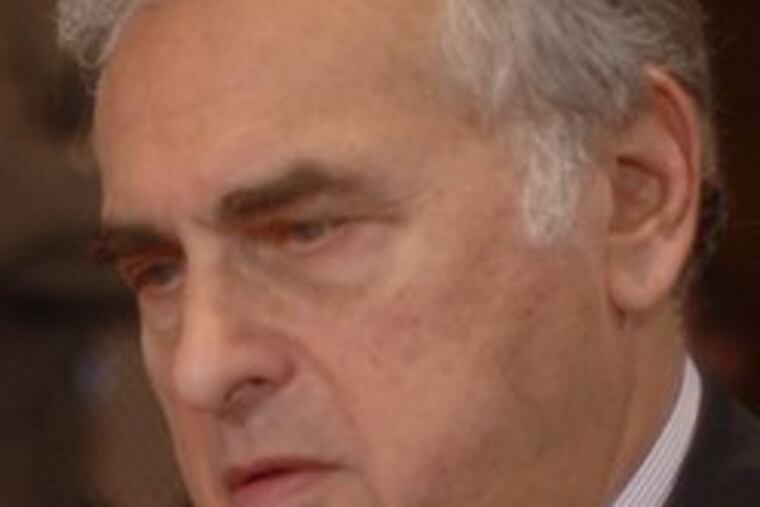
The cash-strapped developer of Pittsburgh's slots casino yesterday signed over control of the project to a firm led by the primary investor in Philadelphia's stalled SugarHouse Casino.
Gambling operator Don Barden, who had missed payments in connection with his $780 million Pittsburgh riverfront casino, the Majestic Star, agreed to partner with Chicago billionaire Neil G. Bluhm and Bluhm's Walton Street Capital L.L.C. to complete the project.
The deal, in which Walton Street will infuse $120 million into the Pittsburgh casino, now goes before the Pennsylvania Gaming Control Board for review. If approved, it would give majority ownership - 75 percent - of the Pittsburgh casino to Walton Street, and the remaining 25 percent to Barden.
As the primary investor also in the $700 million SugarHouse Casino proposed for Philadelphia, Bluhm would have a major hand in gambling houses on both ends of the state.
Yesterday's agreement between Barden, Bluhm and Walton Street capped more than two weeks of intense negotiations. Barden worked the deal from his gambling company's base in Detroit, while Bluhm was in Chicago, his hometown and where Walton Street is based.
It was Barden, beset by financial difficulties, including defaulting on a loan and missing a payment to the contractor, Keating Building Corp., on the Pittsburgh project, who approached Bluhm and Walton Street June 30.
Keating Building Corp. is run by Daniel J. Keating, who is also a major investor on the proposed SugarHouse Casino for Philadelphia.
Walton Street, formed by Bluhm and former senior executives of JMB Realty Corp. in 1994, is a private equity fund that has raised more than $5 billion and has about $12 billion in assets.
"I was proud of the fact I was able to bring the [Pittsburgh] project this far," Barden said earlier this week. He had steered the project for the past year and a half since winning the slots license in December 2006. "I'm obviously disappointed I could not get it over the one-yard line.
"But I'm enough of a realist to know you can't always get everything you want in life," he said. "I'm glad the dream I had for the Pittsburgh casino will come true, but under a different ownership."
Barden had survived numerous court challenges by local groups with gripes about the Magestic Star. Last year, the two losing bidders, Isle of Capri Casinos Inc. and a partnership comprised of Harrah's Entertainment Inc. and the developer of the Station Square complex on the Pittsburgh riverfront, appealed the gaming board's decision to award him Pittsburgh's sole slots license. The Pennsylvania Supreme Court affirmed the board's decision.
For Bluhm, securing the Pittsburgh casino comes at a time when Philadelphia and state politicians are mounting pressure to relocate the SugarHouse Casino, and Foxwoods Philadelphia Casino, the other city casino planned for the riverfront.
Under terms of yesterday's deal, Barden would have a seat on the board of directors of the newly formed company that will complete the Pittsburgh casino.
The deal has its detractors.
On Monday, State Sens. Jane Clare Orie (R., Allegheny) and Jim Ferlo (D., Allegheny), whose district includes Pittsburgh, called on the state gaming board to make public all documents related to the change in ownership, business structure, and financing of the Pittsburgh casino.
They also requested that the board reopen the licensing application process.
"The request by PITG seeks to substitute a failed licensee [Barden] with its own choice for an entirely new licensee, in contravention of the law," Orie said in a statement.
Gaming board spokeswoman Mary DiGiacomo-Colins said the senators' concerns would be made part of the record when the deal is reviewed in a hearing.
"There is going to be a change of control that we will have to look at," DiGiacomo-Colins said yesterday.
She described Barden, who in recent months had great difficulty in securing financing, of "being in the wrong place, and the market changing rapidly on him."
"The problems here are the result of a very tight credit market that is getting tighter every day," she said. "It's reflective of the financial and economic issues facing this country overall."