Winging It: A 'feud' goes public, and news shows miss the point
Being a 21st-century American, I watch television, and often find news networks do informative and accurate reporting on the airlines, a subject I know something about. But I was disappointed Wednesday night to see two network programs, ABC Evening News and CNN's Larry King Live, lend credibility to some dubious accusations made by US Airways pilots.
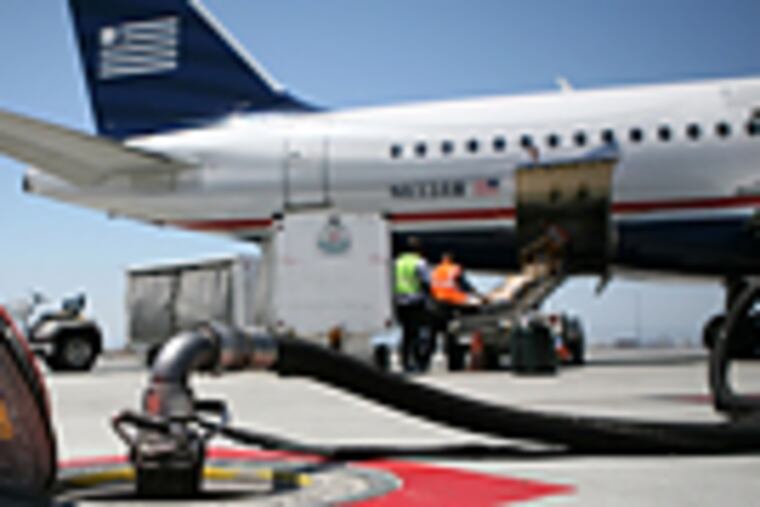
Being a 21st-century American, I watch television, and often find news networks do informative and accurate reporting on the airlines, a subject I know something about. But I was disappointed Wednesday night to see two network programs,
ABC Evening News
and CNN's
Larry King Live
, lend credibility to some dubious accusations made by US Airways pilots.
The US Airline Pilots Association, the union that recently won the right to represent more than 5,000 US Airways pilots, contended in a news release and in a newspaper ad that the company was trying to pressure captains over how much fuel their jets carry on long, over-the-ocean flights. As the pilots noted in their release, fuel loads are "considered a critical safety determination that should be left to the captain's determination."
Needless to say, fuel costs are the airlines' biggest worry now, rising so much that they are threatening some carriers' very existence. Fuel adds weight to airplanes, meaning a flight costs more to operate if it's carrying a heavier load than it needs to operate safely.
The pilots' union said US Airways had called in some of its "most senior captains" (in fact, only the most senior captains fly the big transatlantic jets) for retraining on how much fuel they should be using. The labor group considered the training requirement a disciplinary issue that could lead to a pilot's losing his license, and it complained about it to the Federal Aviation Administration. I posted a news story giving the pilots' opinions and a brief response from US Airways on the "Winging It" blog (www.philly.com/philly/blogs/wingingit/) Thursday morning.
Later that day, I received a US Airways message to employees that put the pilots' complaints into perspective by adding information about its aircraft-fueling practices.
Adding credibility to US Airways' position, the union that represents its flight dispatchers called the pilots' claims "nothing more than hot air." Dispatchers, who, like pilots, are licensed by the FAA, are a critical but unsung part of flight planning. They share responsibility with the captain in deciding how much fuel to carry.
"I can say unequivocally that there has been absolutely no pressure on the dispatchers at US Airways to reduce the fuel loads," Don Wright, president of the dispatchers' Transport Workers Union local, said in a statement.
In US Airways' message, the company said that while the FAA requires all airlines' flights to arrive with 45 minutes of fuel left, "we use 60 minutes of arrival fuel as a minimum and currently average 100 minutes in actual operation." The airline said that it found that the eight pilots called in for a meeting with the training department were "adding fuel to their dispatched fuel loads much more frequently than their peers."
To the pilots, being called on the training department carpet feels like intimidation. To the company, as its message said, it was "entirely appropriate" to try to understand if the eight captains were experiencing something different from other pilots.
Another question is whether this isn't a part of the long-running labor dispute between US Airways and its pilots. It's putting it mildly to say many pilots are exasperated that the company and the union can't reach an agreement on a new contract, almost three years after the America West merger.
As airlines try to save on fuel costs, there have been other reports of transatlantic jets of U.S. carriers landing with less than an adequate cushion of fuel. But none of the reports I know of concerned US Airways flights.
More than an airline story, this is a tale of how the media can scare travelers by implying carriers are so desperate to cut costs that they operate in an unsafe way. Despite how dramatic the Larry King Live topic seemed when it started, the show wound up in a shoutfest between those who think the industry is run by bad people who are that desperate, and others - including pilots - who said there's no evidence of that.
US Airways chief executive Doug Parker, by the way, was cast in a bad light by King, who said he had been invited to appear but canceled just two hours before the show started.
Parker, speaking to Inquirer writers and editors on Friday, said he canceled because of a last-minute conflict and because CNN told him the show was supposed to be only about the airlines' fuel-cost problem. Parker said he thought another guest, Jim May of the Air Transport Association, could handle that topic, and he didn't know his airline's dispute with the pilots would even be discussed.
So is this something a US Airways customer should lose sleep over, especially those from the Philadelphia area, who make up a large chunk of its transatlantic passengers? I say you should worry more about oil prices and whether airlines as we know them are going to survive.
For more on what Doug Parker had to say about US Airways and Philadelphia, read airline reporter Linda Loyd's story in yesterday's Inquirer.