Vytorin report hits Merck, Schering
European researchers yesterday reported disappointing results for Vytorin, a costly, heavily advertised cholesterol drug, when it came to treating heart-valve disease.
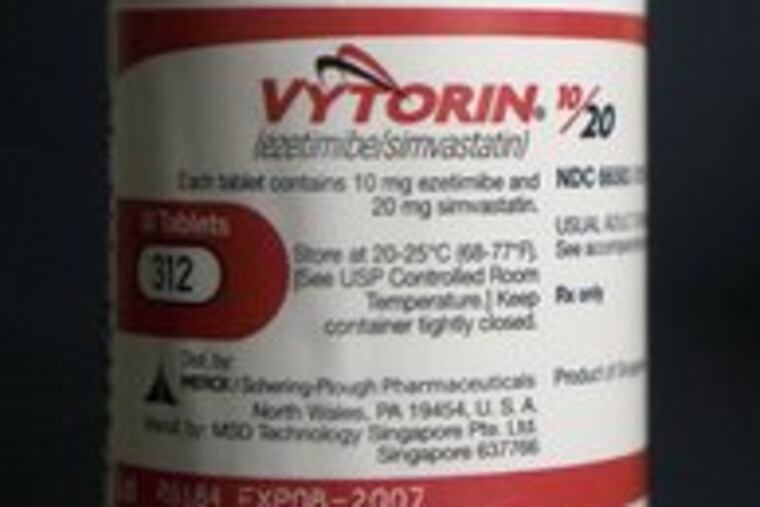
European researchers yesterday reported disappointing results for Vytorin, a costly, heavily advertised cholesterol drug, when it came to treating heart-valve disease.
Shares of the pharmaceutical companies that market the drug together - Merck & Co. Inc. and Schering-Plough Corp. - fell after a preliminary analysis of study results was released.
The study found Vytorin did not prevent complications from aortic stenosis, a condition in which blood-flow to the heart is blocked. The study also found a higher risk of cancer in patients taking Vytorin than in those getting a placebo: 9 percent vs. 7 percent. Other researchers, who looked at a broader sample of data, said the cancer finding likely was an anomaly.
Vytorin did reduce cholesterol and evidence of heart disease in blood vessels.
Because of the study results, which were made public early in the afternoon, Merck and Schering-Plough took the unusual step of rescheduling the release of their second-quarter financial reports until after markets closed, giving them time to put their spin on the data.
Even with the extra time, Merck said it was still assessing the impact of the study, known as SEAS.
In a conference call with investors after the market closed, Fred Hassan, Schering-Plough's chairman and chief executive, referred to the study as a test of a "new use" for Vytorin.
He said it confirmed results from other studies that cholesterol-lowering drugs did not reduce progression of aortic stenosis.
Asked later about the larger number of Vytorin patients with cancer, Hassan said that bioscience was "unpredictable" and that scientists sometimes get "deviant observations."
He pointed to Sir Richard Peto, an Oxford University statistician and cancer expert who analyzed data from the SEAS trial and two other ongoing Vytorin studies. During a teleconference, Peto said there was no evidence of higher risk when the data were combined.
Shares of Merck fell $2.34, or 6 percent, to $35.33. Schering-Plough shares fell nearly 12 percent, to $18.95 from $21.44.
Vytorin is a combination of two drugs, Merck's Zocor, which is available individually in generic form, and Schering-Plough's Zetia. Vytorin's list price is $100 for a month's supply.
Another study in January showed that Vytorin was no better at reducing plaque buildup in neck arteries than Zocor alone. Vytorin prescriptions fell 28 percent from January to June.
The study released yesterday was led by Terje Pedersen of Ulleval University Hospital in Oslo and followed 1,873 patients.
According to the Associated Press, the study found that Vytorin was no better than placebo at lowering the risk of major cardiovascular events in patients with aortic stenosis. It also failed to stave off the need for valve-replacement surgery, hospitalization because of heart failure, and heart-related death. It did reduce arterial plaque buildup and cholesterol.
Les Funtleyder, a health-care strategist with Miller Tabak & Co., said that, proportionately, Vytorin was a more important drug for Schering-Plough than for Merck, but that it was a "growth driver" for Merck as well.
"The market may be overreacting, but these are important drugs, and there are questions being raised about their efficacy and safety," he said.
Questions about Vytorin's cost-effectiveness have been under discussion for months, he said. But the specter of cancer creates a fresh worry for the companies. Most people, Funtleyder said, "stop listening after they hear the word cancer."
Timothy Anderson, a doctor and pharmaceuticals equity analyst at Sanford C. Bernstein & Co. L.L.C., in a written report labeled the cancer finding a "red herring" and said the market reaction to the study "appears to be overdone."
In their quarterly revenue and earnings reports, Merck was up, and Schering-Plough was down.
At Merck, net income for the second quarter of 2008 was up to $1.77 billion, or 82 cents per share, from $1.68 billion last year, a 5 percent increase.
Schering-Plough's second-quarter profit fell to $398 million, 24 cents per share, from $517 million, 34 cents per share during the second quarter of 2007. That's a drop of 23 percent.