Common Market distributes local farmers' produce
In their 27 years of farming, Andy and Dawn Buzby have taken all the usual routes to selling the produce from their 153-acre Salem County farm.
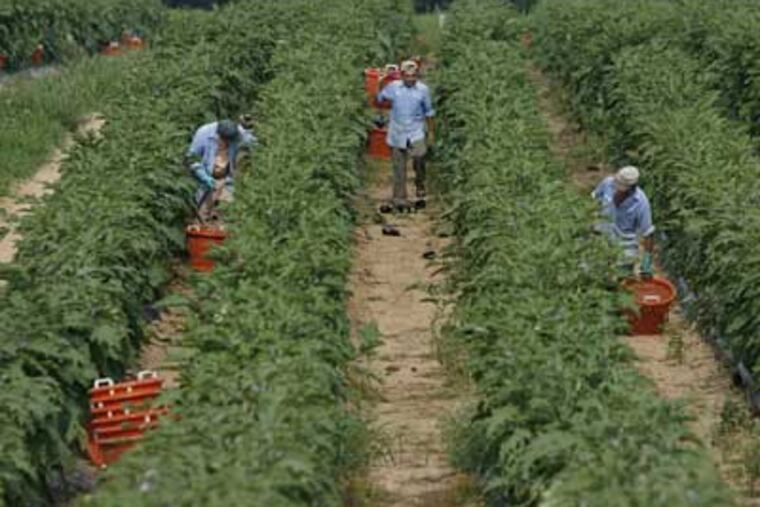
In their 27 years of farming, Andy and Dawn Buzby have taken all the usual routes to selling the produce from their 153-acre Salem County farm.
They have sold to distributors in Vineland, N.J., and Philadelphia, directly to small grocers, and to consumers at farmers' markets.
But the Buzbys had no easy way to sell to a potentially huge market right in their backyard: institutions, such as hospitals and universities.
That changed last month when the Common Market, a nonprofit distributor of fruits and vegetables from farms in the region, started operating.
"I'm just very excited about our product staying local," Dawn Buzby said. "It's fresher. They get the best quality."
Farmers and food-service managers said the Common Market could play an important role in continuing the momentum gained by local-food advocates in recent years.
Many high-end restaurants are big buyers of local produce sold at a premium, and farmers' markets are thriving, but the overall impact on the food industry has been slight because it is hard to hook up local farms with local institutions that buy much more than a typical household does.
"The Common Market is a new frontier for locally grown because it's targeting the institutions and some of the other things that just haven't been as convenient," said Lancaster County farmer Steve Groff, who is selling tomatoes and raspberries through the Common Market.
"I can't go to Philadelphia with my truck and make 15 stops with two or three items that I might grow," Groff said.
Produce buyers at Thomas Jefferson University Hospital in Philadelphia and Cooper University Hospital in Camden said they were thrilled with their weekly deliveries of peaches, green beans, cucumbers and other items.
The hospital food purchasers said buying locally was part of their broader effort to serve healthier food.
Mary Grant, assistant director for production services at Jefferson, said she tried last year to get local produce through her main food distributor. "It was a trial for them and a trial for us," she said.
Dealing with the Common Market has taken all that frustration away, Grant said, and to her relief as a purchaser on a budget, "pricing is extremely comparable to the big guys." She has placed $1,000 orders with the Common Market.
At Cooper in Camden, the director of food and nutrition, Fran Cassidy, has been ordering for the hospital cafeteria. She said the quality of the fresh-picked produce has been great and has helped educate consumers. "We had to tell people 'This is really what a fresh local tomato looks like.' "
In Common Market's fifth week of operation, sales were better than expected, reaching $4,000 for today's deliveries to nine customers, said general manager James DeMarsh.
The local-food advocates, who have been planning the Common Market for more than three years, projected first-year sales of $137,000. It rents space in the Share Food Program warehouse on Hunting Park Avenue.
The distributor received a $100,000 planning grant from Pennsylvania in 2005. The state and the Claneil Foundation in Plymouth Meeting each provided $40,000 to cover a projected operating deficit for the first year, and the Reinvestment Fund, a Philadelphia nonprofit investment group, lent $100,000 to pay farmers before Common Market collected from its buyers, said Haile Johnston, one of the organizers.
But the goal is to be self-sustaining by the end of the second year, said DeMarsh, 27, who came here in May from the Tuscarora Organic Growers Cooperative in Fulton County, Pa.
Before that, DeMarsh, who grew up in a Boston suburb, worked for five years at Ward's Berry Farm in Massachusetts. That experience has enabled him to talk to growers with an understanding that is almost unheard of in distribution, said Michael Rozyne, founder and codirector of Red Tomato Inc., a Canton, Mass., distributor of local produce from Ward's and other farms in New England, New York and Pennsylvania. "He paid his dues," Rozyne said.
DeMarsh said he missed farming, but was convinced that he has an important role to play. "I want to prove to our growers that this idea makes sense."
Dawn Buzby, the Salem County farmer, is on the board of directors. She said her oldest son, Eric, came back to the farm after college because he said he wanted his children to experience what he did growing up.
"The Common Market," Dawn Buzby said, "is part of that future, I think."