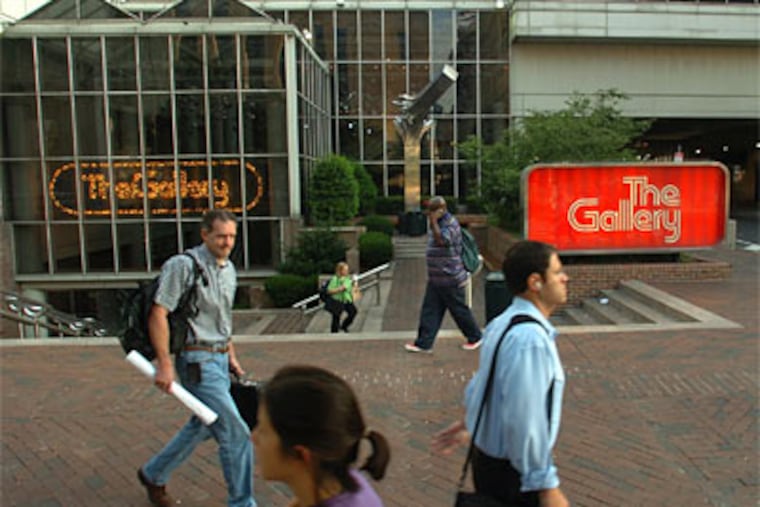
For a half-century, Philadelphia has sought the magic formula to make east Market Street a lure for high-end spenders and restore it as a shopping jewel.
Three decades ago, The Gallery was supposed to do the trick.
Now comes the latest effort - a multimillion-dollar casino. And where else, it turns out, but at The Gallery itself, the nation's first enclosed urban shopping mall that never quite lived up to high expectations.
The surprise announcement Wednesday that Foxwoods Casino developers may place their gaming hall in what opened 31 years ago as the nation's first enclosed urban shopping mall has raised the prospect that an attraction other than retail, in the core of resurgent Center City, yet could revive the whole district.
"I think the casino in The Gallery is something that would be seen as a big sort of demand generator and kind of impetus," said Stephen Mullin, former city finance director and commerce director under Mayor Ed Rendell.
Retail long has been the core catalyst promoted by planners, developers and public officials seeking to erase Market Street's post-World War II reputation as a "dead zone" between City Hall and Philadelphia's historic district.
But despite valiant ventures, retail alone has been unable to reinvigorate this once-majestic boulevard of department stores. One big problem has been the perception that those who shop at Market East simply aren't rich enough to draw in big-bucks businesses.
This fear has helped foil several major projects over the last decade, even as residential and commercial development flowered only blocks away and Center City had a comeback.
The perception of Market East shoppers is a deal killer because it makes it hard for developers to attract the high-end retail tenants that help finance costly and unsubsidized redevelopments, officials say. As a result, revitalization has stalled.
"Quite frankly, I am baffled that it hasn't happened," said James Cuorato, who worked on the project teams that developed The Gallery complex in the 1970s and '80s and who later twice was Philadelphia commerce director.
Where retail is concerned, he said, tenant leases have been make-or-break.
"If the developers can't sign the tenants," said Cuorato, currently an executive with Brandywine Realty Trust, "you don't have a project."
On Market East, big-money tenants have been hard to come by, especially as the department stores that once dominated the avenue have emptied out, leaving behind prime but costly parcels to redevelop.
The squeamishness over Market East drawing poorer shoppers helped thwart an effort in 1999 to land a luxury Nordstrom department store on a massive parcel of low-slung storefronts known as the Girard Estate block across from The Gallery at 11th and Market Streets, according to officials involved.
The perception also played a role in the unraveling of a splashy entertainment-and-retail complex proposal known as DisneyQuest that fell apart in 2004, officials said. That targeted the site of what had been a Gimbel's department store. Today it is a surface parking lot at Eighth and Market Streets.
Both efforts were promoted by one of the key players now pushing for a casino on Market Street: retail developer Ronald Rubin, who is a major Foxwoods investor, too.
Rubin also is chairman and chief executive officer of Pennsylvania Real Estate Investment Trust, which bought The Gallery in 2003 and owns 38 malls and 13 shopping centers in the Mid-Atlantic including Cherry Hill, Willow Grove and Plymouth Meeting.
Both failed initiatives - DisneyQuest and Nordstrom - would have flanked the three-block stretch of Market Street that is home to The Gallery at Market East, owned by PREIT.
PREIT officials said they hoped any casino project at The Gallery would create a greater mix of retail tenants and customers.
They also said they believed the market was more attractive for retailers today than a decade ago.
"A couple of things have happened," said PREIT president Joseph Coradino, who was involved with Nordstrom and DisneyQuest and is now working on elements of the casino plan.
"The Constitution Center opened. The Convention Center is expanding. You've got 90,000 new residents in downtown Philadelphia, and all of a sudden you've got a demographic profile that is very positive," Coradino said.
A center of commerce in colonial times, Market Street in the 19th century became home to some of the grandest downtown department stores. It thrived as the region's shopping nucleus until suburbanization took hold after World War II and took the glamour - and shoppers - out of Center City retail.
The Rouse Co. of Maryland, in partnership with the city's Redevelopment Authority, built The Gallery concept on an urban renewal zone with federal subsidies, which were plentiful in the 1970s.
The hope for the Gallery One (opened 1977) and Gallery Two (1984) was they would glitz up three blocks of Market Street between Eighth and 11th and attract more affluent suburban commuters.
They were built strong enough to hold office towers on top, if desired. The whole development sits atop a rail hub where two of the city's subway lines and suburban rail lines largely intersect in a thicket of underground tracks and pedestrian concourses. A commuter extension between Market East and the suburban lines at 16th Street was built, in part, to help make this happen.
Sales at the Gallery One initially were a success. But in a few years, the mall became a target of protesters angry at the dearth of African American-owned stores inside.
"Those kinds of disturbances early in its history hurt its competitiveness in the suburban market," said Greg Heller, an urban planner who is writing a biography about legendary Philadelphia planner Ed Bacon, whose vision helped promote Market East development.
When Gallery Two opened, a survey found that 75 percent of all shoppers at the Center City shopping mall were city residents - not suburban.
In the late 1980s, the skyscraper frenzy that broke the William-Penn-hat barrier on Market Street west of City Hall ignited interest to build tall along Market East, said Mullin, the former city finance director who now works in the private sector.
"If the real estate crash hadn't come exactly when it came, there probably would have been two or three more skyscrapers over there," Mullin said.
During the 1990s, much private-sector development came to a halt, and Market East took a hit while public subsidies were funneled to the nearby Convention Center, he said.
It wasn't until PREIT came along a decade ago that several big projects were reintroduced.
With Nordstrom, PREIT tried to go all retail and upscale. When that failed, in part due to customer demographics and absence of public subsidies, Rubin's company floated DisneyQuest - but with a mixed use that would have included office towers. It ultimately failed after Disney scaled back its plans, but the retail equation didn't help, either.
"You couldn't make the economics work with just the retail tenants," Coradino said of DisneyQuest, "because the land costs were too high."
Jonathan D. Miniman, a senior analyst who studies PREIT for ING Clarion Real Estate Securities, said Nordstrom likely was offering to put up relatively little money in return for taking on the risk of locating on an unproven strip with lower-income shoppers - a longstanding problem for The Gallery and many urban retailers, he said.
The only way PREIT could develop the Nordstrom site and turn a profit was with a public subsidy at the front end of as much as $100 million, Mullin said.
"There was no way that the city or the state had that kind of dough there," Mullin said.
Several years later on the DisneyQuest project, retail tenants again were hard to land because of Market East's reputation, for one, but also because a separate developer was simultaneously courting some of the same retailers for redevelopment at Penn's Landing, said Cuorato, who was then in charge of the Penn's Landing Corp.
The retailers, trying to strike the best deal, played the developers off each other. Ultimately both projects fell through.
Now the casino proposal is stirring ideas and interest anew. Coradino said a new master plan was being drafted. The owner of the Girard block, SSH Real Estate, is taking part, said its co-partner Peter Soens.
While details on the casino itself are scarce, many people say gambling with some combination of retail, hotel and office space on top of a major transit hub may finally provide the right mix.
"It is a very centrally located area because of the mass transportation," Miniman said. "You just need a reason to get the higher income people to come down there."