Heating-oil price swings can hurt dealers, too
If you want evidence that Wall Street's wild ride is causing vertigo on Main Street, look no further than home-heating-oil prices.
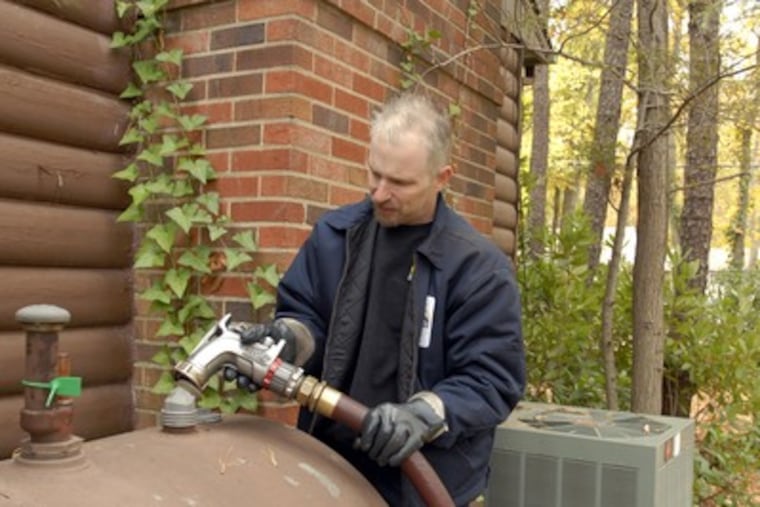
If you want evidence that Wall Street's wild ride is causing vertigo on Main Street, look no further than home-heating-oil prices.
Two months ago, Philadelphia-area customers who locked in prices for the winter agreed to pay as much as $5 a gallon.
Last week, area residents who gambled on paying market prices could buy heating oil from some dealers for less than half that price, and prices in the $2.60 to $2.90 range were common.
Fuel-oil dealers, usually small businesses that serve several thousand households, may not consider themselves players in the global financial markets. But lately, they have been taking as much heat as a stockbroker making margin calls.
Dave Harris, president of Harris Comfort Inc. in Bristol, says he understands that customers may feel burned if they agreed to pay up to $4.99 a gallon in July or August under a "price protection." Still, he does not like the names he's been called.
"Some of them I can't repeat," said Harris, who has worked 55 years in a business his grandfather founded. "People think we're taking advantage of them."
Fuel-oil dealers say that, to the contrary, they are stuck in the middle. They can't afford to offer fixed-price or capped-price plans unless they make deals that limit their own risks - either by locking in the prices they pay to their own suppliers, or buying third-party insurance against unexpected shifts.
The result is that they, too, are hamstrung as the market shifts around them.
On Friday, Bob Harriett, co-owner of Harriett's Oil Service in Medford was offering market-price oil to customers at $2.92 per gallon - a bargain compared with the $4.96 a gallon he offered this summer to customers who agreed to prepay.
Back then, some customers understandably saw value in locking in, even at such high prices. Crude-oil costs had risen to historic levels - spot prices for West Texas Intermediate topped $145 a barrel in mid-July, twice the price a year earlier. Like worried gas-station owners, some heating-oil dealers thought their product could rise to $6 or $7 a gallon.
But in the last two months, alongside the freeze in credit, the meltdown of such Wall Street pillars as Lehman Brothers and Bear Stearns, and the collapse of the Dow, the bottom fell out of the oil market. On Thursday, West Texas Intermediate closed at $65.96, down more than 54 percent from its July peak.
Not everybody agrees on the reason for the dramatic market swings, or what they portend.
Along with some analysts, fuel-oil dealers and their industry groups blame speculators, especially hedge funds, for pushing oil prices unsustainably high. But there is disagreement on how much of the price rise may have been fueled by a speculative bubble, or when and where prices will settle - especially if fears of a demand-depressing global recession come true.
"Prices right now are where we expected them to be. There was no reason for the prices to be where they were this summer. It was 99.9 percent speculation," said Roy Patterson, executive vice president of the Delaware Valley Fuel Dealers Association.
Mary Novak, an energy analyst for IHS Global Insight Inc., estimates that speculation added $20 to $25 per barrel to oil prices at their peak this summer.
"We were saying at the time that we thought that a price of $110 to $120 could be supported if we could avoid a recession," Novak said. Now her firm's models suggest that prices could fall into the $50-$60 range before beginning to climb, along with demand, in 2009.
Brian L. Milne, editor of DTN Refined Fuels, which monitors wholesale markets for companies in the industry, said dumping of oil-futures contracts by hedge funds "really accelerated the downturn. They just needed cash. A lot of these hedge funds had to just sell, sell, sell, no matter what the market was doing."
With conservation and recession both pushing down demand, and with the U.S. dollar remaining strong, Milne expects crude oil to stabilize around $70 to $80 a barrel in the months ahead, though he also said he also expected that "the market's going to remain volatile."
Other analysts downplay the role of speculators.
"Demand and expectations of demand, which drives speculation, are all part of the mix," said Janet Peace, vice president of markets and business strategy at the Pew Center on Global Climate Change.
"People like to blame speculators, but it's not just speculation driving the markets, it is demand," Peace said. "That's why most people think that when the economy turns around, the price of energy will go back up."
To heating-oil dealers and their customers, volatility itself is a major pain. Even some who stand to benefit from the recent drop in prices, such as customers who paid for a capped price rather than a fixed price, have to pay for the market's uncertainty.
Price caps protect oil users two ways. If market prices rise, they don't pay more than the capped price - $4.96 a gallon this year from Harriett's Oil Service, for instance, plus a fee of $250 or more for the cap, depending on usage. But if prices fall, they get the lower rate.
Still, that insurance comes at a price, too, and volatility has driven it higher.
Angus Energy, a Fort Lauderdale company that sells risk-management services to fuel-oil dealers, said the price a dealer paid this summer to insure a price cap peaked at about 54 cents a gallon in July and August.
"Volatility is what causes the premium to spike up so high," said George Wilson, a partner at Angus. Wilson said that just a few years ago, the premium for a capped price was typically less than 5 cents per gallon.
Wilson said the last two years had offered a lesson in the risks of volatility for fuel-oil dealers and their customers.
"Last winter, fixed prices were in the $2.50 to $3 range, and by the end of the winter, prices were up 50 cents. Everybody was happy," Wilson said. "They said, 'Prices went up, and now I saved a dollar a gallon on my heating oil.' "
But this year, with prices down so dramatically, "now the consumer is fit to be tied."
Bob Harriett said he was glad, in hindsight, that most of his company's 4,000 customers elected not to lock in or cap their prices this year.
"We try to give good advice, but we can't tell the future," he said. "Our plight is that we're no longer just in the heating-oil delivery business. We're now commodities traders."