Wading through the morass
With the nation knee-deep in a financial fiasco, here are the major economic and regulatory issues the new president will be dealing with his first term.
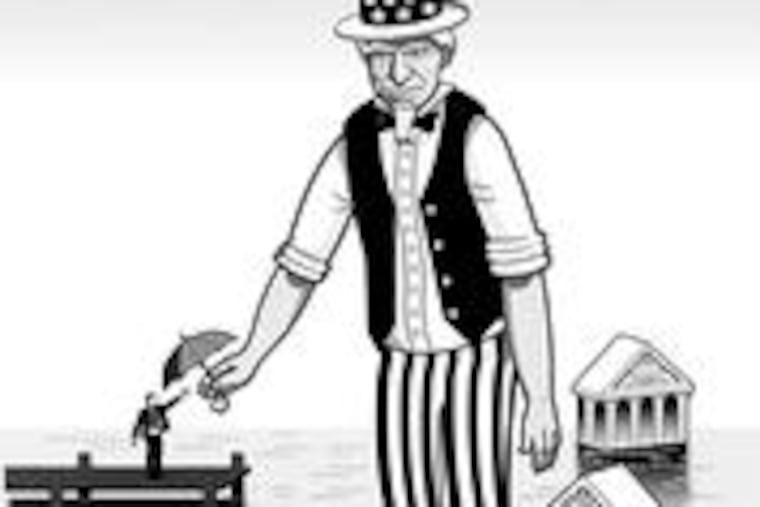
Barack Obama's campaign victory may have been the most arduous in history, but it will pale in comparison to fixing an economy spiraling deeper by the day.
"I do not underestimate the enormity of the task that lies ahead," Obama said Friday after a meeting in Chicago with economic advisers.
Last week brought a cascade of bad economic news. Auto sales plummeted in October. General Motors Corp. said it might not have enough cash to finish the year. Friday's employment report showed that, over the last three months, the number of unemployed climbed 1.3 million to more than 10 million.
Even so, for all the assertions that these are the most dangerous economic times since the Great Depression, economists are generally convinced regulators know how to prevent such a disaster from wiping out decades of gains in the U.S. standard of living.
Obama said his top priority was to help Congress pass a new economic-stimulus program, including extended unemployment benefits, preferably before he moves from the Senate into the Oval Office.
Here are the major economic and regulatory issues he will have to deal with in his first term:
Mortgage finance
When the U.S. Department of Treasury nationalized Fannie Mae and Freddie Mac in September, it put the federal government into the mortgage business big time.
Those two so-called government-sponsored enterprises, or GSEs, along with government-owned Ginnie Mae, funnel money from investors around the globe into the U.S. housing market.
"Right now, the GSEs and Ginnie Mae are pretty much the only things operating in the mortgage market," said Robert Van Order, a former chief economist at Freddie Mac.
Obama's top priority has to be ensuring that the agencies keep functioning, Van Order said. Then sometime next year, the new administration will have to decide what to do with them.
Experts said one possibility would be that they not change much, except for having stronger regulations, higher capital requirements, and more-complete reporting.
"Congress," said Susan E. Woodward, a former chief economist at the U.S. Department of Housing and Urban Development, "is not going to relinquish as powerful a tool as Fannie Mae and Freddie Mac" for getting money into the mortgage market.
Taxes
Samuel Joseph Wurzelbacher - a.k.a., Joe the Plumber, the Republican voter from Ohio worried about whether his taxes would go up under an Obama presidency - made taxes Topic No. 1 during the presidential campaign's final weeks.
Taxes will certainly be a major issue when Obama takes office. But don't hold your breath waiting for every tax change Obama promised on the campaign trail.
"I don't think any president has ever walked in and said, 'I want to do X,' and it's happened that way," said James Edward Maule, a professor at Villanova University School of Law.
Obama is stuck between the colossal, mounting federal budget deficit and the need to get more money into the economy to fight the recession.
One thing is clear, Maule said: There will be tax changes. Whatever Obama tackles - the recession, health care, energy or Social Security - taxes will be involved.
Federal budget deficit
This is not something people want to think about during a recession, but the deficit could reach $1 trillion in the current fiscal year.
If that happens, the deficit would be more than 7 percent of gross domestic product - the highest level since World War II. That could restrict the country's flexibility to combat a long-term economic downturn with government spending.
And looming as always are the overwhelming costs of Social Security and government-paid health care. Just 10 years from now, in a scenario published last week by the Government Accountability Office, 76 cents of every dollar of federal revenue could be spent on retirees, retiree health care, health care for the poor, and interest payments to bondholders.
Obama has proposed taxing higher levels of income to alleviate some of the pressure on Social Security. (See "Taxes" above.)
Financial regulation
The Wall Street credit crisis is proof that the current government regulatory regime is not up to the task of managing 21st-century finance.
How much can change and how fast will depend in part on Obama's pick for secretary of the Treasury. Former Clinton Treasury Secretary Lawrence Summers and New York Federal Reserve president Timothy Geithner are said to be front-runners.
What would a new world of financial regulation look like?
The current system is set up around types of institutions (such as banks, credit unions and brokerages) and types of instruments (such as stocks, bonds and savings accounts).
That enabled too many new instruments to fall through the cracks. An infamous example is the credit default swap, which started as an unregulated way to insure bonds, but became a way for traders to bet vast sums of money with no link to bonds.
Experts said the new system would need to have broader objectives, such as risk management and consumer protection, so regulators could follow everything that financiers dreamed up.
"I think the real challenge of the new administration is to find the right people to devise a system that promotes innovation and regulates it," said Amy Greer, partner with the law firm Reed Smith L.L.P., "because you don't want to stifle it. You have to keep up with it."
Energy
Oil may be down, but it's still running out.
The collapse in the per-gallon price of gasoline from $4 in July to below $2.50 has taken much pain out of filling up, siphoning off the political urgency to take on energy.
But the relief will not last.
The International Energy Agency has warned repeatedly that oil producers are having an increasingly difficult time finding replacements for declining fields.
And the group said last week that continued demand growth from the developing world would cause oil prices to rise again, averaging $100 a barrel between now and 2015, according to news reports. Oil closed last week at $61.04.
If that happens, energy will reclaim a prime spot among the nation's economic headaches, providing fodder for Obama's campaign pledge to invest $150 billion over 10 years in clean energy.
Following through will be tough, according to the Brookings Institution, because "it combines economic costs felt directly by most voters, foreign-policy considerations affecting our key allies and less-reliable nations, and environmental policy, particularly catastrophic climate change."
Read more on the financial turmoil and its impact on you at http://go.philly.com/turmoilEndText