PhillyDeals: AIG says easier loan 'not exactly' a bailout
"This is not exactly a bailout," American International Group chairman and chief executive Edward M. Liddy told investors yesterday, as he explained how the government is refinancing $150 billion in investments, loans, and guarantees for his company.
"This is not exactly a bailout,"
American International Group chairman and chief executive Edward M. Liddy
told investors yesterday, as he explained how the government is refinancing $150 billion in investments, loans, and guarantees for his company.
Let's back up.
In September,
Treasury Secretary Henry Paulson
announced that taxpayers would rescue the giant insurer, which he said was more important than other big companies (
General Motors
, for example) because its customers were banks, and if they all fell apart the whole economy would hurt.
The government charged AIG high interest rates to lend it taxpayers' money, since the loans were risky and the government didn't want to encourage GM
and everyone else to borrow unless they really, really needed it.
But the government also invested so much additional taxpayers' money in AIG that it ended up owning nearly 80 percent of the company, with no assurance AIG was solving its financial problems.
Meanwhile, the government started offering to lend large piles of money to banks, at lower rates of interest, so they can maybe keep making loans, but also to buy other, more troubled banks, so the government doesn't have to take them over, too.
So yesterday the government eased its loan terms for AIG. "It was only fair," wrote
Paul Newsome
, managing director at
Sandler O'Neill + Partners
, "that AIG get similar treatment."
Who's watching?
Who in Washington was supposed to be regulating all of AIG? Nobody, until it blew up. It's been the job of state insurance commissioners, like Pennsylvania's
Joel Ario
in Harrisburg, to do it piecemeal.
The revised rescue "is very good news for AIG and for the customers of AIG," Ario said yesterday.
AIG's insurance operations based in Pennsylvania and other states are sound, despite what competitors have said, Ario says. The company got in trouble up on Wall Street, where it wrote insurance policies ("credit-default swaps") for bonds - and lent billions more on those same bonds - that were based on home loans and other securities that turned out to be riskier than AIG realized.
The swaps were unregulated, by agreement of the Clinton administration, the Republican-led Congress, and
then-Fed Chairman Alan Greenspan
, who thought companies like AIG knew what they were doing better than any regulators.
"This notion that 'We don't need a system for regulatory oversight, the competitive system will solve all flaws' - there are few adherents of that today," Ario said. "We now see - most people agree - there wasn't enough regulatory oversight of an entity like AIG."
Does that mean he, a state regulator, now believes in national regulation? "I'm not sure about that," Ario said. "The federal government tends to react, and it's tough to undo. Making itself more effective and accountable will be difficult."
So how does the federal government prevent big companies like AIG from blowing up and costing billions again? "That will be a charge for the Obama administration as we move into the spring."
Creme or muesli?
Jennifer Tsai
, creative director at
Proad Identity
in Taipei, Taiwan, doesn't think Tastykake Krimpets would fly off the shelves of the best groceries in China, Japan and Korea.
"In the Asian markets, it's very different," Tsai told me. "People don't like very sweet things. They prefer light, natural, organic."
So Tsai drew up a fantasy Tastykake - Organic Muesli Chocolate Krimpets, with a pale-green Tastykake label.
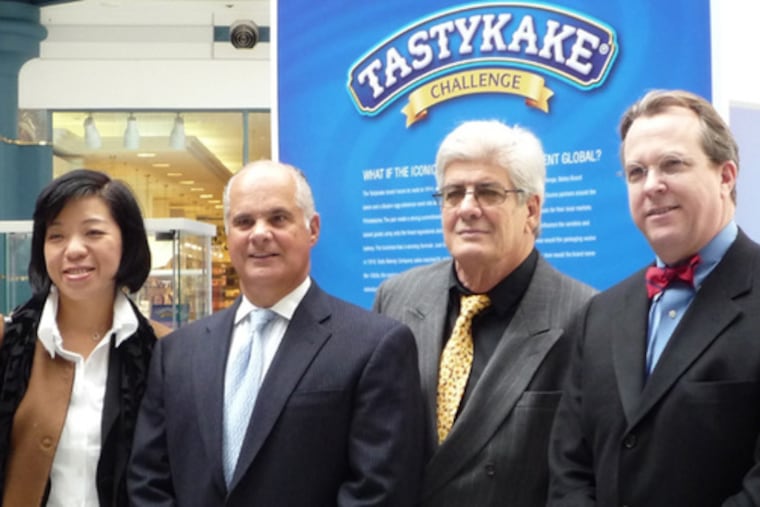
It's one of several solicited by Tastykake's design agency,
Bailey Brand Consulting
of Plymouth Meeting, from firms it has invited to Philadelphia from Europe and Asia for a conference.
The Europeans tweaked the packaging; they want more, smaller Kandy Kakes in each box, for instance.
Tastykakes are perishable; they don't export well. But as work progresses on the company's new, largely automated Navy Yard bakery and office, chief executive
Charlie Pizzi's
letting himself dream a little.
"We're looking at things in a global sense," he told me, "now that we know how to build new bakeries."