PhillyDeals: Ex-Phila. financial movers still in the mix
With the economy downshifting, it's getting hard to remember that the Philadelphia area was until lately home to three of the fastest-growing U.S. financial companies, each adding thousands of jobs a year.
With the economy downshifting, it's getting hard to remember that the Philadelphia area was until lately home to three of the fastest-growing U.S. financial companies, each adding thousands of jobs a year.
MBNA Corp. boss Charles M. Cawley transformed six blocks of downtown Wilmington, suburban campuses, a country club and other first-class assets into a state-within-a-state and the biggest independent credit card lender in the world.
Vernon Hill Jr.'s Commerce Bancorp Inc. opened a branch each week, forced the big New York and Philadelphia banks to spend millions on better service, and cultivated politicians to win public business.
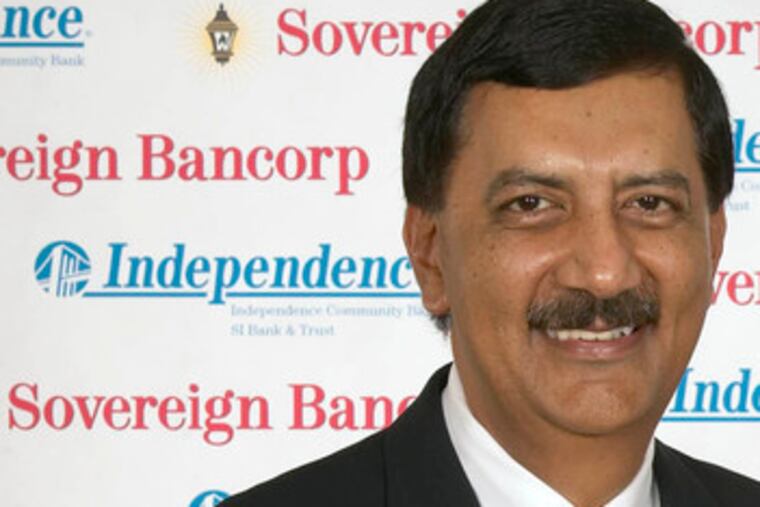
Jay S. Sidhu's Sovereign Bancorp Inc. turned a patchwork collection of branches other companies didn't want into the largest bank ever based in eastern Pennsylvania.
If the men and their companies are very different, they have this in common: As chief executive officer, each was a charismatic, high-energy, outrageous personality who attracted ridicule, accusations and devoted fans.
And each was pushed out, in boardroom coups, during the wave of corporate-governance reform and shareholder-rights rhetoric that followed the Enron Corp. scandal and the federal Sarbanes-Oxley law, which took effect in 2003.
Cawley left after his chief ally on the board died and other directors began questioning his direction; they sold MBNA to Bank of America Corp., which cut thousands of jobs. Hill had to go when federal regulators held up new branch permits as they reviewed the bank's deals with Hill-affiliated companies; Commerce is now part of Canada's Toronto-Dominion Bank. Sidhu was forced aside by activist shareholders impatient for profits; Banco Santander Central Hispano S.A. of Spain has since agreed to buy Sovereign at a fraction of the price it commanded before Sidhu left.
So we don't know how these big-league entrepreneurs would have shifted gears to cope with the looming crisis.
Is it safe to miss them now?
Cawley's retired. But Hill and Sidhu are plotting comebacks.
No respect?
"Philadelphia as a metro area doesn't recognize how important it is to have major companies headquartered here and what it means when we lose them," Hill told me last week. "They love to beat up on the companies while they're here. But when they're gone, you lose jobs and support.
"The government makes a lot of mistakes," Hill added. "But we seem to have gone through a period where you can make a million right decisions, but when you make one wrong decision - and I mean this of national companies in general - you're shot."
Sidhu had the grim satisfaction of seeing his company lose value after he was ousted. "I left under this cloud of activist shareholders saying, 'You haven't done enough for us!' " Sidhu told me. "They were wrapping themselves around the flag of 'governance.' They made it a political campaign."
He said the activists were dangerously impatient. "One has to take a longer-term view, three to five years. Some people think 'long-term' means the quarter after next. That's not right. Companies are built for decades."
Relieved of responsibility for piloting their former companies, these ex-bankers are itching to try their luck in the current depressed markets.
Pennsylvania Commerce Bancorp Inc., which leased its name and systems from Hill's former bank, last week said it would merge with Republic First Bancorp Inc., where Hill is a major investor. The new bank plans to do business as Metro Bank, with Hill as a consultant and the original Commerce as a model. Hill's also trying to start a Metro Bank in England.
Sidhu told me he has set aside an earlier plan to raise investment funds and is now looking for another company to run. "I started with Sovereign in 1989, right before the recession," Sidhu said. He figures it's a good time to "create a Fortune 500 company" from scraps: "I'll take the role of CEO, and execute. I think we can build another organization now."
Hill says he worries the government will get in his way again.
"The regulators were empowered by Sarbanes-Oxley. They're going to be empowered even more by TARP," the government's bank-investment program, he said. "Regulators in all industries feed off the political climate. They're now empowered to exceed the bounds of what makes sense."