Paulson defends bailout strategy
A House panel grilled him about not helping homeowners and failing to force banks to lend.
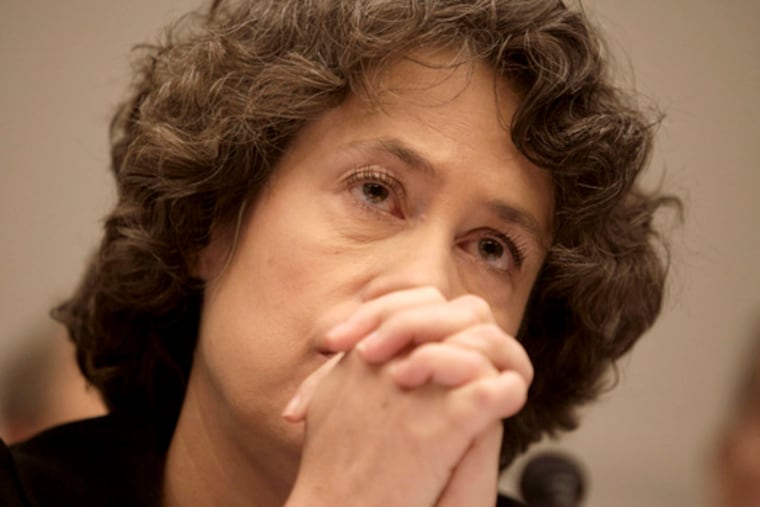
WASHINGTON - Faced with exasperated lawmakers upset by shifts in the government's financial-bailout strategy, Treasury Secretary Henry M. Paulson Jr. launched a spirited defense yesterday of his handling of the $700 billion program.
Testifying before the House Financial Services Committee, he also expressed fresh reservations about tapping the funds for mortgage guarantees to ease skyrocketing home foreclosures.
But Democratic leaders in Congress threw their weight yesterday behind a plan to use $24 billion from the program to help struggling homeowners. The Federal Deposit Insurance Corp. broke with the administration last week and proposed using that amount to help 1.5 million borrowers avoid foreclosure by guaranteeing modified home loans through 2009.
"As foreclosures escalate, we are clearly falling behind the curve," FDIC Chairwoman Sheila Bair told the same House committee yesterday. "Much more aggressive intervention is needed if we are to curb the damage to our neighborhoods and broader economic health."
During Paulson's testimony, committee members grilled him about not doing enough to help distressed homeowners and for failing to force banks that receive some of the $700 billion bailout money to specifically use it to bolster lending to customers, one of the prime reasons the financial-rescue package was passed by Congress on Oct. 3.
"It is essential" that some of the bailout money be used to ease foreclosures, said the panel's chairman, Rep. Barney Frank (D., Mass.), a key player in shaping the bailout package.
Amid fits and starts in the administration's rollout and direction of the program, "I have to say at this point that public confidence in what we have done so far is lower than anybody would want it to be, to the point where it could be an obstacle to further steps," Frank lamented.
The nation's economic woes began with rising foreclosures as some subprime homeowners - those with poor credit histories - were unable to pay their mortgages. When lenders lost money on those loans, the crisis spread to a widespread freezing of the credit markets. Loans became hard to get even for individuals and businesses with good credit, sharply slowing overall economic activity.
Federal Reserve Chairman Ben S. Bernanke told the House panel that the FDIC plan could saddle the government with heavy costs. Still, he called it a "very promising approach."
Paulson said the administration would look for other ways to provide foreclosure relief.
The Treasury chief found himself on the hot seat just one week after he officially abandoned the original rescue strategy of buying rotten mortgages and other bad assets from financial institutions.
Focusing the bailout program instead on infusing billions directly into banks - and possibly other types of companies - to pump up their capital and bolster lending to customers was deemed a faster and more effective approach to stabilizing jittery financial markets, he said.
"There is no playbook for responding to turmoil we have never faced," Paulson told the committee. "We adjusted our strategy to reflect . . . a severe market crisis."
But lawmakers worried that the administration was sending confusing signals to taxpayers and Wall Street investors.
Treasury will focus on rolling out a capital-injection program to pour $250 billion into banks in return for partial-ownership stakes in them, Paulson said. And the department will search for ways to boost the availability of auto loans, student loans and credit cards, which have been become harder to get because of the credit crisis.