A Vexing Challenge
After his long career as PennDOT district engineer, Steve Lester's new job, for just one office park, should be easy. But about that floodplain ...
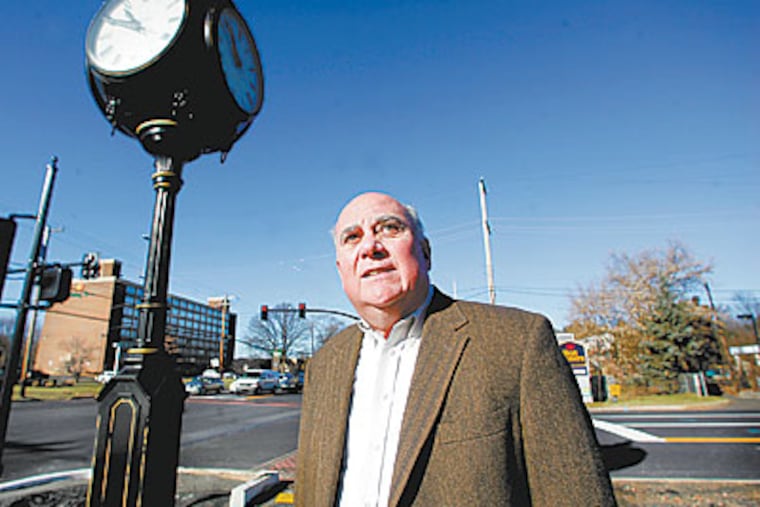
During his long career as a civil engineer for Pennsylvania's Department of Transportation, Steve Lester often did not feel the love.
There were stalled projects, killed projects, funding shortages and accusations from the public that his agency wasn't doing enough to make dangerous roads safe or traffic-choked routes less so.
"It wasn't dull," said Lester, whose 30-year odyssey at PennDot took him from intern to district engineer. When he retired in December 1994, he was responsible for 1,000 employees, more than 3,900 miles of state highways and 2,600 state-owned bridges.
By comparison, it seems his new job - involving just one office park bisected by one major road - should be a breeze. Yet, it might turn out to be the most vexing assignment of any that Lester, 64, has taken on.
Effective Jan. 1, Upper Dublin Township has hired him to find the funds and inspire cooperation among business-property owners to implement a rescue plan proposed for the flood-plagued, vacancy-riddled, motorist- and pedestrian-unfriendly Fort Washington Office Park. A part of that plan, which calls for $68 million in stormwater-management and road improvements, involves getting owners of nearly two dozen buildings to sell their properties - located where experts say no amount of work will eliminate flooding - so they can be razed. What that would cost has not been determined.
"A tough project - a tough, tough project," is how Wesley Wolf, cochair of the Upper Dublin Planning Commission, recently described the envisioned makeover for the low-rise complex of nearly 100 companies that got its start in 1953.
The park shouldn't have been built at all, a team of planning, engineering and water specialists from Temple University determined after a two-year study of the business campus' serious and notorious flooding problems.
Just off the Pennsylvania Turnpike interchange at Route 309, it sits on 593 acres of mostly marshland crossed by four streams.
But what's done is done. Lester's focus, he said, is on rallying a public/private commitment to making the improvements Temple has suggested to transform a site that "doesn't really have the amenities of a modern, first-rate office park" into one that does.
"Part of my job is to be a salesman," he said.
It's a skill honed at PennDot, where Lester counts among his greatest achievements his success at getting municipalities - famously independent in Pennsylvania - to work together on solutions to local traffic problems.
Temple's Center for Sustainable Communities, which advises towns on how to manage growth, released the results of its Fort Washington study - funded with a $420,000 federal transportation grant - in August. Among its recommendations: that as many as 22 office buildings and warehouses in high-risk flood areas should be leveled and that a 1.1-mile stretch of the major thoroughfare Virginia Drive, which is often under water in heavy rainstorms, should be converted into a greenway.
Among the stormwater-management additions Temple has suggested is the construction of six small dams on two of the park's creeks.
Flooding has not only generated millions in property damage and harmed the park's ability to attract tenants, but it has also taken one life - a pedestrian who was swept into a drain by churning water during a storm in September 1989. (The Seltzer Organization broke ground on the complex long before stormwater management was required of new development.)
When word got to Upper Dublin that Lester had retired at the end of October from his post-PennDot job at Urban Engineers, township officials leaped to sign him up as a rainman/frontman for the office park remake. His $60,000 contract is for one year, 16 hours a week, according to township officials.
Jules Mermelstein, president of the township commissioners, said he was hoping that Lester's long history working for the state would "keep us moving. He knows exactly where to go for this kind of grant funding."
The office park is home to businesses ranging from small graphic-design and print shops and a day-care center to larger properties such as college branch campuses, including one for Temple, and a recently completed regional headquarters for GMAC. The latter is owned by Liberty Property Trust, which, with one million square feet, is one of the complex's largest property owners.
Constituting three-quarters of Upper Dublin's commercial real estate and contributing $3.4 million in property, earned-income and service taxes to municipal coffers each year, the office park is "extremely important to us," Mermelstein said. "We have to make sure we stop the deterioration now and reverse it."
There is a sense in Upper Dublin that the timing for Lester's fund-raising work is perfect given the Obama administration's promise of federal support for infrastructure projects and Montgomery County's adoption last month of an economic development program that plans to issue $105 million in loans and grants over the next seven years.
U.S. Rep. Allyson Y. Schwartz, whose district includes the office park, has met recently with township officials, and "she's open to and listening to their ideas," said spokeswoman Rachel Magnuson.
Montgomery County Commissioner Joe Hoeffel said the redevelopment of the office park seemed worthy of consideration for county economic development dollars, because the site "is a long-standing creator of jobs and economic activity."
To get properties out of flood danger, Temple has suggested a complex process known as transfer of development rights, or TDR. It involves developers' or other investors' buying out property owners in the high-risk areas on the office park's east side. Then, as part of the exchange, they would gain the right to build in a denser fashion on available land on the western end.
The businesses in the flood zone will have the option of moving in to the newly developed properties on higher ground or leaving the park for other sites.
In the so-called receiving zone, Temple envisions buildings as tall as six stories, arranged in a mix of stores, offices and other commercial uses easily accessible on foot. Residential development could also be part of it.
To improve vehicle access to the park, Temple has suggested more links between the turnpike interchange and the office park.
Lester said that establishing a steady communication with property and business owners in the park would be a priority so that none of the stakeholders in the process has reason to feel out of the loop.
"When people feel something is being forced on them," he said, "they really get their backs up and fight."
Among those encouraged that Upper Dublin has enlisted Lester's help is Jeffrey Featherstone, who oversaw the Fort Washington study as director of Temple's Center for Sustainable Communities.
The "greatest fear" of researchers, he said, is creating a report that "withers on the vine."
Steve Lester
Age: 64.
Education: Villanova University, bachelor's and master's degrees in civil engineering.
Lives in: Flourtown, Montgomery County.
Work history: Urban Engineers Inc., vice president of engineering and quality services, from January 1995 through October 2008; PennDot, from June 1965 to December 1994, retiring as district engineer for the five-county Philadelphia district.
High-profile projects: Interstate 95 through Philadelphia; the Vine Street Expressway in Center City; the Blue Route linking the Pennsylvania Turnpike at Plymouth Meeting to I-95 near Chester.
Projects he wishes had been built: An expressway from the Betsy Ross Bridge through parts of Northeast Philadelphia; the completion of Woodhaven Road, which now dead-ends at Philadelphia's border with Montgomery and Bucks Counties.
Other activities: President, Greater Valley Forge Transportation Management Association.EndText