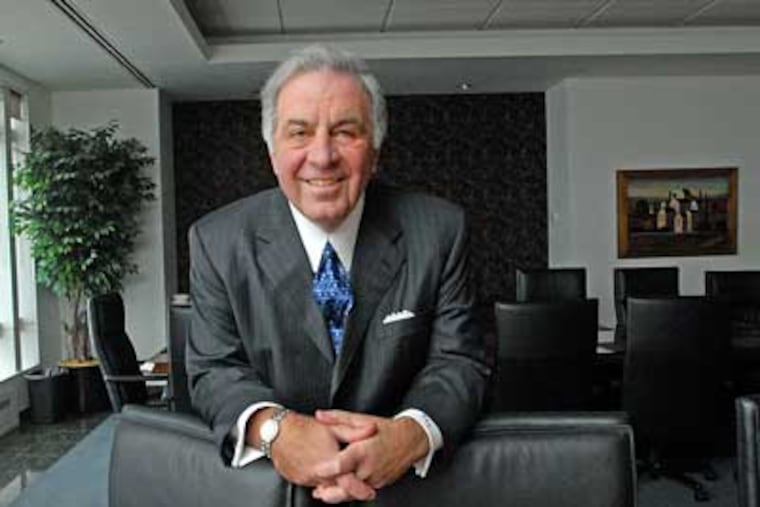
As chairman of Stradley Ronon Stevens & Young L.L.P., William Sasso had the good fortune of seeing his financial-services clients rake in tidy profits during the deal-making boom of a few years ago.
But now, like leaders of other Center City firms, he's had to adjust to recessionary times. The firm missed its budgeted revenue target by 10 percent in 2008, cutting into profitability.
Sasso says that cuts at Stradley have been modest because of the firm's low overhead. Even so, the 195-lawyer firm has clamped down on its travel budget and has let go several of its real estate lawyers. Sasso says he expects that the huge amount of federal bailout money likely to course through the economy this year will fuel a strong recovery, but if it doesn't, the firm is prepared for further tightening.
Question: How tough is it out there for law firms right now?
Answer: Well, it all depends on what your practice areas are and what you're focused on. It's interesting because we've focused on financial institutions in addition to corporate business and pharmaceutical work. And a number of financial institutions are having problems - banks, especially. In the other areas, the mutual fund area and the insurance area, that business really hasn't been impacted much.
In banking, you have a downturn in capital markets and banks extending credit. So the transactional work that you would normally do for banks has decreased. I would say it's off by a good 50 percent.
Q: What are your clients telling you about when a turnaround might take place?
A: It's interesting because, among the banking clients, you get mixed reactions. The healthy banks say it has to turn around. They say we've got money to lend and we have to get it out there. And I think the Fed is doing everything that it can to encourage that. Other institutions that are going through acquisitions, reorganization and everything else, they're going to have to take care of their own internal issues for the first quarter of '09, but then they're going to have to start putting money out there as well in the second and third quarter.
Q: What adjustments have you made at Stradley Ronon in response to the downturn?
A: Well, when you look at the typical law firm, the major expenditures are labor, lawyers and occupancy costs and technology. I think we were very fortunate in that we never established a high-cost structure. We weren't one of the firms that necessarily got into this lockstep of raising the starting salaries.
Q: But where have you cut?
A: Travel budget, marketing budget. We're known as a firm that gives back a lot to the community. Our charitable budget is probably the largest per lawyer of any firm in town. We're going to have to cut back a bit on that, as well. There is nothing we can do about that.
Q: What can a 200-lawyer firm offer a big financial institution? For years, the impression has been that you have to be huge to be successful.
A: Well, we never bought into that. We thought we would carve out our market niche. We wouldn't try and be all things to all people. We would look to the financial institutions, we would look to big pharma and corporate and securities work. And so we've developed the sophistication in the areas in which we focused, and we didn't try and be more than that. And we found that companies, if they saw the expertise there, didn't care if you were 200 lawyers or 400 lawyers.
Q: How flexible are you on billing, and how do you work out disagreements with clients?
A: We make it clear to the clients that we'll work with them on how they want to be charged. Sometimes in-house counsel are very comfortable with the standard hourly rates, however many hours it takes.
But more and more clients are saying, "Give me some sense of what the budget is going to be. And staff it accordingly. You know, don't tell me you're going put 10 lawyers on this. I'm not going to pay those types of bills."
Q: Is there any downside to the client that in striving for efficiency there may be an incentive for everybody up and down the line to take shortcuts?
A: I think that, number one, if you're staffing correctly and have an experienced lawyer who is running the show, which we always do, he knows what has to be done and doesn't need to be done.
Q: Do you think the billable hour [$395 per hour on average for Stradley partners; $220 for associates] then is on its way out?
A: I think the billable hour will always be with us. But I think clients are becoming more focused on the billable hour. And if they don't see that they are getting value from the billable hour, the intelligent lawyer better be ready to talk about alternatives.
In fact, he ought to be raising the issue with the clients first rather than waiting for them to react to it.
I always tell new clients that we can basically develop any type of scenario that they like. You just really have to play it by ear. But I make it clear that the overriding principle that we have here at the firm is that we'll never ask you to pay a bill where you think you haven't gotten value for the money.
Q: Are there occasions when clients say to you, "I don't think this bill is correct. I'm going to pay a lesser amount"?
A: If it's at all reasonable, we accept that.
William R. Sasso
Age: 61.
Hometown: Gwynedd Valley
Education: B.A., LaSalle University; J.D., Harvard Law School.
Occupation: Partner in the business practice group and chairman of Stradley Ronon Stevens & Young.
Personal: Married, two sons, one in medical school, one in law school. Enjoys golf and dining out at the Blue Horse restaurant, of which he is a part owner, in Blue Bell.
EndText