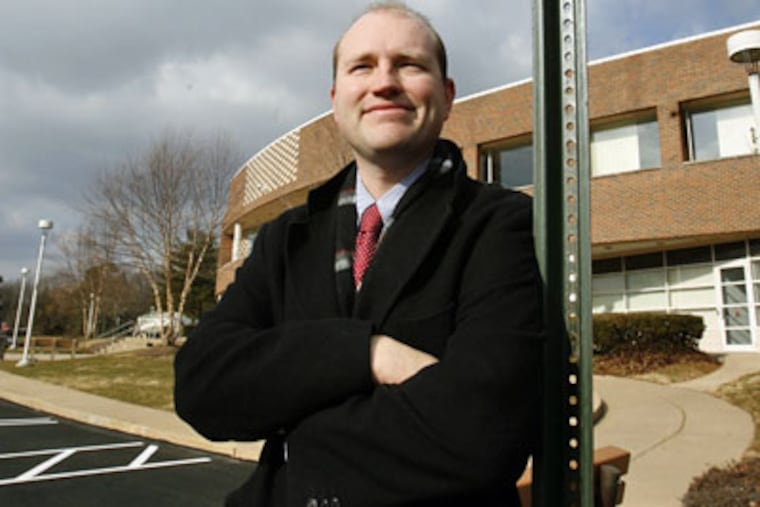
With workforces shrinking each month, the last place where businesses want their employees is stuck in traffic.
Yet for Rob Henry, the more jams he sits in, the more impassioned he becomes about his work.
As executive director of GVF Transportation (that's GVF as in Greater Valley Forge) since July 1, he heads a King of Prussia-based nonprofit public-private partnership whose overall mission is to ease the region's commuting woes.
GVF Transportation influences the Greater Valley Forge area's infrastructure and public-transit agenda as well as state and federal transportation policy. It also helps businesses set up car pooling and shuttle buses for employees, and manages, among other things, the traffic-information Web site Phillytraffic.com.
Henry is the first new leader at the transportation-management association since its founding in 1990. That year, he was a freshman at Cardinal Dougherty High School, not yet driving.
Nine years later, Henry joined what is now a nine-person agency with more than 100 members, including major employers GlaxoSmithKline P.L.C., Wyeth and the Vanguard Group Inc. Since then, he has worked his way up to the top post from project coordinator, manager and assistant director.
Question: What are your priorities?
Answer: To look at what we have, try to get more private investment in our infrastructure. We don't have legislation that enables us to do that. That's one of the initiatives for this year. [Another is] to work with SEPTA to continue to expand their service into the core suburbs. Not just small projects, but also megaprojects such as the Route 100 [also known as the Norristown High Speed Line] extension [and] potential extension of the R-6 from Norristown up into Berks County.
Q: What do you consider the region's major transportation problems or challenges?
A: Funding. It's number one on everybody's agenda. We have more structurally deficient bridges than anywhere. And now, due to deferred maintenance, we're kind of paying that price. But now, rather than just say we can't afford to do this, or we're just going to put all our money toward bridges, how else can we bring in funding?
And there's a lot of unhappy choices, such as raising the gas tax, doing vehicle-mile tolling. Tolling. If you look at the turnpike as a model, they're always able to expand. They're able to clear incidents faster, more efficiently, and they plow more efficiently. The road operates more efficiently. And that's because of the tolling revenue.
Q: What do you think the impact of this region's infrastructure is on the ability to attract new business and retain the business that is here?
A: I think it's huge. One of the things we try and go out and preach is that we're not just competing anymore in the United States. It's a global economy. So I do think attracting new companies and attracting new business, we have to have a solid infrastructure. If you look at just China and India as examples, they're spending a fortune on infrastructure. And we're just talking about replacing our bridges, and not widening some of our highways or even maintaining some of our facilities.
Q: What pieces of legislation, both state-level and national, are you planning on lobbying either for or against in 2009?
A: Statewide, it would be a privatization law. Right now in Pennsylvania, if a private infrastructure company would like to invest in Pennsylvania, it's very prohibitive. And that needs to change. I've talked to two major infrastructure companies. And both of those executives said, "We will not invest in Pennsylvania until they have a privatization law in place."
Nationally, the big one is going to be the reauthorization of the transportation bill. We're working on some simple things, such as, there's a transit benefit you can get where if you take transit or if you park, you can get X-percentage of tax-free dollars. Parking gets more than taking transit or, say, van pooling. All we want to do is have parity.
Q: How do you think President-elect Barack Obama's infrastructure program will impact this region?
A: It's hard to say at this point because there's still not enough guidance out there. One of the challenges is, you hear: "It has to be shovel-ready projects." It's hard to have a shovel-ready project if there was no money behind it to begin with. You haven't been going for permits . . . for right-of-way acquisition, because there was no money to pay for it.
Q: In the time that you have been here, what accomplishments would you say you're most proud of?
A: One would be the coalition-building. We have municipalities and businesses working together that for many years did not work together.
The other is, we did some legislation to amend the vehicle code, called Steer It Clear. Prior to Steer It Clear, if you were in a fender bender and . . . a state trooper came up and asked you to move your car, you didn't have to. And that just created gridlock. You had the gaper delays, and you have other secondary accidents, which is where a lot of fatalities occur. What that legislation did is, it gave the trooper or the local police officer the ability to say, "Well, OK. If you don't want to pull your car over, then I will take your car and pull it to the side."
Rob Henry
Title: Executive director, GVF Transportation.
Age: 33.
Resides: Quakertown.
Family: Wife, Michelle; daughters, Julia and Maeve.
Education: Bachelor of science degree, Temple University.
In his spare time: Cochairman, Richland Township Park and Recreation Board; director, ACT (Association for Commuter Transportation) National.
How he gets to work: "I drive [38 miles each way]. I take the Northeast Extension. One of the ironies of my job is I'm probably going to three and four meetings a day. To not drive is prohibitive."
The road he most despises: The Blue Route (Route 476), particularly the stretch between the Mid-County Interchange with the Pennsylvania Turnpike and the Schuylkill Expressway. EndText