PhillyDeals: Despite inauguration, investors skeptical
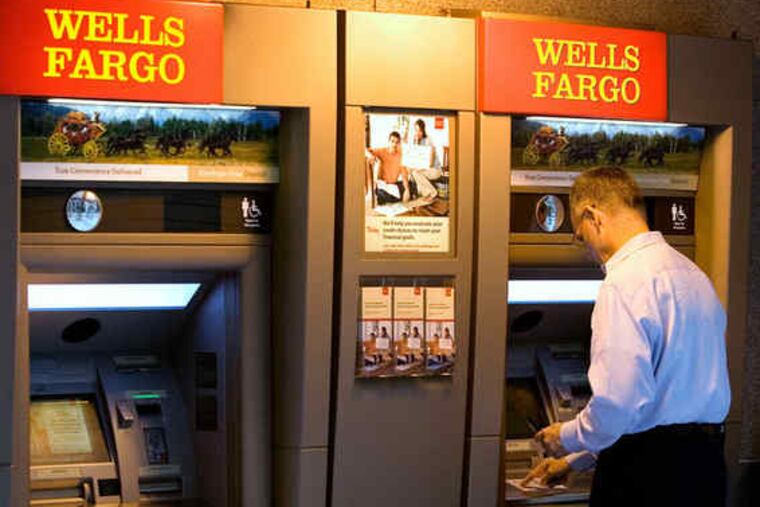
President Obama's triumphal inauguration didn't change the hearts of skeptical investors in the troubled financial system. Shares of Wells Fargo & Co., the newly dominant bank in the Philadelphia area, fell 23.82 percent, to $14.23, after analyst Paul J. Miller Jr. at Friedman, Billings, Ramsey & Co. Inc. said Wells "will have to cut its dividend" and raise more capital after absorbing Wachovia Corp.
President Obama's
triumphal inauguration didn't change the hearts of skeptical investors in the troubled financial system.
Shares of Wells Fargo & Co., the newly dominant bank in the Philadelphia area, fell 23.82 percent, to $14.23, after analyst Paul J. Miller Jr. at Friedman, Billings, Ramsey & Co. Inc. said Wells "will have to cut its dividend" and raise more capital after absorbing Wachovia Corp.
Shares of PNC Financial Services Group, the biggest bank based in Pennsylvania, fell 41.40 percent, to $22.00, on fears it might turn out like State Street Corp., of Boston, which lost more than half its value after disclosing what Standard & Poor's analyst Charles Rausch called "earnings pressures" on investment servicing and asset management. PNC is in those businesses, too.
Wells and PNC were two of the more solvent big banks. They already have tens of billions in government capital. Where would they get more?
Irresponsible bets
When all else fails, there's the government. The United Kingdom yesterday boosted its ownership of multinational giant Royal Bank of Scotland Group Inc. to 70 percent. That means Citizens Bank of Pennsylvania and other RBS affiliates are now under control of the Bank of England.
British Prime Minister Gordon Brown blamed RBS's "irresponsible" bets on U.S. subprime loans and foreign mergers for an estimated $40 billion in losses, the Financial Times reported. "Investors feel the bank may be fully nationalized," the paper reported.
Fresh meat
Bill Mills,
PNC's top Philadelphia executive, recently visited the new Del Frisco's steakhouse on Chestnut Street, where a fellow diner reminded him the ornate, high-ceiling space used to be a
First Pennsylvania
bank office.
"Yes, it did," Mills said. "My job now is to keep my bank from getting turned into a restaurant."
News and capital
Carlos Slim-Helu is about as rich as Bill Gates or Warren Buffett. He controls Mexico's wireline phone monopoly (Telmex), its mobile-phone monopoly (America Movil), the Carso industrial group, the Inbursa banking group, and a lot of old CompUSA stores he shut down when he couldn't close the deal for Circuit City Stores Inc.
Slim is what Brian L. Roberts might be, if the Comcast Corp. chief executive officer had been born in a large, developing country instead of Philadelphia.
The New York Times borrowed $250 million from Slim's banks yesterday. He's already the largest outside shareholder. Will Slim take over America's newspaper of record?
Who knows? But the Times has been through this before. In 1980, it suffered from rising costs, falling profit and a weak share price. In rode Wharton-grad corporate-raider Saul P. Steinberg, who, using Philadelphia's doomed Reliance Insurance Co. as his cash cow, bought a big chunk of the Times.
Steinberg worried journalists who had exposed his pressure tactics and his ties to a corruption investigation. He made noise about buying more Times shares and starting a media empire.
But events proved he bought the shares - and other print and broadcast stocks - because he liked the price, not the business. Steinberg sold his stake in the early 1980s, booked a big profit, and left the Times to recover on its own.
Analogy
A half-century after he helped his native Finland set up its first analog TV station in the 1950s,
Jukka Hamalainen
helped replace analog with HDTV: He headed
Panasonic's AVC American Laboratories
in Burlington, where he headed a staff of 100, whose projects included HDTV prototypes.
"It's a lot smaller now," said Hamalainen, now retired. He said Panasonic Corp. now did its basic research back home in Japan, and uses the Burlington site to "support set-top boxes and cable TV, and make sure what they develop in Japan is adapted here in the United States."
Hamalainen was invited to tell his story at the IEEE electronic engineers' luncheon in Philadelphia yesterday. He knows the deadline for analog's replacement is next month, but he predicted it'll take longer. "This gets complicated," Hamalainen said.