Regulators shift blame for massive AIG failure
WASHINGTON - Lawmakers blasted state and federal regulators for dodging blame and keeping secrets after the failure of insurance giant American International Group Inc., which now has access to more than $170 billion in taxpayer money.
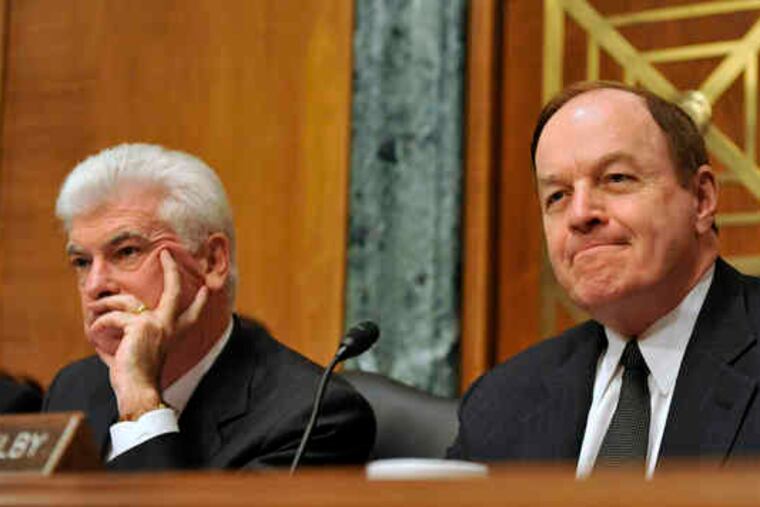
WASHINGTON - Lawmakers blasted state and federal regulators for dodging blame and keeping secrets after the failure of insurance giant American International Group Inc., which now has access to more than $170 billion in taxpayer money.
Calling AIG "the greatest corporate failure in American history," Sen. Richard Shelby (R., Ala.) yesterday needled the New York state insurance regulator and representatives from the Federal Reserve and Office of Thrift Supervision about the lack of oversight leading to AIG's collapse.
AIG on Monday reported a $61.7 billion quarterly loss, the worst in U.S. history. The same day, Treasury provided AIG as much as $30 billion in additional aid from the $700 billion financial-bailout program.
The government effectively controls the insolvent company, with the Treasury Department owning up to 79.9 percent.
In turns apologetic and defensive, the regulators explained why their agencies were not set up to oversee a firm like AIG, or why the company's problems were outside of their jurisdictions.
The toughest questioning fell on Federal Reserve Vice Chairman David Kohn. His appearance followed rare and withering criticism of AIG this week from Fed Chairman Ben S. Bernanke.
Banking Committee Chairman Sen. Christopher J. Dodd (D., Conn.) demanded to know yesterday which other banks had benefited from the billions of dollars AIG has spent winding down its credit default swap business and other relationships. The swaps insure companies against losses on corporate bonds, but are not regulated as insurance is. AIG was the top player in the multitrillion-dollar industry that played a major part in the financial crisis.
Kohn refused to say who had been made whole after deals with AIG went bad, arguing that the information would undermine what little confidence remains in the financial markets.
Kohn defended the use of taxpayer money to repay other banks because "if we imposed losses on the counterparties for AIG," there could be disastrous ripple effects throughout the financial system.
AIG is so sprawling, so intertwined with institutions worldwide, that its downfall could set off a vicious chain reaction. Upheaval on such a global scale would plunge the U.S. economy deeper into recession, drive up unemployment, and stifle hopes for an economic rebound any time soon.
Scott Polakoff, acting director of the Office of Thrift Supervision, told lawmakers his agency had relied on imperfect modeling and optimistic assumptions about AIG's credit default swap business. But he also suggested the company's financial-products division had furnished inadequate records for examination.