PhillyDeals: AIG bonus recipients aren't the bad guys
A couple of times I've suggested (to reader outrage) that banker bonus payments are among the least of this Republic's financial problems, and may actually help the government get better returns from its outrageous investments in Citigroup Inc. and American International Group Inc.
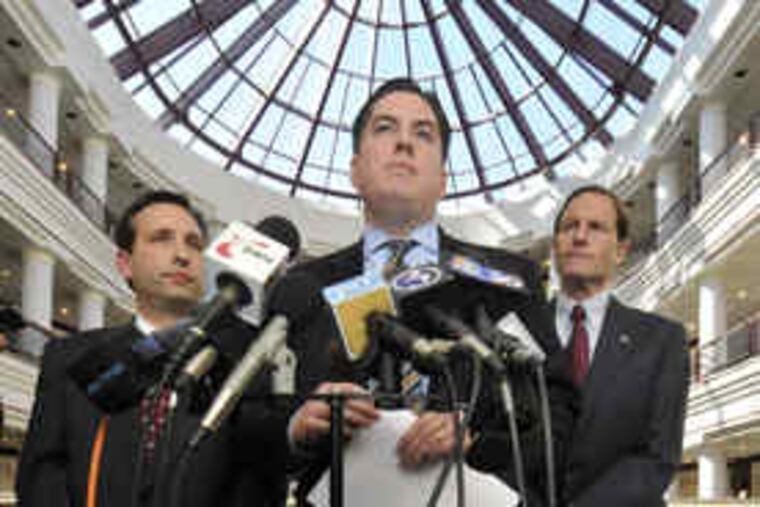
A couple of times I've suggested (to reader outrage) that banker bonus payments are among the least of this Republic's financial problems, and may actually help the government get better returns from its outrageous investments in Citigroup Inc. and American International Group Inc.
The bosses who set up these corporate doomsday machines, starting with ex-CEOs Sanford "Sandy" Weill, who paid himself hundreds of millions in stock and cash bonuses as he built Citi on a shaky foundation of subprime loans, and Maurice "Hank" Greenberg, who ran AIG for 30 years, are now long gone. So are the people they put in charge.
Plenty of Americans, including prominent congressmen and the state prosecutors in New York and Connecticut, are willing to look past those facts.
They're more worried about the symbolism of paying extra cash to the people trying to salvage these taxpayer-backed companies, at a time when voters are angry because the government is spending billions it doesn't have to bail them out, while jobs are scarce, and home values and retirement accounts are way down.
Last week, I asked Christina Pretto, spokeswoman for AIG and former spokeswoman for Citi, to explain why these men and women were awarded bonuses in the first place, and whether these folks really caused the problems taxpayers are paying to fix.
Pretto promised a response, then went dark. The AIG chief executive now, Edward Liddy, after initially defending the bonuses, wilted under the pressure, and asked his people to give the money back.
So it has remained for one of the bonus recipients, Jake DeSantis, to explain, in a letter to Liddy published by the New York Times yesterday, why he's quitting his job atop AIG Financial Products' commodities desk, instead of returning his $742,000 bonus.
"I was raised by school teachers working multiple jobs in a world of closing steel mills," DeSantis wrote. He earned a scholarship to MIT, and a well-paid job at AIG.
"I was in no way involved in - or responsible for - the credit-default-swap transactions that have hamstrung AIG. . . . Most of those responsible have left the company and have conspicuously escaped the public outrage. . . .
"I never received any pay resulting from the credit default swaps that are now losing so much money." Instead he lost a pile when AIG's investments headed south.
But he believed Liddy when the former Allstate Insurance Co. chief executive promised to pay extra to AIG people who stuck around to clean up the mess.
"None of us should be cheated of our payments any more than a plumber should be cheated after he has fixed the pipes but a careless electrician causes a fire that burns down the house."
And then DeSantis gave the game away:
"I know that because of hard work I have benefited more than most during the economic boom and have saved enough that my family is unlikely to suffer devastating losses during the current bust.
"Some might argue that members of my profession have been overpaid, and I wouldn't disagree.
"That is why I have decided to donate 100 percent of the effective after-tax proceeds of my retention payment directly to organizations that are helping people who are suffering from the global downturn."
In short: The protesters are wrong - these bonuses weren't for the bad guys. But they are right, too - for too long, our financial engineers, including the hardworking MIT scholarship kid, have been paid too much, a cause, or a symptom, of the distortions that got us into this mess. It's his bad luck to get whacked when the music stopped.
Why couldn't Liddy have put it that way? My guess is it's because he has spent his life in the insurance business, which has an awfully hard time making anything clear.
Tax wars
Big fights coming: President Obama's budget chief, Peter Orszag, said yesterday that the government has tapped ex-Federal Reserve chief Paul Volcker to run a board that will rewrite the federal tax code.
It will have three tasks, according to Orszag: "One is tax simplification; the second is closing tax loopholes and reducing tax evasion; and the third is reducing corporate welfare." The report is due Dec. 4.