SCA Americas rolls along, helping ration tissue
The cashier at a Dunkin' Donuts drive-thru in West Philadelphia wraps a single brown napkin around a foam cup before handing it to a motorist bracing for a messy ride over potholes.
The cashier at a Dunkin' Donuts drive-thru in West Philadelphia wraps a single brown napkin around a foam cup before handing it to a motorist bracing for a messy ride over potholes.
Hang on! Wasn't it just a few months ago that batches of plush white napkins would pass through this window like door prizes for drivers?
"One more napkin, please?"
"Sure," the cashier says, and out comes another sheet of recycled fiber that flaps in the breeze. "They only come out one at a time."
No accident, folks, just as it's seldom an act of God when toilet paper at a public restroom tears too easily, or the automated towel dispenser refuses to spit out a second sheet no matter how long you wave your hand at it.
It's part of a business strategy - in this case, one being honed on the 26th floor of Philadelphia's Cira Centre, where a Swedish company is looking to boost its bottom line by stopping hankie hoarding across the country.
SCA Americas Inc. is elbowing its way into roadside rest stops, office buildings, and food outlets by having its engineers design dispensers that force consumers on a reduced free-tissue diet.
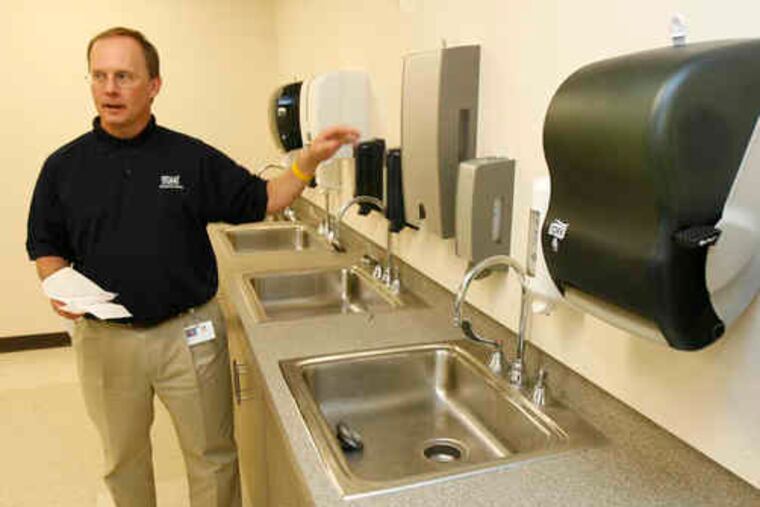
The company has just opened a 10,000-square-foot University City laboratory for dispenser design, headed up by inventor-engineers such as John Formon.
Their mission: to design contraptions that stop people from reeling in reams of paper to dry hands, wipe away ketchup, and, well, you know.
"And you thought it was just a dispenser," Formon, 52, director of innovation for SCA, said with a cunning smile at his crew's new white-walled space at Science Center, three times the size of SCA's soon-to-be-shuttered lab in Neenah, Wis.
The European forestry and paper-products company swooped into this region in 1993 by snapping up a piece of now-defunct Scott Paper Co., of Eddystone. It bought paper mills across the country and, in 2006, moved its North and South American headquarters into Cira Centre.
The dispenser lab will replace a smaller one the company has operated in Wisconsin. The new lab means SCA is heading full throttle into a competition with Georgia-Pacific and Kimberly-Clark Corp. - the other big guns that sell tissue and dispensers for what is termed the "away-from-home" market.
"Every second napkin in restaurants is coming from SCA here in North America," said Sune Lundin, recently named president of SCA Americas.
Locally, the company's recycled-content tissue products and Tork brand dispensers can be found at Lincoln Financial Field, the Franklin Institute, Dunkin' Donuts, and Taco Bell, to name a few.
The company manufactures tissue, napkins, and towels in mills nationwide and sells them with dispensers designed to work best when used with SCA products.
"We promise our customers that they will reduce consumption 25 percent, or we will rebate them," said Amy Bellcourt, SCA vice president of communications. "We have never had a customer ask for a rebate."
That can add up to big bucks if you're a big buyer of napkins, paper towels, or toilet tissue - especially during a recession and a burgeoning "go green" movement.
"We recently met with a large fast-food chain, a brand name you would recognize, and we talked to them and they told us they were spending more than $20 million a year on their paper products," Bellcourt said. "If we can reduce their expense by even 10 percent, that's a significant amount of money for them."
The one-napkin-at-a-time Tork dispenser at Dunkin' Donuts was invented by Formon, who previously worked for Georgia-Pacific. He talks about dispenser design like a wizard sharing secrets.
On restroom debris: "If you go into a restroom and you see little pieces of paper all over the floor," he said, "that means they weren't using the right paper in the dispenser."
On toilet paper that tears: Adjustable springs can increase friction when a roll spins into action. That causes paper to rip more easily, which cuts down how much you grab per yank. The more perforations on a roll, the more it rips, too.
On towel machines: A computer chip in automated SCA paper-towel dispensers allows owners to adjust sheet length and set time delays between hand swipes. A frugal owner can set an eight-inch sheet and a long-time delay; a generous owner, a 24-inch sheet with no pause between hand waves.
On germs, germs, germs: "This is a petri dish," Formon said, pointing to a lever on an inexpensive paper-towel dispenser SCA sells. "The germs don't just sit there; they grow. So if you were to swab that and then come back three or four days later, there'd be a higher germ count every day." His advice: Pump the lever with your elbow.
There's a fine line between controlling behavior and annoying people, the company admits.
Peter Zajaczkowski, who oversees SCA's dispenser labs here and in Sweden, said: "If you try and control usage too much, then you get unhappy end users." (No pun intended.)
Gerard Gleason, a San Francisco pulp-and-paper industry consultant on environmental issues, said SCA, along with Georgia-Pacific and Kimberly-Clark, was targeting hospitals, cafeterias, and other large-scale vendors.
Dispenser and wholesale tissue sales represent about $5 billion, or a third of the $15 billion in U.S. tissue-product sales annually.
Georgia-Pacific is the U.S. leader in the away-from-home arena, even though it also sells many consumer brands, such as Northern and Angel Soft.
Kimberly-Clark, which sells Scott, Kleenex, and Cottonelle retail brands, has a smaller focus on wholesale, Gleason said, while all-powerful Procter & Gamble Co. makes only consumer tissue brands.
SCA, which has operations across the globe and is a big retail tissue presence in Latin America, is looking to bolster its U.S. presence as a wholesale player right now. (It stepped up its presence in the U.S. incontinence-care market recently by adding disposable male underwear to its Tena product line.)
"SCA is sort of the yin and the yang of tissue," said Gleason. "They're filling in the market that Procter & Gamble doesn't get involved in."
Those new Tork Xpressnap dispensers at Dunkin' Donuts? They contain interwoven napkins in a design similar to a tissue box. The interlocking system puts an end to the famous finger-wedge maneuver that grabs (and potentially wastes) a bunch at once.
Government agencies are eager to hear the SCA pitch, given that many must meet recycled-content purchasing requirements or are simply looking to cut costs.
"Across all government sectors, from federal to the local city hall, every government agency is coming in and saying, 'We've gotta cut waste,' " Gleason said, "and all of them are looking at dispensers."
Already, he said, SCA's Tork style seems ubiquitous.
"You can still go around the country and see the old Scott Tissue ones that are still mounted, the white-enamel metal dispensers for multifold towels and things like that," he said.
"But those are all going to be replaced by Tork and other systems like that."