PhillyDeals: PNC climbs ranks while keeping low profile
Jim Rohr runs the fifth-biggest bank in the United States, and the biggest in Pennsylvania - PNC Financial Services Group - and does it out of the spotlight that glares on his peers at Citigroup Inc., JPMorgan Chase & Co. Inc., Bank of America Corp. and Wells Fargo & Co.
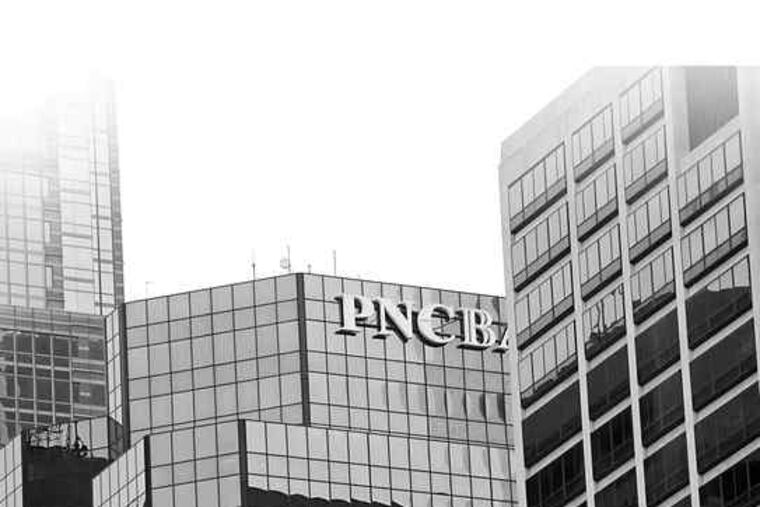
Jim Rohr runs the fifth-biggest bank in the United States, and the biggest in Pennsylvania - PNC Financial Services Group - and does it out of the spotlight that glares on his peers at Citigroup Inc., JPMorgan Chase & Co. Inc., Bank of America Corp. and Wells Fargo & Co.
Rohr missed the circus a few weeks back when the House Banking Committee spent a day grilling the heads of the eight other biggest banks, with both embarrassing and foolish questions.
"I wasn't invited," Rohr told me yesterday, laughing a little, a couple of hours after PNC's share price topped $40 for the first time this year. It reported better-than-expected profit, thanks to extra earnings from home loans and hedging, which Rohr doesn't expect will repeat next quarter.
How did PNC survive the bank wars, to become No. 5?
Partly by aggressive risk management: When the bank faced federal charges for its dealings with American International Group Inc. earlier this decade, Rohr replaced top officials with ex-regulators, tightened financial and governance practices, and settled with the government for millions in fines and promises to do better. Those promises were apparently kept, unlike AIG.
And partly by default: Larger competitors such as Wachovia Corp. and National City Corp. were wiped out in the banking crisis that started last year.
PNC took over National City at a price so low, PNC was able to claim more than $1 billion in "negative goodwill" - the opposite of the usual premium that buyers have to pay when they buy big companies - and then use it as an accounting credit to blunt the impact of bad Nat City loans to steel and auto companies.
Pressed on whether PNC is lending more, or less, since accepting federal assistance along with other major banks, Rohr pointed to $26 billion it lent customers in the first quarter.
I asked the obvious question: Was that more, or less, than PNC and National City lent a year ago? Rohr said he didn't know: That's not one of the many numbers he had to report, by law, in PNC's fat first-quarter filing. Though he added that a lot of consumers and companies these days want fewer loans, not more.
If Rohr has avoided the Capitol Hill hot seat, he's still been spending time in Washington, behind the scenes.
Federal Deposit Insurance Corp. Chairwoman Sheila Bair has asked Rohr to join in the public-private assets program, designed to restart the frozen loan markets by buying unwanted loans and bonds. "It'll depend on how it's financed, and how it's structured, and who participates, and the price," Rohr said.
PNC is also in Washington as a business move: Under Rohr, it bought troubled Riggs National Corp., the capital's biggest local lender.
Riggs likes being in the country's strongest market these days. Though Congress doesn't save at PNC: "The members have their own bank," Rohr said. "It doesn't charge for overdrafts. That's hard to compete with."
Beyond the national banking crisis, Rohr worries state and local governments are going broke.
"In Pennsylvania, we still have the second- or third-highest net corporate income tax in the country," Rohr pointed out. "That's going to be a bigger and bigger issue as states, counties, and cities start raising their corporate taxes" to fund strained budgets. "People are going to move away."
What to do? Consolidate local government functions. For example, "Pennsylvania has something like 40 percent of all the municipal pension funds in America," Rohr said. "It's very expensive. The right thing is for the state to put those together."
Rohr doesn't buy the idea that U.S. banks are going to keep consolidating until there's just a handful. "You'll have some giant banks, some large regional banks, some small banks," he said. "Like now."
I asked him about something Bill Hankowsky, chief executive officer of Liberty Property Trust, recounted earlier in the day: Community banks are making more real estate loans, to pick up slack from big banks that aren't lending.
Yes, said Rohr - "But the average small bank has four to five times their capital in real estate loans. There's going to be a lot of trouble" as property prices stay weak.
Will PNC buy up more remains, at hard-times discounts? "Our goal right now is to make the National City thing work," he said. "We like this mix of businesses."
Of course, he has said that before. When PNC was smaller.