Part 8: Race to college: Ali's choice
Fresh from the nerve-racking race that is college admissions, Ali Derassouyan felt like a winner - a bit confused, but a winner.
Originally published May 10, 2009.
Fresh from the nerve-racking race that is college admissions, Ali Derassouyan felt like a winner - a bit confused, but a winner.
Of the nearly 23,000 students who applied to the University of Pennsylvania this year, 17 percent got in - and she was one of them.
But should she go there? In a particularly competitive college admissions year, the senior at Nazareth Academy, a Catholic prep school in Northeast Philadelphia, had been accepted to six other schools, though she was wait-listed at her first choice, Cornell.
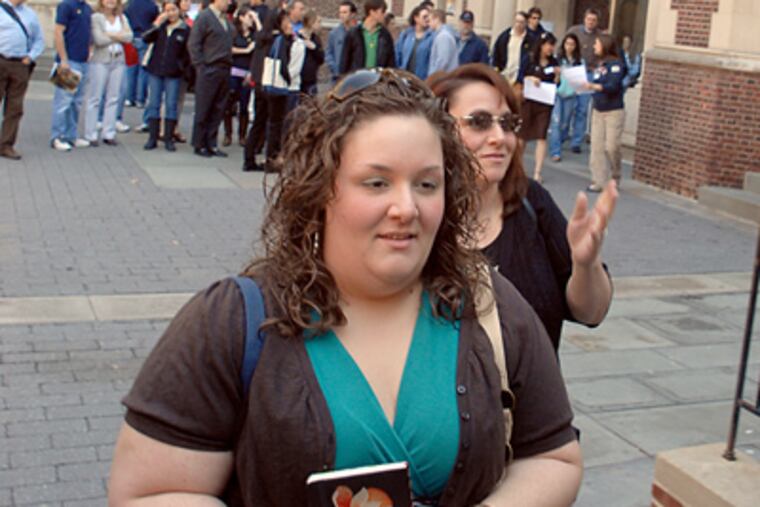
So a few weeks ago, Ali, 17, and her mother drove from Langhorne to Penn for a daylong pitch on all it has to offer.
"It's a day to dream," the admissions officer told Ali and 221 other accepted students as they started the morning in historic Irvine Auditorium.
As Ali sat listening, a Penn student dressed as the school's Quaker mascot came by, raised his hand, and high-fived her.
Recruitment push
For Penn, the day in mid-April was its final push to recruit some of the nation's top students in what many experts are calling the most topsy-turvy admissions year in decades.
With the loss of jobs and college savings looming over the decision in many households, even the best schools worried about reaching their enrollment targets.
"I think this was a harder decision for students and families than ever before," said Jess Lord, dean of admissions at Haverford College.
Most of the seven high-achieving students, including Ali, whom The Inquirer followed through the admissions process this year agonized over their decisions, waiting almost until the last minute - May 1 - to decide.
Several picked the school with the best financial-aid package even when it wasn't their first choice.
All seemed fine - even thrilled - with how things worked out: One student was accepted early-decision to her dream school, another won a lucrative athletic scholarship, two got into Ivy League schools, and those who needed money got enough to attend school next fall.
The admissions picture also looked brighter for colleges last week, with many closing in on their enrollment targets, though some were still apprehensive about the number of students who may pull out over the summer.
"There's been an exponential increase in the tension around the process, on both sides of the desk - whether you're a student or an admissions officer," said David Hawkins of the National Association for College Admission Counseling.
With a peak number of students graduating from high school this spring, admissions experts had predicted one of the most competitive years ever for students.
And while competition remained stiff, getting in may have been a tad easier because many schools, including Penn and Swarthmore, accepted a higher percentage of applicants, in part because they feared the economy would dampen enrollment.
Meanwhile, less costly state schools were inundated, making admission a bit harder.
At William Penn Charter, a high-end private school in Philadelphia's East Falls section, 27 percent of the 90 seniors enrolled at public colleges, up from 18 percent last year, said Dan Evans, director of college counseling.
"It really jumps out at you," he said.
At Conestoga High in Tredyffrin Township, some students were turned down by colleges that usually would have accepted them, including the state-related University of Pittsburgh, said Misty Lang Whelan, chair of student services.
"We definitely felt a pinch," she said.
Opportunities abound
1,370 days.
It was a number Ali had never thought about before. But as she sat in Irvine Auditorium, she learned that's how many school days she would have over four years at Penn.
"Today is about how to use those 1,370 days," the admissions officer told Ali and the other students:
Do cutting-edge research in other countries, or alongside doctors at Penn's hospital.
Become the next Rhodes Scholar.
Eat dinner and discuss world topics with Pulitzer Prize-winning professors.
The opportunities were dizzying for Ali, who hopes to become a cardiologist.
"The more I see, the more I'm liking it," she said as she set out on the college tour.
What the others chose
Three days before the May 1 deadline, Kirby Dixon, a senior at Penn Charter, and her mother, a guidance counselor at Germantown High School, were still weighing the pros and cons - and the cost - of the colleges that had accepted her.
They had even constructed a chart to lay out the numbers.
With the scholarships and loans she would get, attending George Washington would cost $108,000 over four years, Tufts $75,600, and Georgetown $65,000.
Penn came in at $53,000 for four years. Kirby would have to borrow nearly half of that and her mother pay the rest.
Brandeis University topped them all with a scholarship worth $200,000 over four years - full tuition, room, and board.
The decision was agonizing for Kirby.
"Money was the big factor, but also comfort," she said.
While she had wanted to leave the area, she didn't feel comfortable at Brandeis. The campus, in a Boston suburb, didn't wow her. And she didn't see enough diversity in the student body.
She chose Penn.
"The only downfall was that it is in Philadelphia," said Kirby. "But think of the connections I'll get."
For Samuel and Cooper Gorelick, twins at Cherry Hill High School West, the decision also rested heavily on money. With six children, the Gorelicks live on an annual income of $41,000 and would be hard-pressed to pay college bills.
Sam wanted to go to Rowan University until he learned that he and his parents would have to take out more than $8,000 in loans each year after state and federal aid.
The aspiring teacher and coeditor of his school paper opted instead to live at home and commute to Rutgers-Camden. Between its aid package and the savings in room and board, he will probably attend almost for free.
Cooper, a thespian with an interest in architecture, also altered his path.
Unsure about his major, he opted for Camden County College rather than take out loans to go to Drexel or Temple. Because he is in the top 20 percent of his class, he can attend community college for free for two years, then transfer to a state school for the final two years, also free under the New Jersey STARS program.
As a heavily recruited athlete, Brett Johnson of Ocean City, N.J., could be getting a huge break on college costs. The Olympic track hopeful in February chose the University of Virginia over Kentucky, but could not disclose his financial package. He is to room with Monmouth County's Robby Andrews, one of his biggest competitors on the track and in his race for college.
Walter Pinder of Overbrook High School also worried about finding the money to go to college. But as the year went on he worried about much more.
In January, the poet and drum-line member was beaten and stabbed by a group of teens and left the state to finish high school in an undisclosed location.
According to his Overbrook guidance counselor, about a half-dozen colleges, including Penn State's main campus, accepted him. She had not yet heard his choice. Walter could not be reached for comment.
Samantha DiFeliciantonio, a varsity first baseman for the Conestoga High softball team with an interest in international relations, did not spend the winter sweating it. She had known by September that she wanted to go to George Washington.
She applied early-decision and learned in December that her dream would come true.
Applying early was a smart move. George Washington accepted 58 percent of those who applied early, filling 38 percent of its 2009 freshman class by December.
Finding her dream
Ali had spent much of April sorting through financial-aid packages, examining academic programs, revisiting campuses, and, most of all, trying to figure out: "Where can I see myself?"
With college acceptances to top-notch universities, including Villanova, Fordham, and Boston College, she was in a position many students would relish.
She found it maddening.
"I thought the application process was going to be the worst part. This decision process is crazy!" she told her mother days before her visit to Penn.
Because she was on the wait list at Cornell - along with a couple of thousand other students - she had to choose a college without knowing whether she would eventually get in.
"I feel like I'm in limbo," she said.
She had received a full-tuition scholarship to Fordham, a Catholic college in New York City, which intrigued her.
But her father, a Newtown dry cleaner, hoped she would go to Penn.
Her first visit to campus got her thinking maybe he was right: If she wants to go to medical school in the Philadelphia area, Penn makes sense. Plus, she said, "it's hard to turn down an Ivy League education."
The cost difference between the two schools wasn't an issue. Figuring in both aid packages, Ali and her family would have to pay about the same per year - $16,000.
Pleasant surprise
On this warm, sun-drenched day, Ali and her mother walked the 279-acre West Philadelphia campus, enamored of residence-hall courtyards that looked like scenes from Harry Potter.
Their concerns about safety on an urban campus faded.
"So far, I keep forgetting where I am. It doesn't feel like a city school. It feels like an old-world setting," said Ali's mother, Andrea.
"I'd feel very comfortable and safe," Ali said. But off campus, she added, "I would make sure I was with people I knew or trusted."
Inside the dorms, the rooms seemed larger than the ones she had seen at Fordham, where she felt "claustrophobic." And she loved the single in the high-rise, with its own kitchenette and bathroom.
At Penn's study-abroad office, Ali excitedly picked up literature on opportunities in Australia, Ireland, England, Kenya, and Guyana.
She became even more encouraged during an afternoon panel in which Penn students gave the prospects the scoop on campus life. They were candid, diverse, and enthusiastic, not "nerdy" as she thought they might be.
"My roommate's from Uganda, and my best friend's from Israel," said one.
Partying is part of campus life, said another, but "you don't have to drink here. We're not all alcoholics."
Then a premed major from Havertown explained that work was hard but that there was time for fun. "I'm the only female on the campus stand-up comedy group," she said.
That point especially hit home with Ali.
"Just knowing she has so much work to do but is still able to balance it - that's reassuring to me. That was my concern," Ali said.
Two days later, Ali canceled a campus visit to Fordham.
For now, her mind was made up, though she wasn't withdrawing from Cornell.
She could see herself at Penn.
EndText