14 Phila. residents go car-less
Even Sue Pringle, executive director of a local environmental group, struggles to wean herself from driving. As a resident of Laverock, she found herself behind the wheel seven days a week. When she moved from Montgomery County to Philadelphia a year and a half ago, she hoped to quit driving - but she kept wanting her car.
Even Sue Pringle, executive director of a local environmental group, struggles to wean herself from driving.
As a resident of Laverock, she found herself behind the wheel seven days a week. When she moved from Montgomery County to Philadelphia a year and a half ago, she hoped to quit driving - but she kept wanting her car.
For example, she'd have to meet someone for her job at UC Green, only to realize she'd be late if she didn't drive - so she often found herself blasting car exhaust.
Then in April, she broke her ankle, and her crutches made it difficult to travel by trolley.
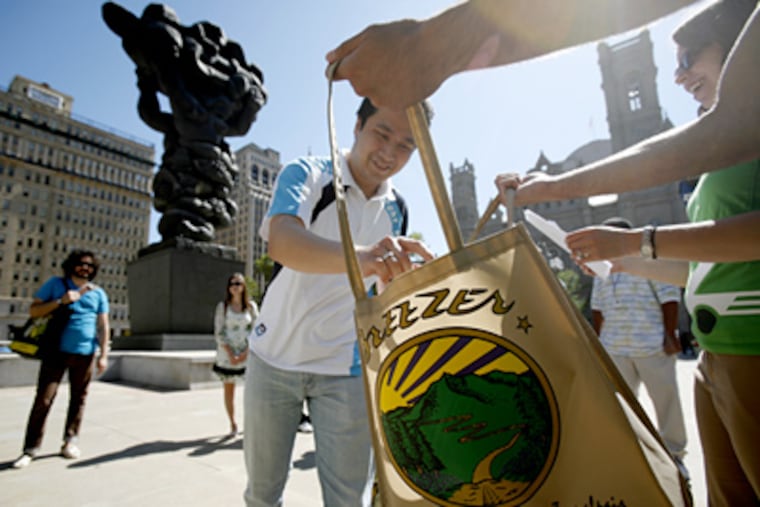
But now she believes she's ready to stop driving. So she sold her Volkswagen on Tuesday - and yesterday joined 13 other Philadelphia residents who pledged to live car-free for 30 days. Some of them symbolically dropped their vehicle keys into a lock box at Thomas Paine Plaza at the Municipal Services Building.
"I wish I'd done this when I was 21," Pringle, now 48, said. "It would have been easier then. But I'm determined."
To help wean the participants from their wheels, car-sharing service Zipcar, which is behind the car-free program, is providing perks, such as a $200 credit for the company's services and 10 SEPTA tokens. Another of the backers, Fuji Bikes, is lending participants bicycles - and so far, five people have signed up for that, including Pringle.
Zipcar calls the program a "Low-Car Diet," and kicked it off yesterday here and in 12 other U.S. cities.
This is the second year for Zipcar's program, but it isn't the only one. The nonprofit PhillyCarShare challenged locals to give up their keys in a similar program in May 2008. Both PhillyCarShare and Zipcar, which is a for-profit company, provide cars to customers who lease vehicles by the hour or the day.
"The more people get rid of their cars and consider alternatives, the better it is for our cities," said Jeremy Nelson, Zipcar Philadelphia general manager.
Participants this year had varying reasons for signing up for the car "diet" program.
After Laura Harris Twilley learned last week the catalytic converter in her Nissan Sentra would cost around $1,500 to fix, she sold it for $2,450. This week, she rode a $50 bike from her home in South Philadelphia to her job at a retailer at the Navy Yard. Now she's borrowing one of Fuji's bikes - and she says the commute takes her less than seven minutes longer than the car ride did. When she arrives at work, she hits the showers at her company's gym.
"I have to plan what to wear, but it helps me be more structured," she said. She's excited about exercising every day.
Another participant in the car-free program, Shana McDanold, of West Philadelphia, wants to stop driving but worries about not having her car in an emergency. She's glad she can still use it after a month of trying other ways of getting around town.
"It'll force me to think about what I'm doing," she said. "I need to work through learning that there are other options."
The Low-Car Dieters plan to blog about their month at www.zipcar.com/lowcardiet.
Pringle is long used to a 20-minute walk to her job in West Philadelphia. She tries different paths each day and notices things she might have missed in a speeding car. This week, she saw yellow- and peach-colored columbine flowers blooming. She stopped to wonder, smiling. "It's lovely," she said. "It's much less stressful than driving."
Possible impact
Estimate of the savings of one person giving up a car for 30 days.*
Miles not driven: 750.
Gasoline not used: 42 gallons.
Gas money saved: $117.
Reduction in nitrogen oxide emissions: 1.65 pounds.
*Calculated based on regional and national averages.
SOURCE: Delaware Valley Regional Planning Commission.
EndText