Conventioneers scaling back
Phila. is getting bookings for fewer gatherings - and hotel rooms. Those who do come are opting for basics.
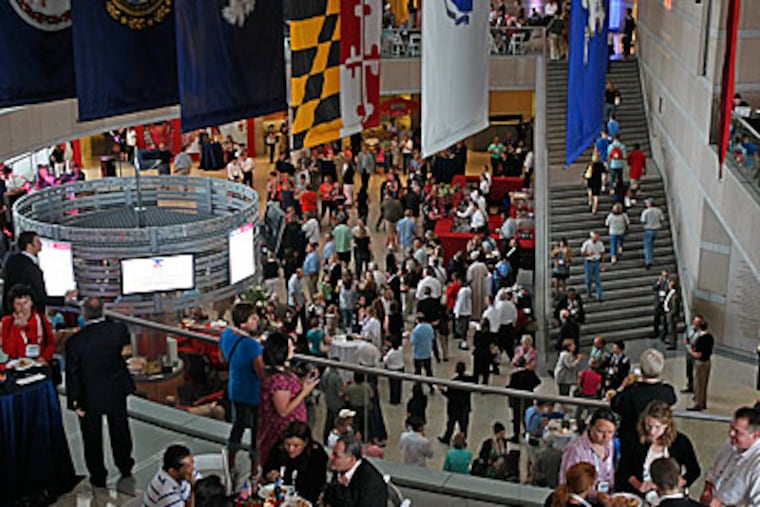
Just as the huge, and hugely expensive, expansion of the Pennsylvania Convention Center is transforming the Center City streetscape, the convention business, too, is being radically altered.
With corporate travel to such gatherings down sharply, those who do assemble are cutting back drastically on the fancy hors d'oeuvres, the lavish dinners, even on the presentations at the meetings themselves.
Consider the less-elaborate fare the American Association of Museums offered when 5,000 members - 1,000 fewer than expected - met here in the spring: Entertainment was scaled back, a museum-store exhibit was scrapped, and flowers were eliminated for a reception.
"Everyone is tightening up a bit," said Ashley Albrecht, a local conference coordinator who worked on the museum group's five-day convention. "Some of the extras that would have been a given before are definitely not, now."
In the first six months of this year, demand for meetings and conventions declined 8.6 percent compared with the same period in 2008, according to the U.S. Travel Association in Washington, which tracks the $770 billion American travel industry. Spending for meetings and conventions fell 14.1 percent.
In the city, meetings and conventions are down about 13 percent this year from last year, the Philadelphia Convention and Visitors Bureau said.
"We saw this disaster coming last summer, based on historical bookings," said Jack Ferguson, executive vice president of the bureau, which sets up meetings, conventions and group business.
"Once corporations cut back on travel, it cuts across the board," he said. "It affects every demand sector of the hospitality industry."
Building Owners and Managers Association Inc. (BOMA) saw its membership drop 5 percent this year because of layoffs and downsizing in commercial real estate, said Lisa Prats, vice president of communications, marketing and meetings.
Prats fielded several calls from members who said they couldn't make it to Philadelphia last month for the group's convention.
"They'd say, 'I'd love to come, but my budget has been cut. Travel has been frozen,' " she said. The group forecast attendance of 5,800 when it contracted about three years ago with the Convention Center. Actual turnout was 3,200.
Convention officials and hoteliers say they are seeing that kind of disparity time and time again.
The city's 41 hotels reported a 65.1 percent occupancy rate through May 31, down from 71 percent a year ago. The total number of rooms filled was down by almost 62 percent, to 1.03 million from 2.7 million.
For the first five months of the year, the 7 to 8 percent loss in "consumed room nights" for gatherings booked by the Convention and Visitors Bureau into the Convention Center represented a $15 million economic impact on Philadelphia, Ferguson said.
Those grim numbers come as the city is trying to lure ever-bigger gatherings. The Convention Center's $786 million expansion, due for completion in early 2011, will bring 60 percent more exhibit and meeting space.
But these days, even the city's smaller venues, such as the Kimmel Center, the Franklin Institute, and the Art Museum, are feeling the pinch.
"We are seeing a lower number of registrants at conferences in general," said Kellie Brielmaier, senior facility-rentals manager at the National Constitution Center, where bookings are down 15 percent this year.
When the American Society for Mass Spectrometry held its cocktail reception there last month, 1,300 research scientists showed up instead of 2,000. Last week, 3,000 members of the National Conference of State Legislatures attended a welcoming reception, down from the 3,500 contracted a year ago.
Cost-cutting is evident in switches from open bars to cash bars and in pared-down menus, Brielmaier said. "They'll go from a carving station with roast beef to one more self-serve, like a sandwich station with hoagies."
Lois Switken, director of sales and catering at the Franklin Institute - the largest non-hotel-related venue for convention events in the city - said some groups gathering there weren't fully availing themselves of what the facility had to offer.
"Head count is definitely lower," she said, and "if 600 people come to an event, they would maybe only buy 400 tickets to a special-exhibits event, like Galileo."
The Vietnam Helicopter Pilots Association had its 26th annual reunion at the Philadelphia Marriott Downtown earlier this month, attended by 1,300 people.
The group's outgoing president, Jack Salm, said the down economy made some cost-cutting necessary. Eliminating coffee at the annual business meeting saved $3,700; cutting back on audio-visual support (no jumbotron) saved $33,000.
"These, plus other . . . measures, enabled the organization to come in under budget and resulted in a very successful reunion," Salm said.
By this time of year, phones usually start ringing at the Adventure Aquarium and Currents Ballroom in Camden as companies look for space for holiday parties, booked six to nine months in advance.
Not this year, said sales director Andrew Lovell, adding that the Aquarium was about 12 percent behind the revenue it needed by midsummer.
"Companies are just trying to get through this month, or this quarter, before they start planning an end-of-the-year holiday party," Lovell said. "If they've announced a hiring freeze or just had layoffs, it's hard to justify having a party to their employees."
BOMA offered a steep discount on the conference rate ($100 instead of $695) for recently laid-off members, and it bused attendees from Washington, D.C., and New Jersey to its four-day gathering last month. Yet the group still saw a 20 percent drop in those who attended every event.
"In normal times, I would have covered the full $695 registration fee for two or three delegates," said BOMA member Ginny Carita, an executive at Advance Realty Group in Bedminster, N.J., whose travel budget was slashed by 35 percent. "But between travel, the hotel room, and the price for the conference, I could not do it."
Instead, Carita said, she allowed four of her staff members to board one of the buses paid for by the BOMA New Jersey chapter.
Each attended one education course and the convention trade show. Then they hopped back on the bus and went home.