A turn for worse on jobs and retail
First-time claims rose, and retail sales took an unexpected drop.
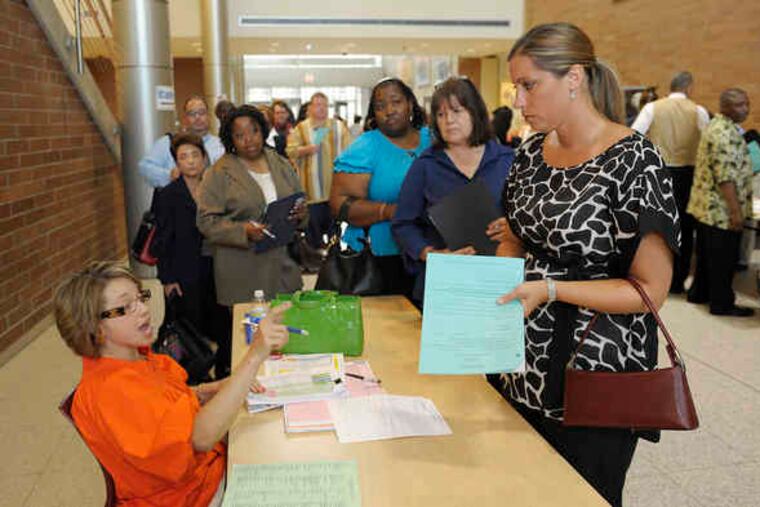
WASHINGTON - Retail sales disappointed in July and the number of newly laid-off workers filing claims for unemployment benefits rose unexpectedly last week. The latest government reports reinforced concerns about how quickly consumers will be able to contribute to a broad economic recovery.
"There is really no positive spin to put on these numbers," Jennifer Lee, an economist with BMO Capital Markets, wrote in a research note. "The U.S. consumer remains very weak."
The Commerce Department said yesterday that retail sales fell 0.1 percent last month. Economists had expected a gain of 0.7 percent.
While autos, helped by the start of the Cash for Clunkers program, showed a 2.4 percent jump - the biggest in six months - there was widespread weakness elsewhere. Gas stations, department stores, electronics outlets, and furniture stores all reported declines.
Among retailers in the Philadelphia region, Urban Outfitters Inc. yesterday reported a lower profit that still was higher than expected. But A.C. Moore Arts & Crafts, of Berlin, N.J., posted a wider second-quarter loss as same-store sales sank.
Wal-Mart yesterday reported virtually flat second-quarter income compared with a year ago, but the results beat Wall Street expectations and the discount retailer raised the low end of its profit outlook.
The July dip in U.S. retail sales was the first setback after two months of modest gains. Excluding autos, sales fell 0.6 percent, worse than the 0.1 percent rise economists had forecast. And excluding both auto and gas purchases, retail sales fell 0.4 percent, the fifth straight monthly decline.
The Labor Department said initial jobless claims increased to a seasonally adjusted 558,000, from 554,000 the previous week. Analysts expected new claims to drop to 545,000, according to Thomson Reuters.
The number of people remaining on the benefit rolls, meanwhile, fell to 6.2 million from 6.34 million the previous week. Analysts had expected a smaller decline. The continuing-claims data lag initial claims by one week.
The four-week average of initial claims, which smooths out fluctuations, rose by 8,500 to 565,000. That reverses six straight weeks of decline.
And, while there have been recent signs of stability in the U.S. housing market after three years of plunging prices, record foreclosures persist. The number of U.S. households on the verge of losing their homes rose 7 percent in July.
Foreclosure filings rose 32 percent from the same month last year, RealtyTrac Inc. said yesterday. More than 360,000 households, or one in every 355 homes, received a foreclosure-related notice. That is the highest monthly level since the foreclosure-listing firm began publishing the data more than four years ago.
In Pennsylvania, foreclosure filings were up 27.4 percent from July 2008 (although RealtyTrac noted that the actual increase might not be as high due to data-collection changes or improvements). One in every 1,030 homes received a foreclosure-related notice. In New Jersey, filings were up nearly 40 percent. One in every 541 homes received a notice.