Gold briefly tops $1,000 an ounce
The price of gold briefly shot past $1,000 per ounce yesterday to its highest since March 2008, suggesting that investors are wary of the U.S. dollar's weakness and expect international interest rates to remain low for some time.
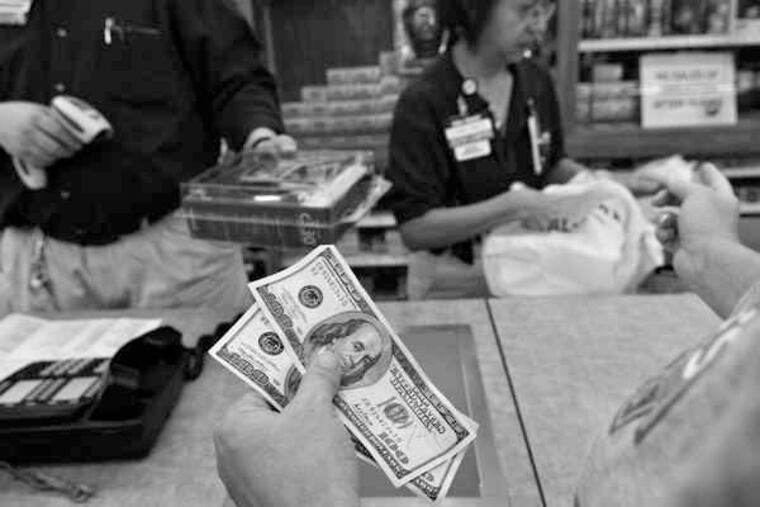
The price of gold briefly shot past $1,000 per ounce yesterday to its highest since March 2008, suggesting that investors are wary of the U.S. dollar's weakness and expect international interest rates to remain low for some time.
Gold for December delivery peaked during the day at $1,009.70 on the New York Mercantile Exchange before falling back to settle at $999.80, up $3.10 from Friday's close.
Gold is typically bought as an alternative to the dollar among assets favored by investors seeking to preserve capital. Its rise often correlates to a drop in the value of the American currency.
That occurred in the spring 2008, when worries about the financial crisis brewing in the U.S. helped drive gold to a record. The price of gold most recently went above $1,000 last February.
"It is mainly the reflection of the weakness of the dollar," said Julian Jessop, economist at Capital Economics.
The dollar fell to 92.32 yen yesterday from 93.05 yen on Sunday. That meant it took nearly one yen less to buy a dollar yesterday. The euro strengthened to $1.4467 from $1.4332 as stock markets rose and investor sentiment improved.
Jessop noted, however, that gold also was being boosted by market expectations that global central banks would keep their interest rates low for some time. One disadvantage to holding gold is that no interest is earned. But since interest rates - such as on government bonds and bank certificates of deposit - have fallen sharply, that disadvantage for gold is lessened.
"Near-zero interest rates in many of the world's largest economies reduces the opportunity cost of holding gold," Jessop said.
The fact that 20 of the world's rich and developing nations promised over the weekend to keep in place their economic-stimulus measures - including spending and low interest rates - reinforced the appeal of gold.
Those government moves could help boost economic activity and liquidity in financial markets, but they can weigh on the value of a currency. The current U.S. rate near zero means investors can earn better returns on their funds by investing in commodities such as gold or in countries with higher yields, such as Poland, Turkey, Brazil, and Australia.
Jessop was not convinced gold could sustain its high price since consumers quickly start selling gold items to take advantage of stronger prices. "This rally is sowing the seeds of its own destruction," he said.
Published comments on Sunday from a Chinese government official in a British newspaper knocking the U.S. Federal Reserve's policy of buying bonds also drove the dollar lower, said Joseph Trevisani, chief market analyst at FXSolutions.
"Most of our foreign reserves are in U.S. bonds and this is very difficult to change, so we will diversify incremental reserves into euros, yen, and other currencies," the Chinese official, Cheng Siwei, said in the interview.
The Fed has committed to buying up to $300 billion in long-term Treasurys to boost liquidity in financial markets and hold down interest rates.
"The Chinese have serious influence," he said. China is the largest holder of U.S. Treasury securities, and its buying of U.S. debt enables the government to fund its deficit spending.