Basic training for Peco line mechanics is tough
Rashad Anderson has a culinary degree and worked at a university cafeteria. He wanted to open a restaurant, but nobody would lend him money. The only job he could find lately was in demolition.
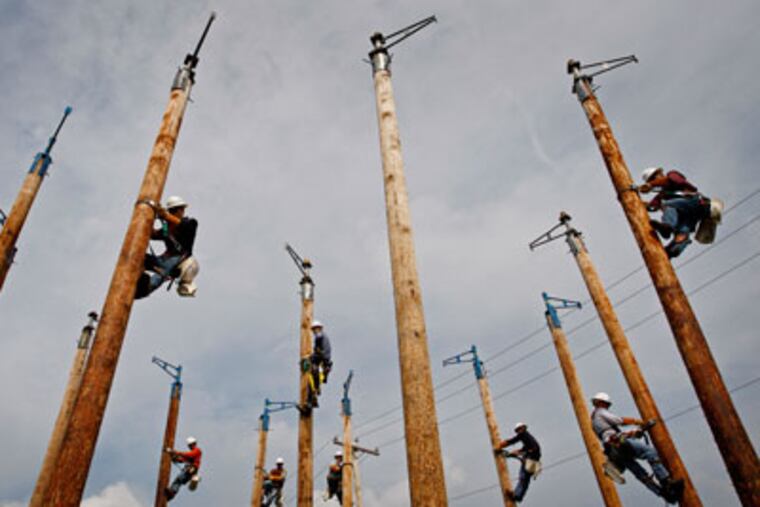
Rashad Anderson has a culinary degree and worked at a university cafeteria. He wanted to open a restaurant, but nobody would lend him money. The only job he could find lately was in demolition.
"It's a tough job market," said Anderson, 30, of Overbrook Farms, Philadelphia. "I could only find part-time work. I had a business plan, but I was unable to get financing for the restaurant."
Then Anderson heard that Peco Energy Co. was hiring aerial line mechanics. "I thought I'd give it a try."
Peco received 939 applications. More than 200 were invited to take a written test. Eighty-four were tested for mechanical and physical skills, including scaling a utility pole, three stories up.
Twenty men got hired. Anderson made the grade.
"I guess I made a good impression on somebody," he said.
Two weeks ago, the new hires began a 10-week training program at Peco's Aerial Line School on Gallagher Road in Plymouth Township.
It is tough work, like boot camp. The trainees learn the basics of Peco's electrical-distribution system, about tools, vehicles, and splicing wire.
It takes a special person to be a mechanic - they used to be called linemen before two women joined the ranks.
"Not a lot of people are willing to put on leg irons, climb up a pole, and grab 13,000 volts," said George Deal, an assistant business manager of Electricians Local 614, which represents Peco's unionized employees.
Veterans say the hardest part of climbing poles with a 25-pound tool belt is learning to angle the legs properly so the steel-spiked gaffs strapped to their feet sink securely into the timber. And then there's the view from 40 feet up - the height unhinges many trainees.
"There's a 20 percent dropout rate," said Ron Della Penna, a foreman who was assigned to assist the instructors. "There's a chance they will all make it, but that would be a first."
Jobs like these are in short supply in today's economy. Several are second- and third-generation linemen.
Apprentice aerial mechanics start at $34,278. After 31/2 years, and more training and examinations, a first-class mechanic earns $77,200. And then there's overtime, which invariably is earned in the worst weather - during heat waves when transformers melt down, or during ice storms, when power lines crash to earth.
The money is what attracted David McNeil, 43, the oldest trainee (several others are right out of high school). McNeil, of Downingtown, was a signal maintenance worker for SEPTA, but he has three children he wants to send to college. Peco pays more.
McNeil said his calloused hands were tough compared with the young men who were suffering from blisters, but the teenagers had more energy.
"Typically I'm the last one off the pole," he said on Thursday, a humid day when he perspired so much he changed shirts three times. "It's hard work, but my friends who do this job say it's worth it."
It is also dangerous work. The U.S. Department of Labor says that utility workers suffer some of the highest injury rates.
In the 1990s, about 200 Peco mechanics got hurt on the job, said Mark Hackney, manager of electrical training. The company decided to improve its training, equipment, and procedures. The cowboy culture was suppressed. Now Peco wins national safety awards.
This year's class will be the first to be trained to use a new type of security belt that tightly encircles the pole, reducing the risk of falls.
"The new process has its advantages and disadvantages," said Joe Cooper, 62, a senior training specialist and de facto drill sergeant. When Cooper learned the trade 41 years ago, linemen strapped themselves in only when they reached the work area. The new belts slow him down.
"I never fell, but I know a few others who did," said Cooper, who like many mechanics, is lean and carries himself with a little swagger. "Some ruined their careers."
Two years ago, Peco suspended the line school after several trainees suffered strains. Now trainees are expected to spend three weeks getting in shape before school begins. A physical therapist also participates, and training includes instruction on stretching, cooling down, and proper diet.
Peco had considered canceling the line school this year because fewer mechanics are retiring in the tough economy than expected, said Eric G. Helt, Peco's vice president for electric operations. His department has 580 maintenance workers, including 310 aerial line mechanics.
But Helt expects that when the economy improves, more older mechanics will retire, and a younger generation will need to be moving into position to fill the void. So he was able to argue successfully to his superiors to invest in the new hires this year.
"This is an expensive endeavor for us," said Helt. The school costs $600,000, including equipment and the salaries of eight mechanics who come in from the field to help the six full-time instructors.
"We have an aging workforce, and there's such a lag until the new workers are prepared to step in," he said. "We had to go for it."
Go to http://go.philly.com/jobbing for the Inquirer's continuing series Jobs at a Loss.
EndText