Untapped niche
It was a brilliantly sunny Friday in late September, and developer Carl Dranoff was doing what he does best: Park himself in the middle of a construction site - hard hat tightly fitted to his head, surrounded by 170 men and women representing nearly every building trade - to oversee every detail of his latest project.
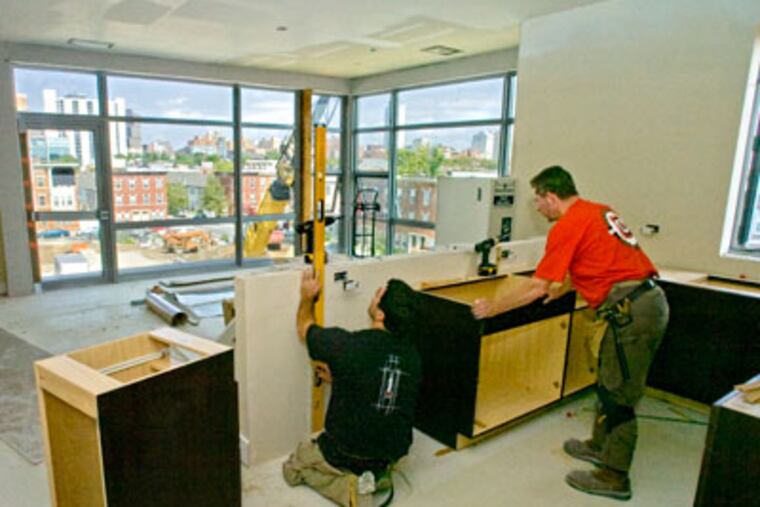
It was a brilliantly sunny Friday in late September, and developer Carl Dranoff was doing what he does best:
Park himself in the middle of a construction site - hard hat tightly fitted to his head, surrounded by 170 men and women representing nearly every building trade - to oversee every detail of his latest project.
"We set trends in rentals and have good benchmarks," he shouted over the noise of a cement mixer. "There's a whole new universe of decisions and experiences in building from the ground up."
This particular location was 777 South Broad, a $70 million mid-rise (five stories) that will include 146 one- and two-bedroom rental units.
The project, the start of Dranoff's effort to push the border of Center City farther south, sits less than a quarter-mile from Dranoff's 31-story, $130 million Symphony House condo tower.
Rents will range from $1,900 for one bedroom to $2,600 for two. The largest two-bedroom units, at the corners with the best views, will go for $3,800 a month. Currently, the average rent in the region is $1,361, up 6 percent from 2008, according to the apartment search engine Rental.com.
"The rental market is still strong on the landlord's side," said John Featherman, who focuses on Center City apartments for Prudential Fox & Roach. "Many renters today are people who had to relocate to Philadelphia and couldn't sell their houses."
The high-end renters that Prudential Fox & Roach associate broker Suzin Kline handles are primarily transfers - corporate executives, that is - who either rent for a year to get the lay of the land or simply do not want the hassle of owning.
"They demand services and look for places full of people to make their lives easier," Kline said.
Because the focus for almost a decade was on for-sale condos, the Center City market remains shy of long-term high-end rentals.
There is about a seven-month supply of condos now and demand remains strong, Center City District president Paul Levy said, but that market's recovery is six months to a year away.
"So rental is all that is happening now," Levy said.
This is the economic climate in which the 61-year-old Dranoff, a Northeast Philadelphia native, sincerely expects to add to his list of successes, which include Center City's Locust on the Park, the Victor in Camden, and Manayunk's Venice Lofts.
He is banking on amenities: "green" features; "hospitality suites" for tenants' out-of-town visitors; commercial washers and dryers on every floor to supplement the units in each apartment; a gigantic "sky" deck with two commercial-size grills and a hot tub; a ground-floor pub; and soundproofing so hefty your next-door neighbor will never hear you play your baby grand.
This time, there's a lot more than just Dranoff's expertise and vision riding on the project; Dranoff Properties Inc. is the largest investor in 777 South Broad.
"We had to place much more equity into this project than we had planned," Dranoff said. "When we got ready to start, the financial market had changed, and it was as tough for us to get loans as for homeowners and commercial projects."
By contrast, his $65 million Left Bank in University City, completed in the late 1990s, was financed primarily by the AFL-CIO Building Investment Trust.
New York-based developer Don Monti, who focuses on revitalizing downtowns in cities smaller than Philadelphia, said banks today "want to see lots of skin in the game at your end."
In today's marketplace, "lenders want 50 percent or more of a developer's equity in a project - no matter how good the project is," said Monti, president of Renaissance Downtowns.
Still, he said, "there's no place to park your money today and expect to get much more than a 1.5 percent to 2 percent return. Building rental might be a patient approach."
Many experts, including Monti, are predicting that downtown locations will continue postrecession growth trends once the economy reverses course. They believe there is plenty of room for a mix of sale and rental units.
"Long-term, I think [the rental market] is strong, particularly for young professionals, as opposed to affluent retirees, who prefer to own," said economist Kevin Gillen, vice president at Philadelphia's Econsult.
"Short-term, the outlook is weaker, as the first-time home buyer tax credit is motivating some renters to become owners, and the slumping economy limits both the desire and ability of the remaining renters to seek out luxury units," he said.
Jeffrey Otteau, of the Otteau Valuation Group in New Brunswick, said the dynamics of the next housing cycle - including skyrocketing energy costs, sustainability, and declining income - will favor downtown housing.
"There will be increasing demand for rental," Otteau said, helped by tighter credit that will force people to buy houses later in life and remain in them longer.
As with almost all Dranoff's previous efforts, 777's location concerns Center City's "square-centric" real estate industry (as in: If it isn't on or within walking distance to Rittenhouse Square, forget it).
"Of course," Dranoff said. "We do push the envelope into new locations, but they are calculated risks. We're not going to another planet. We're creating a new anchor project and expect everything in between to fill in."
So far, 500 prospective renters have filled out forms on the building's Web site, he said. The leasing office is set to open in November, with the first move-ins scheduled for March.
While assigning it the role of a "marketing plus," Dranoff said he believed the "green" or sustainable quality of 777 South Broad was becoming as important to his target market as "being seven minutes from everywhere."
Whether "green" becomes a factor depends on how it is deployed, Gillen said.
"If it means a weatherized exterior, more efficient mechanical systems, and generally lower energy bills, then prospective renters are more likely to respond to such practical incentives in challenging economic times such as these.
"If you want green to generate green dollars," he added, "you'd better make sure green puts some dollars in your prospects' pockets."